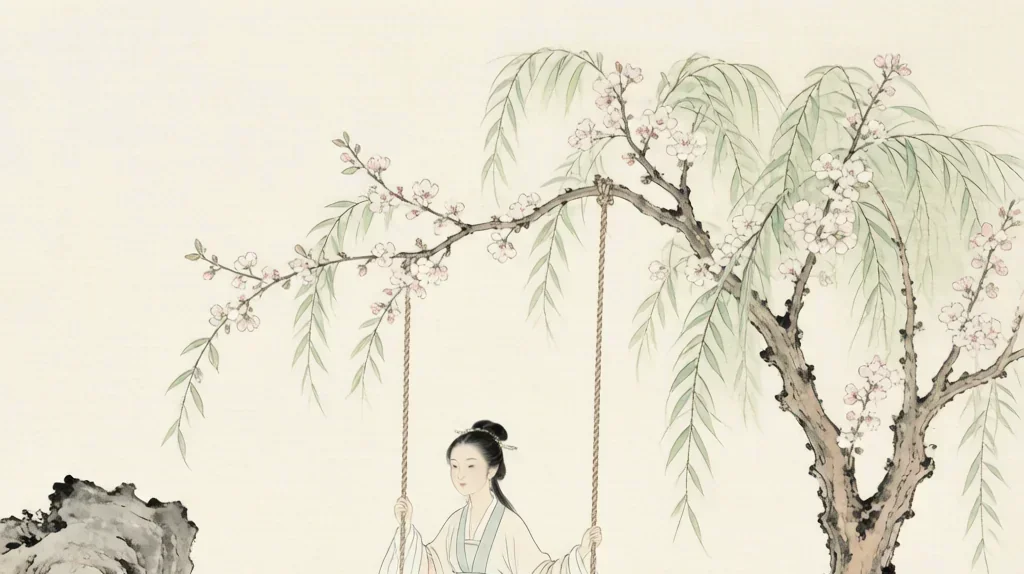
Qiuqian (秋千, the swing) is one of the most graceful traditional games in Chinese culture, in which players stand or sit on a suspended seat and pump themselves higher and higher through the air. For centuries the swing was especially beloved by women and children, who gathered around adorned frames during spring festivals to test courage, skill, and style. More than simple play, qiuqian carried poetic and romantic associations, featured in literature and painting as an image of youthful freedom and seasonal joy. From palace gardens to village greens, the swinging figure became a cherished emblem of spring, making this gentle game a lasting part of Chinese festive life.
Name and Early History
The word qiuqian is often explained as deriving from "qiuqian" meaning a "forward-and-back" motion, and legends attribute the swing's invention to the era of the mythical ruler. Early forms used ropes of vine or hemp hung from a tree branch, with a board for the rider.
By the Han dynasty, swinging was an established pastime, and later dynasties refined the frame into a freestanding wooden structure decorated for festivals. The simplicity of a rope and board ensured the game's wide spread.
The Swing and the Cold Food Festival
Qiuqian is most famously linked to the Cold Food Festival (Hanshi) and the following Qingming (Tomb-Sweeping) period in early spring. During these days, open fires were forbidden and families turned to outdoor play; swinging became the signature activity.
Historical records note that Tang and Song court ladies swung in palace gardens at Qingming, and the custom spread to commoners. The swing thus became a seasonal rite of renewal, welcoming spring with movement and laughter after winter's confinement.
Women and the Swing
Unlike many vigorous male sports, swinging was associated with women and girls, who used it to enjoy rare open-air freedom and exercise. In a society where women's public movement was limited, the swing offered a sanctioned, joyful release.
Poets celebrated the swinging woman as an image of grace and fleeting youth, her ribbons and sleeves streaming as she rose. This gendered association gave the swing a distinct literary identity, appearing in lyrics and paintings as a symbol of spring romance.
Technique and Styles
Basic swinging is a matter of timing: the rider shifts weight and pumps legs to build amplitude, using the natural pendulum motion. A skilled swinger reaches a near-horizontal height, a feat of both nerve and rhythm.
Variations include seated and standing swings, and trick styles where the rider turns or releases briefly. Some folk contests judged height, smoothness, or the ability to perform while keeping composure—turning play into friendly competition.
Swing Frames and Decoration
Traditional frames were wooden A-frames or crossbeams hung with two ropes and a plank. Festival swings were often painted and hung with colored cloth, lanterns, or flowers, making the apparatus itself a festive object.
In northern regions, multiple swings might be set in a row for community play; in southern gardens, a single elegant swing hung from a pavilion beam. The decoration reflected local taste while keeping the essential form unchanged.
The Swing in Poetry and Art
Chinese literature abounds with swinging scenes. Song dynasty ci poetry depicts girls on swings at Qingming, their laughter mixing with spring wind, while painters placed swinging figures in garden scrolls as markers of leisure and desire.
The swing's appeal to artists lies in its motion and suspension—a body hovering between earth and sky, caught in a moment of weightless delight. This made it a favorite motif for expressing the bittersweet brevity of youth and spring.
Regional and Ethnic Forms
China's ethnic minorities keep vibrant swing traditions. Korean communities in the northeast hold famous swinging contests at festivals, where women swing to touch high targets with their feet. These events draw crowds and prize skill and height.
Elsewhere, swing games vary in frame height and rules, but the core joy of rising through the air unites them. Such diversity shows the swing's deep roots across the country's many cultures.
Symbolism and Romance
The swing carries rich symbolic freight: spring renewal, the flight of the spirit, and the playful edge of courtship. A high swing suggests aspiration and freedom; the rhythmic rise and fall mirrors the seasons and human fortune.
In folk imagination, the swinging maiden is both innocent and alluring, a figure of playful desire. This dualism helped the swing survive as a genteel yet slightly daring game suitable for festival display.
At the same time, the swing taught a gentle courage: to rise high required trusting the rope and one's own balance, a small lesson in facing the unknown with poise. That quiet bravery, more than spectacle, is perhaps why generations remembered the swing as a formative joy of youth.
Modern Play and Preservation
Today the swing remains common on playgrounds and at spring festivals, though often as a simple amusement rather than a ritual. Heritage events reconstruct decorated Qingming swings to keep the custom visible.
The game's endurance lies in its universality: no special skill to begin, infinite room to improve, and a pure physical pleasure. As a piece of intangible culture, qiuqian connects modern players to centuries of spring joy and to the women whose laughter once filled garden air.
The swing has also followed Chinese communities overseas, appearing at cultural festivals as a gentle ambassador of spring custom. Set up in a park, a decorated qiuqian frame draws newcomers of every background to try the timeless motion, reminding all who ride it of a simple, shared delight in leaving the ground, if only for a moment.
Swing Safety and Etiquette
Because the swing sends a body high into the air, folk wisdom built in simple cautions: check the ropes and frame before playing, keep a clear space beneath and around, and avoid crowding the seat. Children were watched, and turn-taking kept the frame fair for all.
Etiquette was part of the pleasure. A polite swinger waited their turn, helped steady the seat for the next rider, and refrained from reckless swinging near onlookers. These small courtesies turned the game into a communal grace rather than a scramble, fitting the swing's place as a gentle, social spring custom.
❓ Frequently Asked Questions
What is qiuqian?
Qiuqian (秋千) is the Chinese swing—a suspended seat that players pump to swing higher, a traditional spring festival game.
When is swinging traditionally played?
Especially during the Cold Food and Qingming festivals in early spring, when it became a signature outdoor pastime.
Who played the swing?
It was especially associated with women and girls, who enjoyed it as a rare form of open-air freedom and exercise.
How is height built on a swing?
By timed weight shifts and leg pumps that exploit the pendulum motion; skilled riders reach near-horizontal height.
Why does the swing appear in poetry?
Its graceful, suspended motion made it a symbol of spring, youth, and playful romance in Chinese literature and painting.
Is swinging still practiced?
Yes, on playgrounds and at heritage festivals, with ethnic minority swinging contests keeping the competitive form alive.