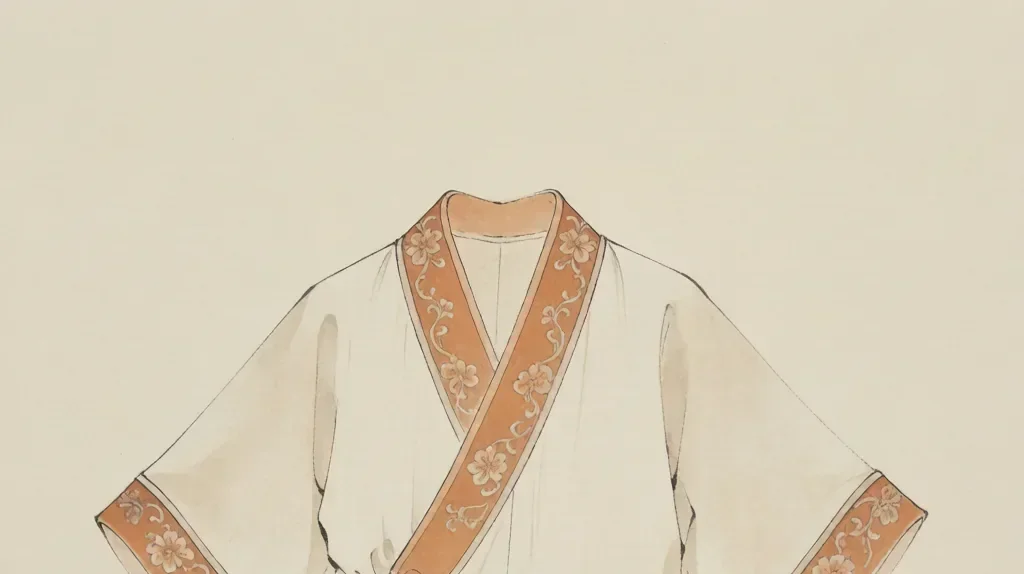
The banbi (半臂, literally "half arm") is a short-sleeved jacket that was a staple of Chinese dress from the Tang dynasty onward, worn over the main robe to add a layer at the shoulders and upper body while leaving the forearms bare. Neither a full coat nor a sleeveless vest, the banbi occupied a useful middle ground: it gave warmth and ornament across the torso, freed the hands and lower arms, and created a pleasing layered look at the neckline. Worn by men and women, in court and in the street, the banbi is one of the clearest examples of how Chinese clothing built outfits from independent pieces, each with its own job. Its comfort and practicality explain why the short-sleeved layer reappears across many periods and why it still interests makers today.
Name and basic form
The name banbi explains the garment: ban (半) means "half" and bi (臂) means "arm," so the piece has half-length sleeves that typically end at the elbow or just above it. The body is a short jacket, often reaching the waist or hip, with a front opening that could be crossed (jiaoling) or straight (zhiling) depending on period and fashion.
Unlike a full ao (jacket) with long sleeves, the banbi was deliberately curtailed at the arm. This made it cooler than a long-sleeved coat and lighter than a robe, while still covering the shoulders and chest. The result was a tidy shell that could be added or removed as the day warmed or cooled, a flexibility valued in the variable climate of the lower Yangtze and central plains.
Origins and early history
Short-sleeved upper garments appear in Chinese sources from at least the Han period, but the banbi as a named, fashionable layer is most firmly associated with the Tang dynasty (618–907). Tang society prized layered, colourful dress, and the banbi fit perfectly into that aesthetic, worn over a long-sleeved inner robe and sometimes under an outer skirt or coat.
The Tang was also a cosmopolitan age, with trade and tribute bringing Central Asian, Persian, and Buddhist-monastic clothing influences to the capital. Some scholars link the popularity of the short-sleeved jacket to these cross-currents, though the basic idea of a half-sleeve layer was practical enough to arise independently. What is clear is that by the high Tang the banbi was a recognised, illustrated garment.
How it was worn in the Tang
In Tang women's dress, the banbi was commonly worn over a narrow-sleeved inner jacket and paired with a long skirt (qun), sometimes with the skirt pulled up to the bust and a short blouse beneath. The banbi's open or crossed front revealed the layers underneath, producing the famous Tang look of stacked colours and textures at the torso.
Men wore banbi too, particularly as part of casual or semi-formal wear and in warmer months. Tomb figurines, wall paintings, and the illustrated fengsu (customs) manuals of the period show both sexes in the half-sleeve jacket, often with the lower robe showing below. The garment signalled ease rather than ceremony.
Fabric and colour
As with most Chinese garments, the banbi's material tracked the wearer's means. Silk in many weaves — plain sha gauze for summer, denser satin for cooler wear — was preferred by the well-to-do; cotton and linen served humbler wardrobes. Bright, saturated colours were a Tang speciality, and the banbi often provided a vivid block of hue in an outfit.
Pattern came through weave, embroidery, or printed design. Small floral sprays, geometric bands, and auspicious motifs appear in surviving textile fragments and in depictions. Because the banbi sat high on the body and framed the face, its colour was chosen to flatter and to coordinate with the skirt and inner robe — an early exercise in outfit planning.
Social and seasonal role
The banbi was pragmatic before it was symbolic. Its chief function was temperature management: a half-sleeve layer adds warmth to the core without overheating the arms or limiting the hands. Servants, travellers, and workers appreciated this; so did anyone moving between sun and shade through a long day.
At the same time, because it was visible and decorative, the banbi carried social information. A fine silk banbi with good embroidery signalled leisure and means; a plain cotton one signalled work. Yet the garment was not tightly restricted by rank, so it moved freely across classes and survives in images of everyone from palace ladies to market figures.
Relation to other layers
The banbi belongs to a family of partial upper garments. The bijia is sleeveless, the banbi short-sleeved, and the full ao long-sleeved; together they show how Chinese dress solved comfort through modular layers. A wearer might choose among them by season and occasion, sometimes combining them.
It also relates to the half-arm or kuajia types seen in later periods and to the short-sleeved jackets of neighbouring cultures. The logic — cover the shoulders, free the arms — is near universal, which is why similar garments appear across Eurasia. The Chinese banbi is distinguished by how neatly it was integrated into a layered, right-closing system.
In art and archaeology
Our picture of the banbi comes from several kinds of evidence. Painted ceramic figurines from Tang tombs show women in short-sleeved jackets over long skirts. Cave-temple murals at Dunhuang depict donors and apsaras in layered dress that includes half-sleeve garments. Illustrated scrolls and pattern manuals reinforce the type.
Surviving textiles are rarer but informative: fragments of tailored silk with finished armholes and hems let conservators reconstruct how such jackets were cut and sewn. Together, image and cloth confirm that the banbi was a real, repeated garment rather than a literary flourish, and they let modern makers copy its proportions with some confidence.
Later echoes and continuity
Although fashions changed after the Tang, the short-sleeved layer never fully disappeared. Later dynasties produced their own half-sleeve and three-quarter-sleeve jackets, and the practical idea persisted in informal and warm-weather dress. The Ming and Qing periods favoured different collars and lengths, but the banbi's logic lived on in seasonal layering.
In opera costume and festival dress, short-sleeved jackets reappear as practical, attractive stage pieces, much as they did on the Tang street. The continuity suggests that once a garment solves a basic problem this well, it keeps returning in new guises long after its original name fades from daily speech.
The banbi in the hanfu revival
Modern enthusiasts of traditional clothing have rediscovered the banbi as an ideal warm-weather and beginner-friendly piece. Its short sleeves and simple cut make it comfortable in heat and approachable for new sewists, while its Tang associations give it historical romance. It is commonly worn over a long-sleeved shirt and skirt in the popular "Tang-style" daily ensemble.
Contemporary makers offer banbi in both historically inspired silk and modern printed cotton, sometimes with the crossed Tang front and sometimes with a straight opening. Pattern-sharing communities treat it as a gateway garment: quick to finish, easy to wear, and instantly readable as traditional. Its revival shows the enduring appeal of a garment designed, above all, to be useful.
Making and wearing one today
For someone curious to try, a banbi needs only two body panels, two short sleeve pieces, a front closure, and a neckline finish. Cutting on the straight grain keeps waste low, and the short sleeves remove the trickiest part of tailored garment-making. A first version in cotton can be completed quickly and worn at once.
Styling follows the historical logic: put it over a long-sleeved inner top and a skirt or trousers, and let the half-sleeve reveal the cuff beneath. Choose a colour that contrasts gently with the layers so the banbi reads as a deliberate piece. In doing so, the wearer repeats a choice made by Tang dressers more than a thousand years ago — proof that good design in clothing is quietly timeless.
❓ Frequently Asked Questions
What is a banbi?
A banbi is a traditional Chinese short-sleeved jacket, with sleeves ending around the elbow, worn as a layer over a long-sleeved inner robe to cover the torso while leaving the forearms bare.
When was the banbi popular?
It was a recognised and fashionable layer especially in the Tang dynasty, though short-sleeved upper garments appear earlier and the idea recurs in later periods.
Who wore the banbi?
Both men and women wore it, across social classes, as practical and decorative warm-weather or layered dress.
How is a banbi different from a bijia?
The banbi has short sleeves; the bijia is sleeveless. Both are torso layers, but the banbi covers the upper arm and the bijia leaves the arms fully free.
Why was it useful?
It added warmth to the core without overheating or restricting the hands, making it ideal for variable weather and active days.
Can I wear a banbi in modern hanfu?
Yes; the banbi is a popular, comfortable piece in the hanfu revival, especially for warm weather, and is simple for makers to sew.