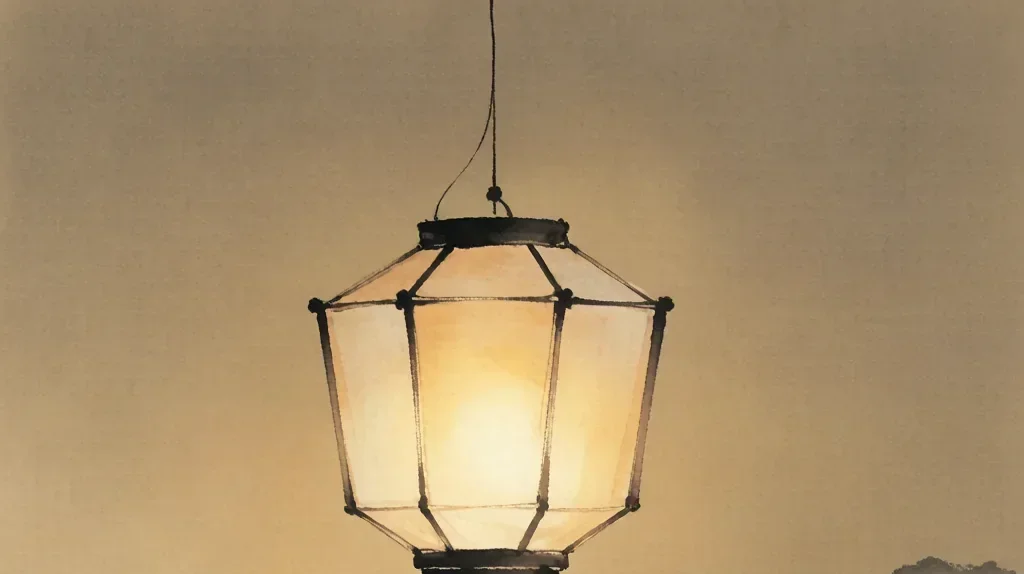
The lantern riddle, dēng mí (灯谜), is a word game played during the Lantern Festival and other lantern-hung occasions, in which a clever written clue is pasted beneath a glowing lantern and passersby try to guess the hidden word. Born from the Chinese love of puns and character play, it turns a festival of light into a public contest of wit. A good riddle rewards knowledge of homophones, radicals, and classical allusion, so solving one is both a laugh and a small literacy test. For centuries it was the parlor and street game of the literate and semi-literate alike, proof that wordplay could be as festive as fireworks.
The Lantern Festival Setting
The game belongs to the fifteenth day of the first lunar month, the Lantern Festival (元宵节), when streets fill with lanterns and families walk out at night. Riddle slips were hung on the lanterns—hence "lantern riddle"—and a correct guess might win a small prize from the stall keeper.
The lantern gave the game its theater: a glowing paper house for a tiny puzzle. Walking among hundreds of lit riddles, a person moved through a city of questions, each lantern a small mystery waiting to be named.
Origins of the Riddle Game
The roots lie in the "hidden-word" games of the Han and Three Kingdoms periods, where scholars guessed characters and phrases. By the Song period, pasting riddles on lanterns during the festival was a settled custom in cities, and the practice spread downward through society.
The word mí (谜) itself means "enigma." The form fused two old pleasures: the lantern's beauty and the brain's puzzle. Their meeting made the festival both luminous and literate.
How a Lantern Riddle Works
A riddle gives a clue, usually a line or couplet, and asks for a single character, word, or phrase. The solver must see through a surface meaning to a hidden one. The answer is often announced by writing it on the back or telling the keeper, who checks a key list.
Clues may point by sound (a homophone), by shape (a character's strokes), or by allusion (a line from a poem). The fun is the "turn"—the moment the literal sense flips into the answer. A good riddle hides in plain sight.
Types of Wordplay
Chinese riddles exploit the script. A "character-splitting" riddle takes a word apart by its components; a "homophone" riddle uses similar sounds; a "allusion" riddle quotes a known text. Some ask for a proverb, others for the name of a place or thing.
Because characters bundle sound and shape and meaning, the language is unusually rich for this game. A single character can be cracked three ways, and setters compete to be fair but surprising.
Examples and the "Turn"
A classic teaching riddle: "A thousand miles of meeting" (千里相会) hints at the character 重, read as "heavy" but built from "thousand" (千) and "li" (里). The solver sees the parts inside the whole. Another gives a picture pun or a borrowed phrase.
The pleasure is cognitive, not just linguistic. The mind holds the clue, rejects the obvious, and snaps onto the answer. That click—the "turn"—is why players crowd a good lantern despite the cold night.
Riddle Stalls and Social Play
Historically, shops and families hung riddles and offered prizes: a sweet, a small coin, or a paper fan. Crowds gathered, shouted answers, and good setters gained local fame. The game was loud, social, and a little competitive.
It also crossed classes. Scholars showed off with literary allusions; children enjoyed simple object riddles. A single lantern string might carry both, so grandfather and grandson could each find a win.
Lantern Making and the Setting
The riddles depend on the lanterns that carry them, and Chinese lantern-making is itself a folk art of bamboo, paper, and silk. A riddle lantern need not be fancy—a plain paper globe suffices—but the glow is essential to the mood.
The pairing of craft and word is typical of Chinese folk culture, where a beautiful object often hides a mental game. The lantern is the stage; the riddle is the play performed on it.
Modern Riddles and Media
Today lantern riddles appear in parks, schools, and television quizzes during the festival, and newspapers once printed them for readers to mail in. Digital versions circulate on phones, keeping the form alive off the lantern string.
The risk is the same as with other folk games: when a riddle becomes only a quiz, it loses the lantern-lit street atmosphere that made it magic. The best modern events restore that setting, lighting the words as well as asking them.
Why Wordplay Matters
The lantern riddle matters because it made literacy festive. To solve one, you needed to know characters, sounds, and classics—skills gained through study—but the reward was play, not exam. The game honored learning without solemnity.
It also built community. Strangers debated a clue under the same lantern; a solved riddle was a small shared triumph. In a culture that cherishes the written word, the lantern riddle is the night when words took to the streets and glowed.
Riddles Beyond the Lantern
The habit of riddle-making spread beyond the festival. "Crotch characters" and word games appeared in novels and operas, where a clever clue might reveal a hidden name or fate. Scholars amused themselves with literary enigmas, and children learned simple object riddles at home.
In this wider life, the lantern riddle was only the brightest instance of a culture that loves to hide meaning and reward the sharp reader. The lantern simply gave the game a public, glowing stage once a year.
Teaching Through Play
Riddles were also schooling. A parent who set a clue taught a child to think in characters and sounds; a teacher who used them drilled memory with joy. The lantern fair was, in effect, a school without walls, where learning felt like winning.
This gentle pedagogy is part of why the game was cherished. It turned the hard work of literacy into a night's play, and a child who solved a lantern riddle had practiced, without dread, the very skills the exam hall later demanded.
The same spirit survives in classroom warm-ups and family game nights, where a riddle breaks ice and wakes attention. The lantern has changed into a light bulb, but the pleasure of the "turn"—the mind flipping from wrong to right—is exactly as it was under the old paper glow.
❓ Frequently Asked Questions
What is a lantern riddle?
A written word puzzle hung beneath a festival lantern; solvers guess the hidden character or phrase.
When are they played?
Mainly at the Lantern Festival on the fifteenth of the first lunar month, and at other lantern occasions.
How do you solve one?
By seeing past the literal clue through homophone, character shape, or allusion to the answer.
Why suit Chinese so well?
Characters bundle sound, shape, and meaning, giving setters many ways to hide a word.
Were they social?
Yes; crowds gathered at stalls, shouted answers, and good setters won local fame.
Do they survive today?
They appear in parks, schools, TV quizzes, and on phones, though the lantern setting is the soul of the game.