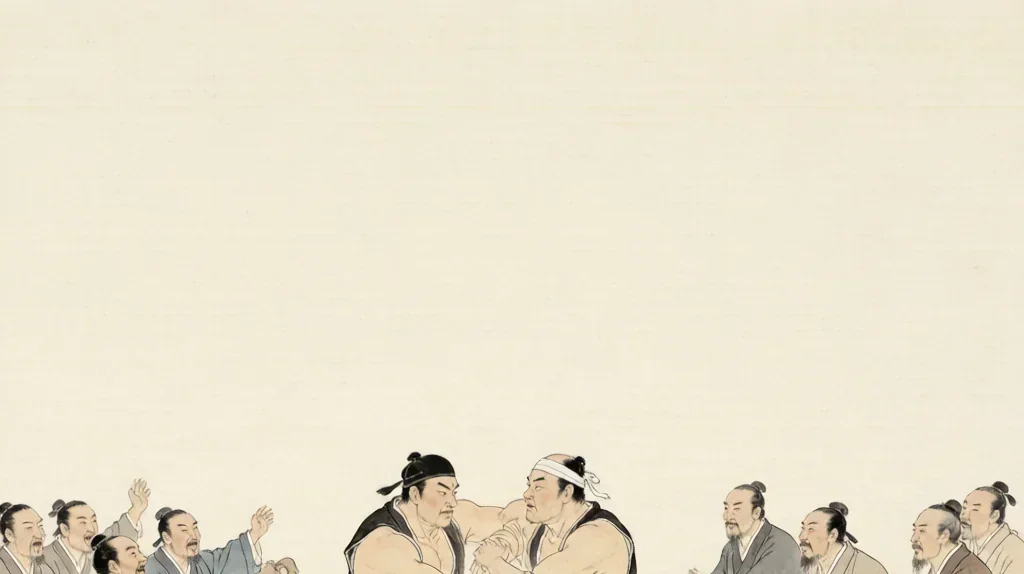
Jiaodi (角抵), often translated as "horn butting" or ancient Chinese wrestling, is one of the oldest organized physical contests in Chinese culture, stretching back more than two thousand years. Originally a form of hand-to-hand grappling used to train soldiers and test strength, it gradually evolved into a popular spectator sport performed at court banquets, temple fairs, and public festivals. Closely related to later terms such as jiaoli (角力, "strength wrestling") and xiangpu (相撲, "mutual striking"), jiaodi is widely regarded by historians as a direct ancestor of Japanese sumo and of the many regional wrestling styles found across East Asia. More than a simple test of force, it embodied a cultural ideal in which controlled physical skill expressed discipline, ritual, and communal celebration.
Mythic Origins and Early Legends
The earliest Chinese accounts link grappling contests to the semi-legendary struggles of antiquity. The Huangdi Neijing and later texts describe the Yellow Emperor (Huangdi) defeating the rebel Chi You, sometimes imagined as a horned giant, in a great battle decided by close combat. Later folklore explained the name jiaodi—literally "horn goring"—by claiming that early wrestlers wore horned caps and butted one another like rams. Whether historical or symbolic, these stories show that the Chinese imagination long associated wrestling with the founding of order out of chaos.
During the Zhou dynasty (c. 1046–256 BCE), aristocratic education emphasized the "six arts" (liuyi), which included archery and charioteering alongside ritual, music, writing, and mathematics. Grappling was folded into martial training for warriors, and contests of strength became a recognized, if informal, part of military culture. The notion that physical prowess served public order—protecting the realm and displaying the ruler's vigor—remained central to how wrestling was understood for centuries.
Jiaodi as Military Training
In the Han dynasty (206 BCE–220 CE), wrestling was formalized as a tool of the state. Emperors sponsored large open-air gatherings called jiaodi xi (角抵戲, "horn-butting games"), which combined wrestling with acrobatics, music, and theatrical displays. These were not merely entertainment; they were also a way to keep soldiers fit and to demonstrate the dynasty's wealth and stability to visiting envoys and commoners alike.
The historian Ban Gu, in his Hanshu (History of the Han), records that jiaodi performances drew huge crowds in the capital. Wrestlers trained in camps and competed before officials, and victory could bring reward and reputation. The sport thus straddled two worlds: a serious component of defense and a vibrant popular spectacle that cut across class lines.
The Han "Horn-Butting Games"
The Han jiaodi xi grew into elaborate festivals lasting days. They featured not only wrestlers but also dancers, conjurers, and animal acts, reflecting a broader appetite for spectacle at the imperial court. Foreign tributaries sometimes brought their own strongmen, turning the games into an informal stage for cultural exchange along the emerging Silk Roads.
Crucially, the Han court used these games to project soft power. By staging a peaceful, joyful contest of strength rather than open warfare, rulers presented themselves as patrons of both martial virtue and civilian harmony. The vocabulary of jiaodi—skill within rules, respect between opponents—became a model for other competitive pastimes.
Tang Dynasty Court Wrestling
By the Tang dynasty (618–907 CE), wrestling was known more often as xiangpu and was a favorite amusement of emperors and generals. Tang rulers, many of whom prized horsemanship and martial display, employed professional wrestlers at court and organized matches during feasts. The sport was celebrated in poetry and painting, where wrestlers appear as figures of controlled power and theatrical flair.
Tang wrestling also filtered into daily life. Military regiments held internal tournaments, and boys in villages mimicked the holds they saw performed by traveling troupes. The Tang period cemented wrestling's dual identity: a refined court art and a rough-and-tumble folk game played wherever there was open ground and an audience.
Song and Yuan Developments
The Song dynasty (960–1279 CE) saw wrestling flourish in the bustling entertainment quarters of cities such as Kaifeng and Hangzhou. Professional xiangpu performers competed for prizes before paying crowds, and manuals began to describe techniques and training regimens. Wrestling joined the lively commercial culture of teahouses, markets, and festival grounds.
Under the Yuan dynasty (1271–1368), Mongol influences mixed with Chinese grappling traditions. The steppe peoples prized wrestling (bökh) highly, and cross-cultural contact enriched Chinese technique. Paintings from the period show wrestlers in close clinches, sometimes with referees, indicating that codified rules were already taking shape.
Connection to Japanese Sumo
One of jiaodi's most enduring legacies lies abroad. Historical and linguistic evidence links Tang-dynasty xiangpu to the emergence of sumo in Japan, where the characters 相撲 are read as "sumo." Envoys and monks traveling between China and Japan carried wrestling customs, rituals, and terminology across the sea. The ring, the ceremonial dignity, and the emphasis on a single decisive throw all echo Chinese antecedents.
While Japanese sumo developed its own elaborate ritual and isolation, its Chinese cousin continued to diversify at home. Recognizing this kinship helps explain why wrestling styles across Korea, Mongolia, and China share surprising family resemblances despite very different modern forms.
Regional Folk Wrestling Styles
Across China, local wrestling traditions adapted to terrain and temperament. In the north, Mongolian-style belt wrestling and Manchu shuaijiao emphasized throws and grips; in parts of the south, lighter forms of grappling appeared at village festivals. Many of these coalesced into what is today called shuaijiao (摔跤, "throw wrestling"), still practiced as a sport and martial art.
These regional styles kept jiaodi's spirit alive long after the imperial court faded. Temple fairs and harvest celebrations often closed with a wrestling match, blending sport with community identity. The best wrestlers became local heroes, their names passed down in oral tradition.
Technique and Rules
Traditional Chinese wrestling rewards leverage, balance, and timing over brute mass. Core principles include maintaining a low center of gravity, controlling the opponent's belt or limbs, and using rotation to unbalance. Many techniques aim to trip or lift an opponent so that a clean fall ends the bout, echoing the "one throw" logic seen in sumo.
Although exact rules varied by era and region, a consistent ethic emerges: the contest should be decisive but contained. Opponents bow or salute before and after, and excessive cruelty is discouraged. This restrained competitiveness made wrestling acceptable as both training and entertainment across a strongly ritual-minded society.
Ritual and Symbolism
Wrestling was never only about winning. It symbolized the cosmic struggle between order and disorder, the taming of raw force by skill and propriety. Performers at court often appeared in stylized costume, and matches could be framed as allegories of virtuous rule. Even folk bouts carried a festive blessing, believed to stir communal energy and ward off stagnation.
The horned-cap origin myth resurfaced in decorative arts, where wrestlers appear on tomb tiles, bronze mirrors, and festival banners. These images fixed jiaodi in the visual memory of Chinese culture, ensuring that even non-practitioners recognized the wrestling figure as a sign of strength and vigor.
Modern Legacy and Revival
Today, jiaodi survives primarily through shuaijiao and through the living wrestling traditions of China's ethnic minorities, such as Mongolian bökh and Uyghur oglak tartish. Sports schools and martial arts associations teach its throws as both competition and heritage. Documentaries and museum exhibits increasingly present jiaodi as a cornerstone of East Asian physical culture.
The modern revival also reflects a broader interest in "intangible cultural heritage." As communities seek to preserve distinctive local games, jiaodi's long history offers a ready model: a contest that is at once martial, festive, and civilizing. Its journey from battlefield drill to court spectacle to folk festival captures something essential about how Chinese culture has always balanced strength with ceremony.
❓ Frequently Asked Questions
What does jiaodi mean?
Jiaodi (角抵) literally means "horn butting" and refers to ancient Chinese wrestling, a grappling contest of strength and skill with roots over two thousand years old.
Is jiaodi related to Japanese sumo?
Yes. The Tang-era term xiangpu (相撲) was carried to Japan, where the same characters are read as sumo, and many rituals of the two sports share common ancestry.
Was jiaodi only a sport?
No. It served as military training, court entertainment, and a folk festival activity, blending practical combat with ritual spectacle.
How is jiaodi different from modern shuaijiao?
Shuaijiao is the modern Chinese throw-wrestling that evolved from jiaodi, with codified rules and sport organizations, while jiaodi is the historical ancestor.
Did women practice jiaodi?
Historical records focus on male wrestlers, but folk festivals and minority traditions include mixed or women's wrestling in some regions.
Is jiaodi still practiced today?
Yes, through shuaijiao and ethnic minority wrestling like Mongolian bökh, and it is promoted as intangible cultural heritage.