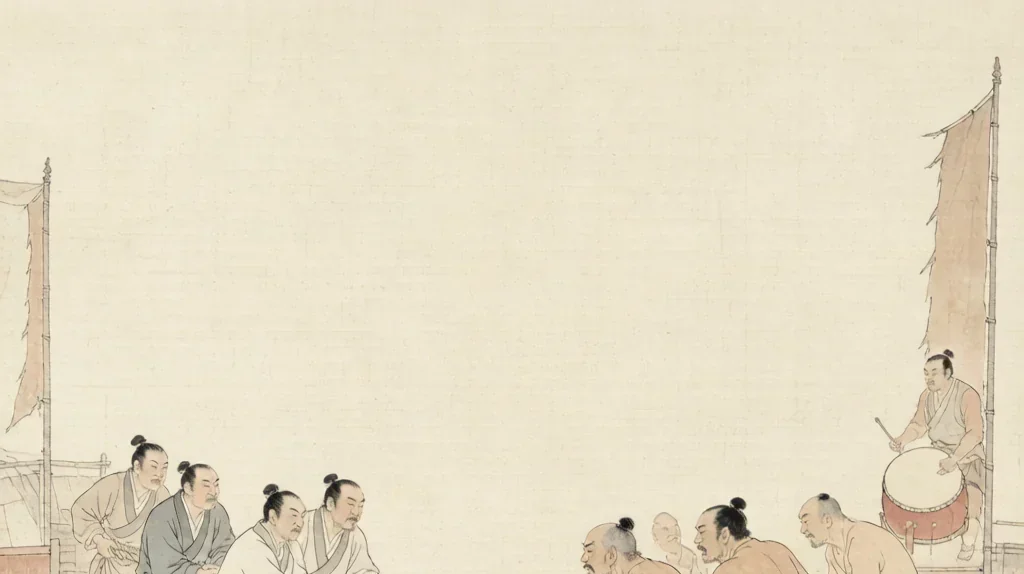
Tug-of-war (拔河, bá hé, literally "pulling the river") is a team contest of strength and unity found across China for well over a thousand years. Two sides grip a single rope and pull against each other, each trying to drag the opposing team across a center line. Deceptively simple, the game demands coordination, rhythm, and collective will as much as raw muscle. In Chinese history it moved from a military training drill through imperial court spectacle to a beloved village and festival sport, and it remains a staple of school sports days and community celebrations—a vivid emblem of solidarity expressed through friendly rivalry.
Name and Early Meaning
The Chinese name bahe means "pulling the river," a poetic image of hauling against a great current. The term captures the game's feel: a contest not against a person but against a force, requiring the whole body and a steady, flowing effort rather than a single yank.
Early forms used a sturdy hemp rope, often with a marker knot at the center and side lines scratched in the ground or marked with flags. The equipment's simplicity meant any community could stage a match with materials on hand.
Military Origins
Historical sources trace tug-of-war to training exercises of the late Zhou and Tang periods, where pulling a rope built the coordinated strength useful for hauling siege gear, boats, and supplies. The Tang court recorded bahe as a drill that taught units to pull as one.
Because synchronized pulling translated directly to logistics and warfare, commanders valued the game as practical preparation. Its martial pedigree distinguish it from purely recreational pastimes and explain its early presence in army life.
Tang Court Spectacle
By the Tang dynasty (618–907 CE), tug-of-war had become a court entertainment. The Fengshi Wenjian Ji and other texts describe elaborate matches with hundreds of participants and musicians beating drums to set the pulling rhythm, cheered by emperors and officials.
These spectacles were both sport and state theater, displaying the realm's vigor and unity. The drumbeat that paced the pull became a signature of the game, linking physical effort to communal music—a pattern still seen in festival versions today.
Rules and Field Setup
The basic rules are stable across time: a center mark on the rope is aligned with a center line on the ground; the team that pulls the mark past its side line wins. Many traditional matches used a "win by a set distance" rule rather than sudden collapse.
Team size varied from a handful to scores of pullers, with larger ropes and helpers feeding slack. A referee or drum master judged the center and called the start, ensuring the contest was orderly and observable to crowds.
Technique and Teamwork
Success depends less on one strong person than on unified technique. Pullers lean back in a line, plant heels, and pull on a shared cadence; a coordinated "heave" beats scattered maximum effort. The back "anchor" braces the rope and steadies the team.
Coaches traditionally taught breathing and timing, since panicked yanking wastes energy. The game is thus a lesson in subordinating individual strength to group rhythm—a physical metaphor for social harmony prized in Chinese culture.
Festival and Village Play
In rural China, tug-of-war anchored harvest festivals, temple fairs, and new-year gatherings. Villages fielded teams by neighborhood or lineage, and a win brought collective pride. The match doubled as a social bond among households.
Because it needed no special venue, bahe fit easily into open squares and fields. The sight of two teams straining amid drums and laughter became a familiar festive tableau, linking sport to community identity.
Symbolism of Unity
Tug-of-war resonates with Confucian and communal values: the victory of the coordinated many over the solitary strong. It dramatizes he (和, harmony) and the idea that collective effort surpasses individual force—a theme echoed in many Chinese proverbs.
The rope itself can symbolize connection: two sides joined by one line, struggling yet linked. This duality—conflict that is also communion—gives the game a quiet philosophical charge beneath its boisterous surface.
In times of hardship, communities have used bahe to rebuild solidarity, gathering neighbors who may have little else in common around a shared rope. The simple act of pulling together, even in play, can mend frayed bonds—a small but real social medicine carried in an old game.
Modern Sport and Schools
Today bahe is a regular feature of school sports days, military training, and corporate team-building. Standardized rules govern rope thickness, team size, and pulling distance, and the game appears in some regional and international championships.
Its low cost and high participation make it ideal for inclusive play: everyone from children to elders can join a side. The modern version keeps the drum, the chant, and the lesson in unity that centuries of Chinese players have known.
Regional and Ethnic Variants
China's minority peoples have their own pulling games. Some use belts or poles instead of a rope; others add ritual elements tying the contest to harvest or hunting. These variants show the game's flexibility across cultures.
Despite local flavor, the core remains: two sides, one line, and a test of who pulls together best. This consistency is why tug-of-war feels instantly familiar wherever it is played within the country.
The game also crossed borders through Chinese communities abroad, who brought bahe to festivals overseas, where it often steals the show as a boisterous, inclusive contest. Its universal intelligibility—grab rope, pull together—makes it a natural icebreaker between cultures, proving that some forms of play need no translation.
Famous Historical Matches
Some Tang court tug-of-war contests grew to remarkable scale, with teams of several hundred pullers and officiating musicians, staged before the emperor as both sport and spectacle. Such events were recorded by court chroniclers who treated the game as a display of national vigor and unity rather than mere recreation.
Village traditions also produced legendary rivalries between lineages or neighborhoods, remembered in local lore long after the ropes frayed. These contests could draw entire communities and settle bragging rights for a season. Whether at court or in a field, the memorable matches shared a pattern: drummers, chanting pullers, and a center mark that decided glory for one side.
❓ Frequently Asked Questions
What does bahe mean?
Bahe (拔河) literally means "pulling the river" and refers to tug-of-war, a team rope-pulling contest.
Where did tug-of-war come from in China?
It began as a military training drill for coordinated hauling and became a Tang court spectacle with drummers.
What makes a team win?
Pulling the center mark past the opposing side line, usually through synchronized effort rather than isolated strength.
Why is teamwork so important?
A coordinated heave on a shared cadence outperforms scattered yanking; the game embodies unity over individual force.
Is tug-of-war still played?
Yes, it is common at school sports days, festivals, military training, and some regional championships.
What does the game symbolize?
It symbolizes harmony and collective strength, a physical metaphor for social unity prized in Chinese culture.