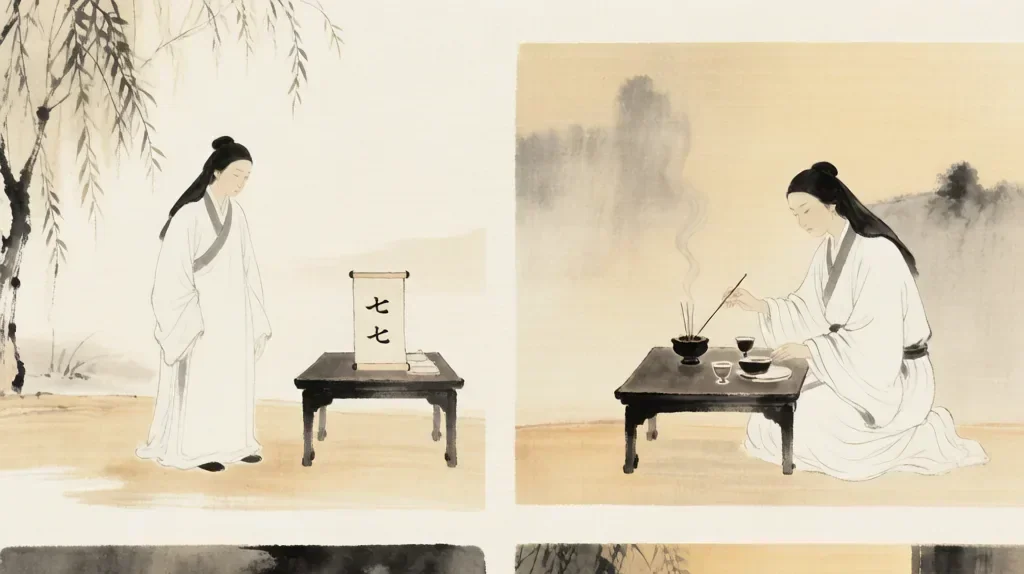
Every seven days, from the moment of death until the forty-ninth day, a candle was lit, incense was burned, and the family gathered before the spirit tablet to offer food, wine, and prayers. The Seven Sevens (七七, qī qī) ritual cycle is one of the most distinctive and psychologically profound elements of Chinese death practice, a seven-week liminal period during which the soul of the deceased navigates the perils of the underworld, faces judgment, and gradually transforms from a frightened ghost into a settled ancestor. For the living, the seven weeks of ritual service were an intensive course in grief, a structured schedule of ceremonies that gave shape and meaning to the chaos of bereavement.
The Buddhist Origins of the Seven-Sevens Cycle
The seven-sevens cycle has its roots in Buddhist cosmology, specifically in the concept of the intermediate state (antarābhava in Sanskrit, zhōng yǒu in Chinese). According to Buddhist teaching, after death, the consciousness does not immediately enter a new rebirth but passes through an intermediate period lasting up to forty-nine days. Every seven days, the soul faces a judgment before the Ten Kings of the underworld, each king presiding over a specific court. The soul's karma is weighed, and its future rebirth — or liberation — is determined.
When Buddhism entered China, this belief system merged with indigenous Chinese concepts of the soul and the afterlife. The indigenous Chinese tradition had its own ideas about a journey through a bureaucratic underworld, and the Buddhist framework was readily adapted. By the Tang dynasty, the seven-sevens cycle was fully integrated into Chinese funeral practice, and it remains one of the most persistent elements of Chinese death ritual — even among families who no longer identify as Buddhist.
The Seven Weekly Ceremonies
Each of the seven weeks had a designated ceremony with specific offerings and prayers. The first seventh day — called tóu qī (头七) — was the most important. On this day, the family held a major service at home, often inviting Buddhist monks or Daoist priests to chant scriptures. The family prepared a feast of the deceased's favorite foods, set a place at the table, and burned paper offerings. It was believed that the soul returned home on this night, and the family often sprinkled ash or flour on the floor to see if the soul's footprints appeared — a practice still observed in some rural areas.
The second through sixth seventh days were marked by smaller services, though their significance grew as the forty-ninth day approached. The fifth seventh day (wǔ qī) was considered especially dangerous, as the soul faced the most severe judgment, often by King Yama himself. Many families held extra-long ceremonies on this day and burned extra paper offerings. The final seventh day, the forty-ninth (qī qī), was the most elaborate of all, as this was the day the soul completed its journey and was either reborn or installed as an ancestor.
The Role of Buddhist and Daoist Clergy
Professional religious specialists played an essential role in guiding the soul through the seven-sevens. Buddhist monks conducted rituals based on the Yulanpen Sutra and the Sutra of the Ten Kings, chanting passages believed to ease the soul's passage through judgment. The monks would 'open the road' for the soul, symbolically clearing obstacles from its path. They would also perform the 'crossing over' (chāo dù) ritual, transferring merit to the deceased to improve their karmic standing.
Daoist priests offered a different but complementary service. In the Daoist framework, the soul's journey was a bureaucratic process, and the priests acted as spiritual lawyers, petitioning the celestial bureaucracy on the soul's behalf. They wrote formal petitions (shū wén) addressed to the Ten Kings, arguing for leniency and presenting evidence of the deceased's virtuous life. These petitions were burned so that the smoke would carry them to the underworld. Many families employed both Buddhist and Daoist specialists, ensuring that the soul was covered from every angle.
Paper Offerings and the Underworld Economy
Throughout the seven-sevens cycle, vast quantities of paper offerings were burned for the deceased's use in the afterlife. The most common was spirit money (jīn zhǐ), sheets of gold- or silver-paper that were folded into ingot shapes and burned. But the offerings went far beyond money. Paper houses, paper cars, paper servants, paper furniture, and even paper credit cards were burned — everything the soul might need in its new existence.
The logic of these offerings was straightforward: the afterlife was understood as a continuation of this life, complete with the same material needs and social structures. A soul that arrived in the underworld without resources would be a wandering ghost, dependent on the charity of others. A soul with ample funds could bribe the judges, pay the ferryman, and establish a comfortable existence. The seven-sevens cycle was thus a period of intensive 'remittance' from the living to the dead, with the smoke of burning offerings serving as the currency of the spirit world.
The Grieving Process and the Seven-Sevens
Beyond its theological significance, the seven-sevens cycle served a profound psychological function. The weekly ceremonies gave the bereaved family a structured schedule of mourning, preventing the isolation and aimlessness that often accompanies grief. Each ceremony brought the family together, reinforced social bonds, and provided a shared focus for the otherwise private experience of sorrow. The seven-week period was long enough to move through the initial shock of loss but short enough to prevent the family from being permanently suspended in mourning.
The cycle also gradually prepared the family for the final separation. Each weekly service reduced the intensity of the soul's presence in the home. By the forty-ninth day, the family was ready — or at least prepared — to accept that the deceased had completed their journey and could now be addressed as an ancestor rather than mourned as a recent loss. The final ceremony marked this transition with a formal installation of the ancestor tablet, after which the deceased was no longer a 'new ghost' but a 'settled ancestor.' The seven-sevens thus carried both the soul and the family through the passage from death to ancestral continuity.
The Ten Kings of the Underworld
At the heart of the seven-sevens lies a court system. Buddhist and Daoist lore describe ten kings who judge the soul across the weeks, each presiding over a stage of its passage. The soul's conduct and the family's merit-making are weighed at every step, and the fifth king, Yama, is the sternest. This bureaucratic afterlife gave the weekly ceremonies a clear purpose: to escort the dead safely through one tribunal after another, with the living acting as advocates through scripture and gift, so that the soul might reach a gentle rebirth. Families therefore spared no effort in those weeks, knowing each court could tip the soul's fate. Each week's rite was a small embassy sent to plead the soul's case before the next court.
The Widow and Female Mourners' Role
The seven weeks were largely carried by the women of the household. The widow led the home services, wept and bowed before the tablet, and directed the burning of offerings, while daughters and sisters prepared the food. In a patrilineal world where the son was the ritual heir, the daily labor of grief fell heavily on female relatives, who kept the household's devotion visible week after week until the final installation of the ancestor, their quiet work the true engine of the rite. Their mourning was labor as much as feeling, a duty performed with hands as well as with tears. Their quiet constancy held the family together through the hardest stretch of its grief. Their hands kept the rites alive when words failed, and the family leaned on that steadiness.
From New Ghost to Settled Ancestor
The fortyninth day closes the cycle with the formal installation of the ancestral tablet in the home shrine. Until then the deceased is a new ghost, still in transition and still needing the family's care. After the tablet is set among the others, he or she is addressed as an ancestor, a settled member of the lineage rather than a wandering soul. The rite thus performs a quiet transformation, carrying both the dead and the bereaved from loss into continuity, and giving grief a definite and gentle end. The tablet on the shelf marked the end of weeping and the start of a calmer, yearly remembrance. What began in tears ended in routine reverence, the gentlest form mourning can take.
Frequently Asked Questions
Chinese Vocabulary
七七 — : Seven sevens; the 49-day cycle of post-death rituals
头七 — : First seventh day; the most important of the weekly ceremonies
超度 — : Crossing over; the ritual of transferring merit to the deceased
阎王 — : King Yama; the judge of the underworld who presides over the soul's fifth-week judgment
中有 — : The intermediate state; the soul's liminal passage between death and rebirth
十王 — : The Ten Kings who judge the soul across the forty-nine days
纸扎 — : Paper effigies of houses, cars, and servants burned for the use of the dead
往生 — : Passage to a favorable rebirth; the hoped-for outcome of the rites
Fun Facts
- In some Taiwanese communities, the family places a bowl of water and a towel outside the door on the first seventh night, so the returning soul can wash before entering.
- The paper offerings burned during the seven sevens are measured by the truckload in some large-scale funerals, with the total cost of offerings sometimes exceeding the cost of the funeral itself.
- Some contemporary Chinese families have adapted the seven-sevens cycle to include online memorial services, where relatives from around the world can participate in the weekly rituals through video calls.
- On the first seventh night some families burn a paper horse and guide, believing the soul rides them home to visit.
- The forty-nine-day length matches the Buddhist teaching that the soul lingers in an intermediate state for up to that span.
- In parts of southern China the family cooks the deceased's favorite dishes on each seventh day and sets a place at the table.