Rites of Life
45 articles — The rituals that mark a Chinese life, from birth to remembrance.
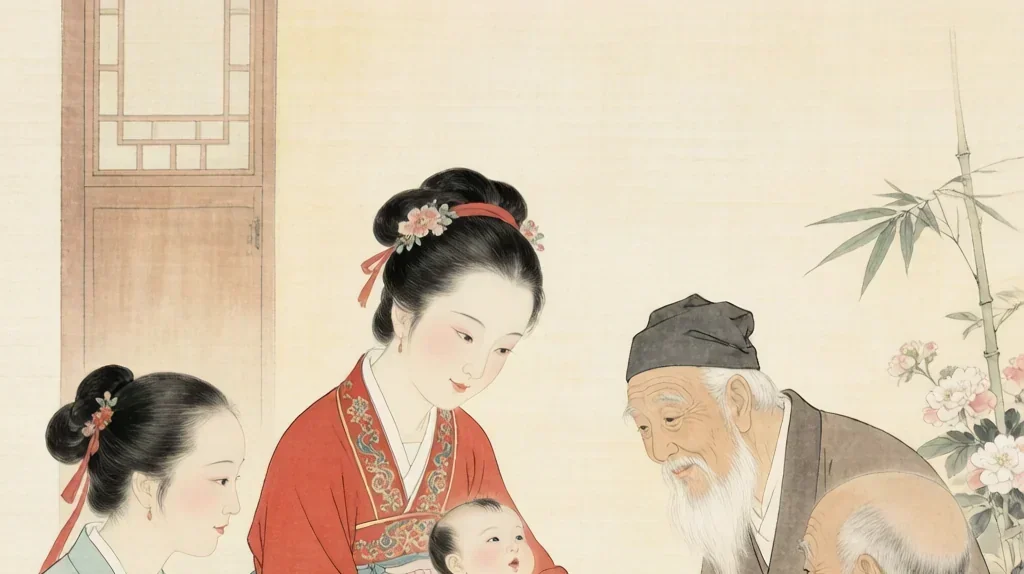
Birth and the Full-Month Celebration (满月): Welcoming New Life
Of all the rites of life in China, the celebration of a newborn's first month — the full-month ceremony (满月, mǎn yuè) — is perhaps the most tender. In a culture that has always prized continuity of the family line, the safe arrival of a child is a victory shared by grandparents, uncles, and ancestors alike.
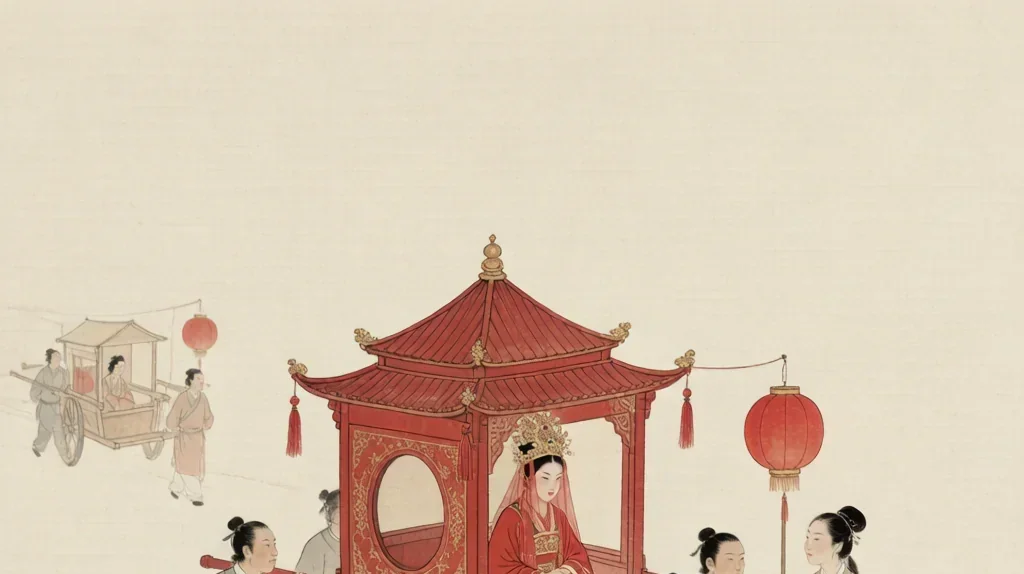
Chinese Wedding Customs: From Matchmaking to Bridal Sedan
Among the life rituals of China, none is more lavishly staged than the wedding (婚礼, hūn lǐ). For most of Chinese history marriage was not a private romance but a bond between two lineages, charged with the duty of continuing the family line and honoring ancestors.

Chinese Funeral Rites: Sending Off the Departed
Chinese culture sees death not as an ending but as a transition — the moment a person becomes an ancestor. The rites that surround that transition, the "white affairs" (白事, bái shì) as opposed to the "red affairs" of weddings, are among the most elaborate and emotionally charged in the entire ritual calendar.
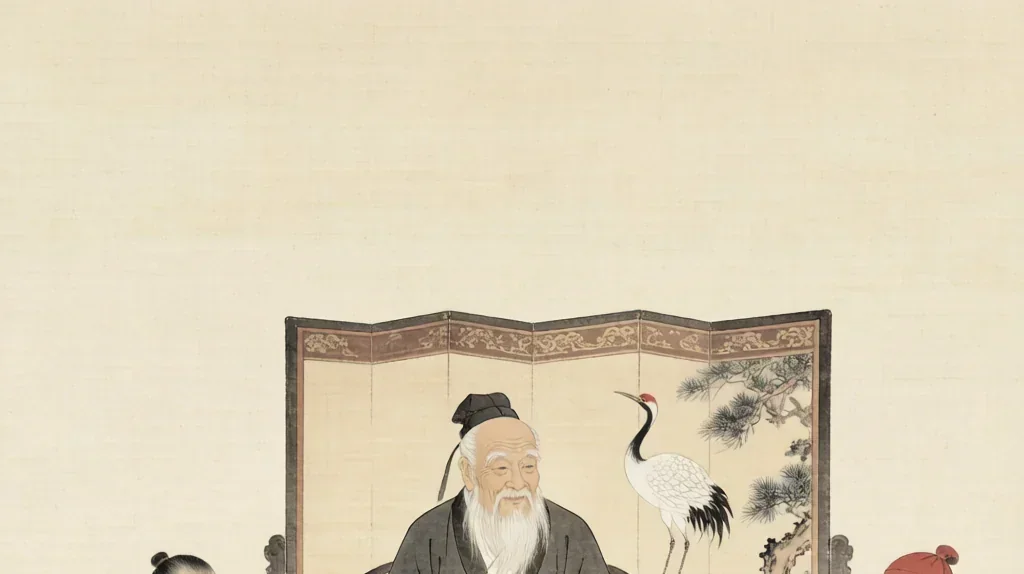
Longevity Birthdays (做寿): Honoring the Elderly
While a child's first birthday is about the future, an elder's milestone birthday is about the past — a life lived long enough to be honored. In Chinese tradition, once a person reaches old age their birthday is no longer a private affair but a "shou" (寿, longevity celebration), an event in which the whole family repays decades of care.

The Three Letters and Six Rites (三书六礼): Traditional Betrothal
In pre-modern China, marriage was less a meeting of two hearts than a contract between two households, and like any serious contract it required paperwork and ceremony. The system that governed it was the "Three Letters and Six Rites" (三书六礼, sān shū liù lǐ), a set of betrothal documents and staged rituals first codified in the "Book of Rites" (礼记, Lǐ Jì) during the Zhou dynasty (1046–256 BCE) and observed, with local variation, for more than two millennia.

Zhuazhou (抓周): The One-Year-Old's Grab Test
Among Chinese birthday rites, none is more delightful than zhuazhou (抓周, zhuā zhōu), the "grab the week" ceremony held when a child turns one. On that day the family lays a spread of ordinary objects before the toddler and watches, with more hope than science, to see which one the child first seizes.
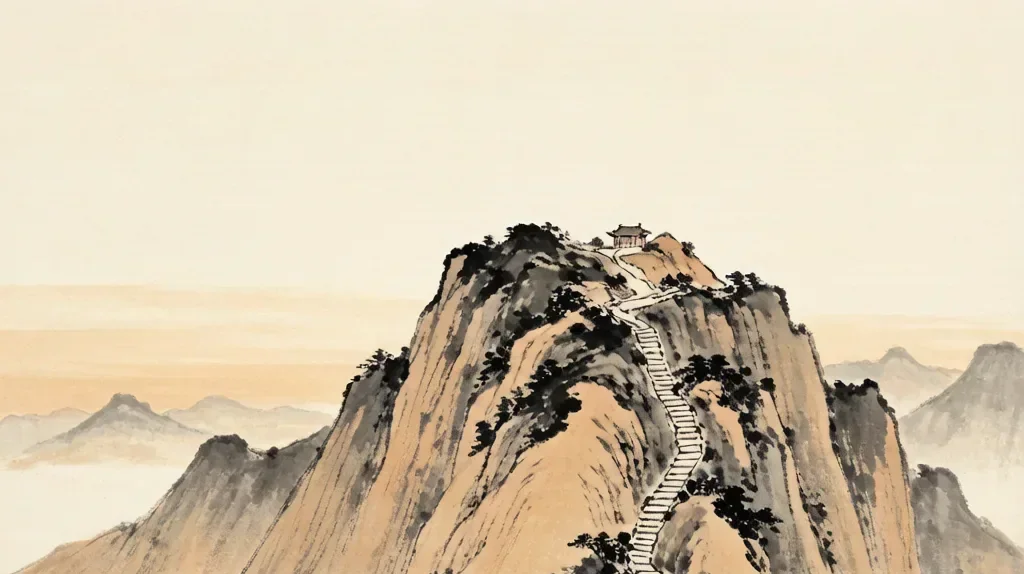
Mount Tai Fengshan: The Emperor's Ultimate Rite
From the plains of Shandong, it rises like a sleeping dragon — Mount Tai (泰山, Tài Shān), the most sacred mountain in Chinese history. For over three thousand years, emperors, pilgrims, and seekers have climbed its slopes to perform the highest rituals of the Chinese tradition: the Feng and Shan sacrifices (封禅, fēng shàn), ceremonies in which the emperor communicated directly with Heaven and Earth from the summit of the world. The Altar of Tai Shan was not merely a place of worship; it was the cosmic axis, the point where Heaven and Earth were closest, and where the Son of Heaven could fulfill his highest duty.
The Ancestor Tablet: The Presence of the Departed
Carved from a single piece of wood, lacquered in black and red, inscribed with gold characters that named the dead and recorded their virtues — the Ancestor Tablet (神主牌, shén zhǔ pái) was the physical anchor of the Chinese cult of the dead. Neither a tombstone nor a mere memorial, the tablet was believed to house the spirit of the ancestor, providing a permanent residence for the soul in the world of the living. Placed in the family shrine, honored with daily incense and seasonal offerings, the tablet transformed the biological fact of death into the social fact of ancestry. Understanding the ancestor tablet is essential for understanding how Chinese families have maintained relationships with their dead for over three thousand years.
Ancestor Worship: The Unbroken Thread
Before the invention of writing, before the founding of dynasties, before Confucius codified the rites — Chinese families were already making offerings to their dead. Ancestor Worship (祭祖, jì zǔ) is the oldest continuously practiced ritual tradition in Chinese civilization, a system of beliefs and practices that has survived every political change, religious transformation, and social revolution in four thousand years of recorded history. At its simplest, ancestor worship is the ongoing relationship between the living and the dead members of a family. At its most profound, it is the foundation of Chinese ethics, the source of social stability, and the mechanism through which generations are connected across the vast span of time.
Betrothal Gifts: The Exchange of Good Faith
In a narrow alley of a Fujian village, the neighbors leaned out of their windows to watch as a procession of red-lacquered cases swayed on the shoulders of hired bearers — twenty-four boxes containing bolts of silk, gold jewelry, dried seafood, jars of rice wine, and a single live rooster with feathers the color of fire. The Betrothal Gift procession (聘礼, pìn lǐ) was the moment when a marriage moved from intention to inevitability, when the spoken promise of two families was made visible in silk, silver, and celebration. For centuries, the exchange of betrothal gifts was not merely a custom but the legal and emotional foundation of Chinese marriage.
The Full Moon Rite: Welcoming the Newborn
For a month, the new mother had not stepped outside. She had eaten only specific foods, abstained from bathing in cold water, and received visitors only from close female relatives. The baby had not been shown to anyone outside the immediate family, protected from the 'evil eye' and the wandering spirits that threatened vulnerable newborns. But on the 30th day after birth, the doors opened. The One-Month Celebration (满月, mǎn yuè) was the first public acknowledgment of a new life — a ritual that welcomed the baby into the family, the community, and the continuing chain of generations. For Chinese families, this was the first great rite of passage, and it was celebrated with a mixture of relief, joy, and elaborate symbolism.
The Bridal Chamber: Joyful Teasing of the New Couple
After the last guest had staggered home and the lanterns had been extinguished, the bride sat alone on the edge of the carved wooden bed, the red silk veil still covering her face. Outside the door, the whispers and giggles of the groom's younger cousins could still be heard, pressing against the paper window for a glimpse of what would happen next. The Bridal Chamber (洞房, dòng fáng) — literally the 'cave room' — was the most private yet most publicly anticipated stage of the Chinese wedding. In this intimate space, the marriage was consummated, the veil was lifted, and the couple began their life together under the watchful eyes — unseen but fully present — of the ancestors whose portraits hung upon the wall.
Incense Offering: The Smoke of Devotion
The great bronze bell of the temple boomed three times, its deep resonance rolling across the monastery compound like thunder through a summer sky. The monks filed into the hall, their saffron robes glowing in the candlelight, and began to chant — a low, rhythmic murmur that rose and fell with the smoke of a thousand incense spirals. The Buddhist Worship Rite (佛教仪式, fó jiào yí shì) is the ritual heart of Chinese Buddhist practice, a structured encounter between the human and the enlightened that has taken the same essential form for nearly two thousand years. Whether performed by a lone devotee at a home altar or by a thousand monks in a great temple, the Buddhist rite is a technology of compassion — a method for generating merit, purifying the mind, and moving closer to liberation.
The Capping Ceremony: Coming of Age Under Heaven
In the bamboo groves of a Zhou dynasty courtyard, a boy of twenty knelt before his father while an elder bound his loose hair into a formal topknot and placed a ceremonial cap upon his head. With that single gesture, the child died and a man was born. The Capping Ceremony (冠礼, guān lǐ) was the first and arguably the most important of the four great rites of passage in classical Chinese life, marking the transition from dependent youth to full social adulthood. For over two millennia, this ritual determined who could marry, inherit, hold office, and offer sacrifices to the ancestors — and its symbolism continues to echo in Chinese coming-of-age traditions today.
The Blood Oath: The Oldest Bond of Brotherhood
Before the ink was dry on the paper, before the terms were read aloud, before the witnesses put their seals — the two parties lit incense and bowed to Heaven. The Contract Rite (立契, lì qì) was the traditional Chinese method of formalizing an agreement, a ceremony that transformed a personal promise into a binding obligation witnessed by the gods, the ancestors, and the community. In a society where written contracts were less important than personal trust, the ritual of sealing an agreement was the moment when words became bonds, and when the parties committed themselves to consequences that reached beyond the human world into the realm of spirits and fate.
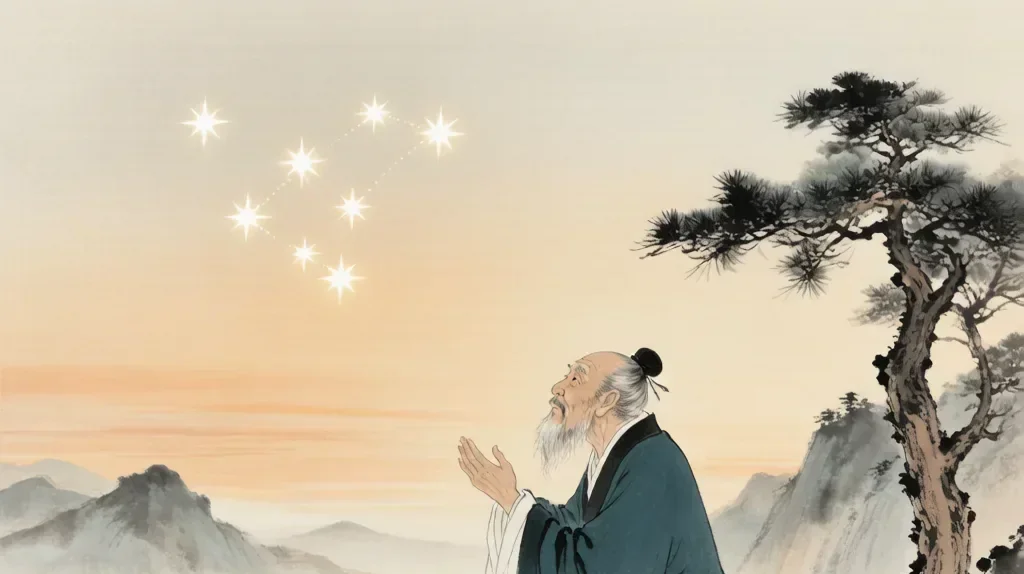
Star Worship: Daoist Rites of Fate
On a high mountain terrace before dawn, the Daoist priest raised his voice in a chant that was older than the temple behind him. He wore a robe embroidered with the eight trigrams and the stars of the Big Dipper. In his hands, he held a sword of peach wood and a bell whose ringing was said to reach the celestial realms. The Daoist Offering (道教斋醮, dào jiào zhāi jiào) was the great ritual of the Daoist tradition — a cosmic ceremony that realigned the forces of the universe, petitioned the celestial bureaucracy, and brought the blessings of the immortals down to earth. In the Daoist worldview, the offering was not merely a request for divine favor but a technical intervention in the workings of the cosmos, a ritual technology that maintained the harmony of Heaven, Earth, and Humanity.
The Final Rites: Preparing for the Journey
When the breath stopped and the soul departed, the household fell into a carefully choreographed silence. The family washed the body, dressed it in the finest clothes the deceased had ever owned — or sometimes in plain hemp, depending on their station — and placed it on a raised platform in the main hall. The Death and Final Rites (丧礼, sāng lǐ) of Chinese tradition are among the most elaborate, expensive, and emotionally demanding rituals in the entire Chinese ceremonial repertoire. For the living, every action taken in the days after a death is freighted with consequence: the welfare of the deceased's soul depends on the correct performance of ritual, and the continuity of the family itself depends on successfully transforming a living member into an ancestor.
Dragon Worship: Praying for Rain
When the summer rains did not come and the rice seedlings began to wither in the cracked earth, the village turned to the Dragon King. A procession of villagers, led by the Daoist priest and carrying a paper-and-bamboo dragon on their shoulders, wound through the parched fields toward the village temple. At the temple, they placed the dragon before the altar, burned incense, and chanted prayers for rain. Dragon Worship (龙王崇拜, lóng wáng chóng bài) was one of the most widespread and urgent rituals of traditional Chinese life — a direct appeal to the master of water, rain, and storms. When the dragon answered, the village survived. When it did not, the village starved.
Encoffining: Dressing the Body for Eternity
In the dim light of the ancestral hall, the coffin lay open — a dark wooden vessel lined with silk, its interior painted with the constellations and the eight trigrams. Around it, the family moved with a precision born of ritual instruction, lifting the body from the deathbed, arranging the limbs, placing the burial objects, and adjusting the garments one last time. Encoffining (入殓, rù liàn) is the most intimate and irreversible of all Chinese funeral rituals: the moment when the living surrender the body of their loved one to the container that will carry it into the earth. Performed incorrectly, it threatened the soul's journey; performed well, it ensured that the deceased entered the afterlife with dignity, comfort, and the necessary provisions.
The Six Rites of Engagement: A Contract Between Families
Before a bride stepped into the sedan chair, before the feasting began, before the couple bowed to heaven and earth — a long and meticulous process of negotiation and ritual unfolded between two families, governed by a code of six formal steps that had remained essentially unchanged for over two thousand years. The Six Rites of Engagement (六礼, liù lǐ) were the procedural backbone of Chinese marriage, transforming what might otherwise be a private arrangement into a public, cosmic, and legally binding union. Each of the six steps was a carefully choreographed exchange that committed the families deeper into the marriage pact, step by irreversible step.
Filial Mourning: Three Years of Devotion
For three years, the son would not hold office. He would not attend festive banquets. He would not cut his hair or trim his beard. He would sleep on a straw mat spread on the bare floor, with a block of wood for a pillow. He would eat plain rice porridge, without meat or wine. His entire public existence was subordinated to a single fact: his father was dead. Filial Mourning (丁忧, dīng yōu) was the most demanding ritual obligation in the Chinese kinship system — a three-year period of deliberate asceticism that tested the mourner's commitment to filial piety to its absolute limit. To complete the three-year mourning was to prove oneself a true son; to abandon it was to invite social ruin.
The First Birthday: Predicting the Child's Future
On a table covered in red cloth, a dozen objects were arranged in a semicircle: a book, a brush, a coin, a small abacus, a toy sword, a spool of thread, a clump of earth, a stalk of grain, a mirror, a flower, a piece of fruit, and a tiny model of a house. The one-year-old child, dressed in new clothes and a tiger hat, was placed at the edge of the table and encouraged to crawl forward. The first object the child touched would reveal their future. The First Birthday (周岁, zhōu suì) ritual — known as zhuā zhōu (抓周), or 'grasp the week' — is one of the most beloved of Chinese childhood ceremonies, a divination game that combines the joy of watching a baby explore with the ancient human desire to know what fate has in store.
Thanking the Teacher: The Graduate's Rite
When the results of the provincial examination were posted, the names of the successful candidates were written in gold characters on a yellow board at the gate of the examination hall. The crowd pressed forward, each candidate searching for his own name. The ones who found it let out cries that were half shout, half sob. They had passed. The Graduate Honor (荣归, róng guī) — the rituals of celebrating academic achievement — was one of the most dramatic public ceremonies in Chinese life. The successful candidate did not merely receive a certificate; he was transformed into a figure of public honor, paraded through the streets, feted by officials, and installed as a new member of the governing elite.
Grave Sweeping: Honoring the Dead Yearly
In the misty hills above a thousand-year-old village, families make their way along winding paths, carrying hoes, baskets of food, bundles of incense, and rolls of spirit paper. They are returning to the graves of their ancestors — not in grief, but in remembrance, obligation, and love. Grave Sweeping (扫墓, sǎo mù) is the most widespread and enduring of all Chinese ancestral rituals, a practice so fundamental that it has survived dynastic collapse, foreign invasion, political revolution, and the mass migration of Chinese people to every continent on earth. It is the annual act that renews the bond between the living and the dead, and in doing so, renews the family itself.
The Hair-Pinning Rite: A Girl Becomes a Woman
In a quiet courtyard on an auspicious morning, a girl of fifteen knelt before her mother as an elder woman combed through her long hair, gathered it into a smooth bun, and fastened it with an ornate hairpin. In that moment, childhood was set aside and womanhood began. The Hair-Pinning Rite (及笄礼, jí jī lǐ) was the female counterpart to the male Capping Ceremony — a ritual transformation that prepared a young woman for marriage, motherhood, and her role in the ancestral lineage. Though less elaborate than its male equivalent, the ceremony was no less significant, marking the point at which a daughter became a full member of her family's ritual community.
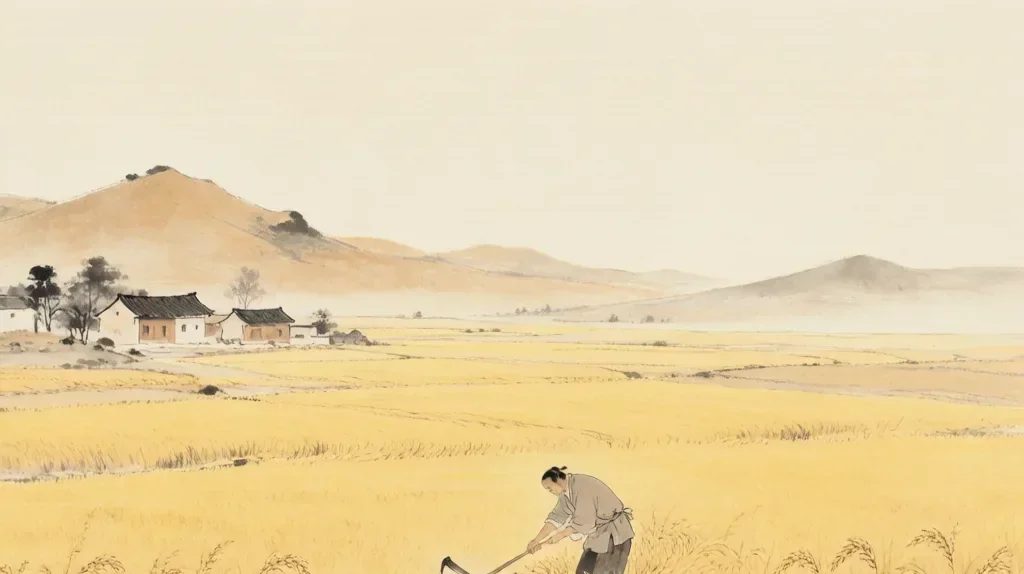
The Soil Sacrifice: Giving Thanks for the Harvest
In the golden autumn fields, when the rice had been cut and the granaries were full, the entire village gathered at the edge of the fields — the oldest farmers carrying bundles of the first sheaves, the children carrying gourds of new wine, and the women carrying baskets of freshly steamed cakes. The Harvest Sacrifice (祭谷, jì gǔ) was the agricultural community's greatest annual ritual, a ceremony of thanks to the gods and spirits who had brought the crops to maturity. In a civilization whose foundations were built on rice and millet, the harvest sacrifice was not optional piety but existential necessity — a communication with the powers of the earth that ensured the cycle of planting and reaping would continue for another year.
The Home Shrine: Daily Communion with Ancestors
In the main hall of a traditional Chinese home, against the wall that faced the door, stood a wooden cabinet or table draped in red silk — the home shrine. Here, in a space no larger than a cupboard, the entire spiritual universe of the family was concentrated: the tablets of the ancestors, the image of the household gods, the incense burner, and the offerings that were changed with the seasons. The Home Shrine (家神龛, jiā shén kān) was the ritual center of domestic life, a place where the family gathered daily to acknowledge the powers that protected them, the ancestors who guided them, and the traditions that gave their lives meaning. In a culture without a weekly congregational worship, the home shrine was the primary religious space for most Chinese people.
House Blessing: Moving into Good Fortune
Before a family moved into a newly built house, before a single piece of furniture was placed, before the first meal was cooked in the new kitchen — a ceremony was held to purify the space and invite in the protective spirits. The House Blessing (乔迁祭, qiáo qiān jì) was the ritual bridge between a building and a home, a ceremony that transformed mere bricks and timber into a dwelling fit for human habitation. For Chinese families, moving into a new house was not simply a change of address — it was a transition that required the permission of the gods, the blessing of the ancestors, and the careful management of the spiritual forces that inhabited every space.
The Imperial Sacrifice: The Emperor Prays at the Temple of Heaven
At the winter solstice, before the sun had risen over Beijing, the Emperor of China emerged from the Forbidden City in a procession of unparalleled splendor — thousands of officials, musicians, and soldiers stretching for miles. He was on his way to the Temple of Heaven to perform the single most important ritual in the Chinese empire: the Grand Sacrifice to Heaven (祭天, jì tiān). Only the emperor, the Son of Heaven, could perform this rite, and only on this day. Through the Imperial Sacrifice, the emperor renewed the mandate that authorized his rule, balanced the cosmos, and ensured the prosperity of the entire realm. It was the highest ritual in the land — and without it, the empire itself was unthinkable.
The Kitchen God: A Yearly Report to Heaven
High on the wall above the kitchen stove, in a small niche or on a faded paper poster, the Kitchen God watched. He watched day and night, through every argument and every kindness, every wasteful spill and every generous meal. And once a year, on the 23rd day of the 12th lunar month, he ascended to Heaven to report everything he had seen to the Jade Emperor. The Kitchen God Rite (祭灶, jì zào) was the most intimate and domestically focused of all Chinese religious observances — a household ritual that transformed the hearth into a cosmic communication channel, linking every family directly to the highest authority in heaven.
The Longevity Rite: Honoring Age
When a parent reached their sixtieth birthday — the completion of a full 60-year cycle of the Chinese zodiac — the family prepared a celebration that was part banquet, part thanksgiving, and part preparation for a good death. The Longevity Rite (寿礼, shòu lǐ) was the most joyful of the lifecycle ceremonies because it celebrated an achievement that everyone hoped to attain but many did not: a long and healthy life. In a society that revered age more than any other demographic distinction, the longevity rite was the supreme affirmation of a life well-lived, a ritual that honored the individual while reinforcing the family's continuity across generations.
Mourning Garments: Weaving Grief into Cloth
When a parent died, a son dressed in unhemmed sackcloth — rough, white, and deliberately uncomfortable — with a rope belt, a hemp headdress, and straw sandals. He would wear these clothes for the next three years, a walking billboard of grief visible to everyone in the village. Mourning Clothes (丧服, sāng fú) in Chinese tradition were not merely a matter of personal sorrow expressed through dress. They were a comprehensive system of social communication, a graded code that announced to the world exactly who the deceased was, who the mourner was, and how close — or distant — their relationship had been. In a culture that valued hierarchy, propriety, and visible social order, the garments of grief were the most eloquent garments a person would ever wear.
New Year Worship: Bowing to Elders and Heaven
As the old year waned and the new year approached, the entire Chinese universe prepared for renewal. In homes across the land, families cleaned their houses, settled their debts, reconciled their quarrels, and decorated their doors with red couplets. At the center of these preparations was New Year Worship (拜年, bài nián) — a complex of rituals that marked the transition from one cycle to the next, realigning the family with the cosmic order and renewing the relationships that sustained social life. More than just a celebration, the Chinese New Year was — and remains — the most complete ritual event in the Chinese calendar, a concentrated period of worship, feasting, gift-giving, and community that reaffirms the family's place in the universe.
The Qingming Rite: The Family Reunion of the Dead
In early April, when the winter chill has finally broken and the first green shoots appear on the hillsides, the roads of China fill with travelers. They carry incense, spirit money, and bundles of food. They are going to the graves of their ancestors. The Qingming Festival (清明节, Qīng Míng Jié) — the 'Pure Brightness Festival' — is the most important day of the year for ancestor worship, a national day of remembrance that combines solemn ritual with the joyful celebration of spring. It is a day when the boundary between the living and the dead becomes thin, and families gather to tend graves, make offerings, and remember those who came before.
Confucius Worship: The Scholar's Highest Rite
For a thousand years, the fate of a Chinese man was decided in a cramped examination cell no larger than a coffin, where he sat for three days and two nights composing essays on the Confucian classics. Before entering that cell, however, he would have passed through a gauntlet of rituals designed to align his mind, his body, and his fortune with the immense task before him. The Scholar Examination Rites (科举祭, kē jǔ jì) were the ritual infrastructure of the imperial examination system — a complex of ceremonies that candidates performed before, during, and after the exams to invoke divine favor, demonstrate moral seriousness, and steel themselves for the most consequential intellectual trial of their lives.
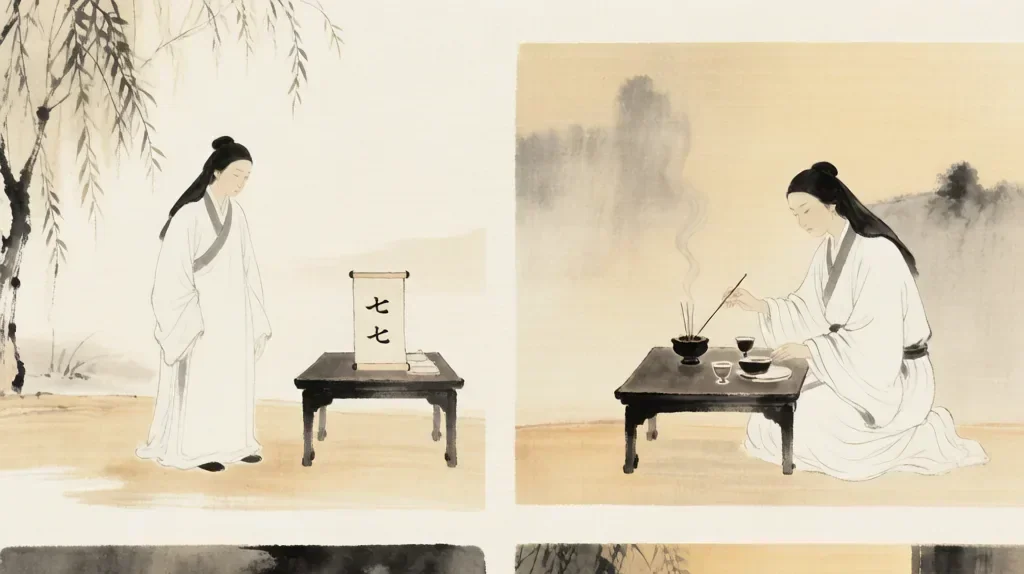
The Seven Sevens: Forty-Nine Days of Mourning
Every seven days, from the moment of death until the forty-ninth day, a candle was lit, incense was burned, and the family gathered before the spirit tablet to offer food, wine, and prayers. The Seven Sevens (七七, qī qī) ritual cycle is one of the most distinctive and psychologically profound elements of Chinese death practice, a seven-week liminal period during which the soul of the deceased navigates the perils of the underworld, faces judgment, and gradually transforms from a frightened ghost into a settled ancestor. For the living, the seven weeks of ritual service were an intensive course in grief, a structured schedule of ceremonies that gave shape and meaning to the chaos of bereavement.
Shop Opening: The Rite of Prosperity
The red silk was cut, the firecrackers exploded, and the lion dancers reared up to snatch the heads of lettuce suspended from the shop's awning. The shopkeeper, dressed in his finest clothes, stood at the door with an incense burner, smiling as the neighborhood gathered to celebrate the new business. The Shop Opening Rite (开张祭, kāi zhāng jì) was the ceremonial launch of a commercial enterprise, a ritual that blended practical business concerns with the spiritual protection necessary for success. In Chinese culture, a business was not merely a commercial entity but a living enterprise with its own fate, its own guardian spirits, and its own obligations to the community. The opening rite ensured that the business began its life under the most favorable possible stars.
Tea as a Wedding Rite: Serving Respect
The young couple knelt before the groom's parents, each holding a small covered cup of fragrant tea. With both hands — a gesture of the deepest respect — they offered the cups to their new father and mother, who accepted, sipped, and returned the cups with red envelopes tucked beneath the saucers. The Tea Wedding Rite (敬茶礼, jìng chá lǐ) is one of the most enduring and beloved elements of the Chinese wedding tradition, a moment of quiet intimacy within the day's larger pageantry. Unlike the cosmic drama of the Three Bows, the tea offering is personal, familial, and warm — a ritual that binds the bride not only to her husband but to his entire lineage.
The Teacher Worship: Becoming a Disciple
The young student knelt on a cushion before the master, a cup of tea trembling in both hands. 'Master, I have come seeking the Way.' The master accepted the tea, sipped it, and returned the cup. The student bowed — head to the ground — three times. With that bow, a relationship was formed that was closer than that between father and son in many ways: the teacher-student bond. Teacher Worship (拜师, bài shī) was one of the most sacred relationships in traditional Chinese culture, a ritualized bond that connected the seeker of knowledge to the keeper of wisdom. In a civilization that revered education above all other paths to success, the act of becoming a disciple was a rite of passage second only to birth and marriage in importance.
The Three Bows: The Heart of the Wedding Ceremony
In a hall draped in red, before an altar laden with incense and offerings, the bride and groom stood side by side for the first time in their lives. At the command of the master of ceremonies, they pressed their hands together and knelt in unison — once to heaven and earth, twice to the ancestors and the groom's parents, and finally to each other. With these three bows, the marriage was sealed in the presence of gods, ghosts, and the assembled community. The Three Worship Marriage (三拜, sān bài) is the ritual heart of the Chinese wedding, the moment when a social contract becomes a cosmic bond, witnessed by the visible and invisible worlds.
Mountain Worship: The Clan at the Ancestral Tomb
Step by step, the path to the ancestors is marked in the landscape of China. It leads through rice paddies, up forested slopes, and across stone bridges built by generations long since buried. At the end of the path lies the tomb — a horseshoe-shaped mound of earth, its stone face inscribed with the names of the dead. The Tomb Sweeping Rite (拜墓, bài mù) is the full ceremonial protocol for visiting and honoring the graves of ancestors, a practice that combines the intimacy of family remembrance with the public performance of lineage continuity. While grave sweeping is often associated specifically with the Qingming Festival, the tomb-sweeping rite is a broader category of ritual that applies to any formal visit to an ancestral grave, whether during festivals, death anniversaries, or special occasions.
The Water Lantern: Guiding Lost Souls
As the sun set and darkness fell over the river, thousands of tiny flames flickered to life on the water's surface — paper lanterns shaped like lotuses, each carrying a prayer, a name, or a silent wish for peace. The Water Lantern Rite (放水灯, fàng shuǐ dēng) is one of the most beautiful and poignant ceremonies in Chinese tradition — a ritual of release, remembrance, and hope. The lanterns float downstream, carrying messages to the dead, guiding wandering souls, and illuminating the boundary between this world and the next. For a few hours on a summer night, the river becomes a moving carpet of light, and the living and the dead share the same luminous space.
The Wedding Sedan: Carrying the Bride to Destiny
At dusk, as lanterns were lit along the narrow lanes of a Jiangsu town, a red sedan chair emerged from the bride's family compound, carried by eight bearers in matching tunics. Inside, hidden behind embroidered curtains and a red silk veil, sat the bride — leaving her childhood home forever, traveling toward a future she had been prepared for but had never seen. The Wedding Sedan (花轿, huā jiào) was the most visually spectacular element of the traditional Chinese wedding, a mobile ritual space that transformed a girl into a wife during the journey between two families. The sedan was not merely transportation; it was the vessel of transformation, and its procession was a public drama of separation, transition, and incorporation.
The Wedding Banquet: Feasting the Union
The courtyard of a Sichuan village erupted with the clash of woks, the sizzle of oil, and the laughter of two hundred guests seated at round tables draped in red. For three days, the cooking had not stopped; for three days, the uncles had been slaughtering pigs, the aunties had been folding dumplings, and the neighbors had been setting up tables that stretched from the family compound into the street. The Wedding Banquet (婚宴, hūn yàn) was not merely a meal — it was the culminating ritual of the Chinese wedding, a public feast that validated the marriage through the universal language of shared food, drink, and celebration. In China, a wedding without a banquet was like a play without a final act: incomplete, unconvincing, and ultimately unreal.
Winter Solstice: The Turning Point of Light
On the longest night of the year, when the cold was deepest and the yang energy of the sun had reached its absolute minimum, Chinese families gathered not in fear but in hope. The Winter Solstice (冬至, dōng zhì) was the moment when the cosmic tide turned — when the darkness stopped deepening and the light began its slow return. The Winter Solstice Rite was the celebration of this cosmic turning point, a festival of family unity, ancestral remembrance, and the reassurance that spring would come again. For Chinese civilization, the winter solstice was second only to the Lunar New Year in importance — a day when the family, the community, and the cosmos itself paused to mark the promise of renewal.