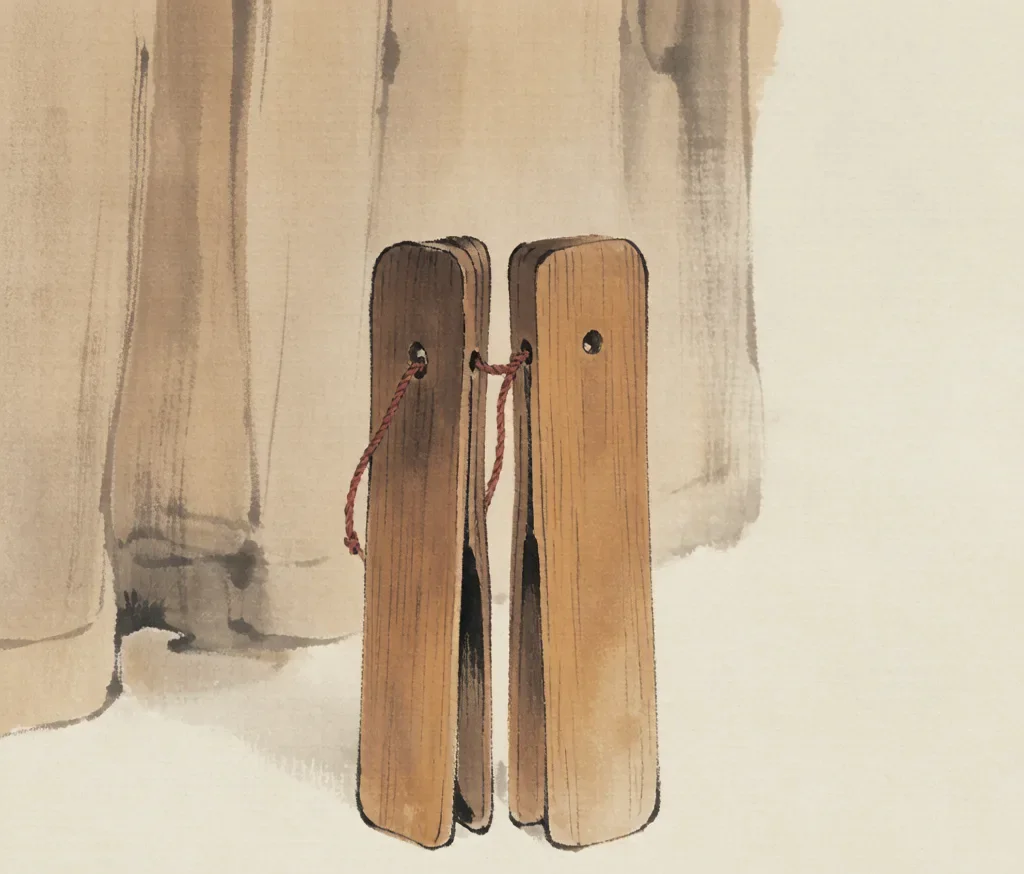
The banban (梆子) is a clapper made of two hardwood sticks, most often cut from dense jujube or date-wood, that are struck together to mark rhythm in Chinese traditional music and opera. Far more than a simple noisemaker, it is the defining rhythmic backbone of the northern Chinese "clapper opera" (bangzi qiang) family, whose name is itself derived from the instrument's sharp, penetrating "bang" accent. Played by the lead percussionist, the banban controls tempo, signals entrances, and shapes the dramatic energy of an entire performance. Its dry, woody knock has echoed through village stages, teahouse theaters, and temple fairs for centuries, and it remains one of the most recognizable percussion colors in Chinese musical theater.
Construction and Materials
A traditional banban consists of a pair of rectangular or slightly tapered hardwood blocks, each roughly the length of a hand and hollowed on the underside to sharpen the resonance. The densest, heaviest woods—especially old jujube—are prized because they produce a bright, focused crack rather than a dull thud. Some regional versions use a single suspended block struck with a smaller stick, but the classic two-piece clapper remains the norm.
The surface is usually left unvarnished or lightly oiled so the player can feel the grain, and the two pieces are tuned to match each other so that repeated strikes sound uniform. Because the instrument is small and nearly indestructible, it travels easily with touring troupes and is cheap enough to be replaced by any village carpenter.
Today craftsmen also turn banban from rosewood, boxwood, or lignum vitae, and mass-produced versions appear in school percussion kits. Even so, opera musicians insist that well-seasoned jujube wood gives the authentic "zing" that cuts through the clang of gongs and cymbals on a crowded stage.
Role in Clapper Opera (Bangzi Qiang)
The banban gives its name to bangzi qiang, a broad family of northern operas built around a bright, metered vocal style accompanied by this clapper. Major members include Shaanxi's Qinqiang, Hebei bangzi, Shanxi's Jinju, Henan's Yuju, and the courtly-pitched styles of the northeast. In all of them the clapper sets the "board" beat against which the melodic instruments elaborate.
Within a bangzi ensemble the banban player is effectively the conductor. By varying the density and accent of strokes—single taps, rapid rolls, or accented downbeats—the percussionist pushes singers through fast narrative passages and slows them for lament. The instrument's unyielding regularity is what gives clapper opera its driving, almost percussive emotional force.
Because the vocal line itself is organized in measured "ban" and "yan" beats, the clapper is not decoration but structural grammar: a singer who loses the banban has lost the music. Generations of performers have drilled with the clapper from childhood for exactly this reason.
Playing Technique
The performer holds one block fixed and strikes it with the other, or holds both and clicks them together in the palm. The basic stroke is a crisp tap on the strong beat, while weaker beats may be implied by the melodic instruments. For excitement, the player executes a "rolling ban" (gun ban) by rapidly alternating the two pieces to create a rattling tremolo.
Dynamic control is subtle: the same pair of sticks can whisper a soft tick to cue a quiet entrance or crack like a firecracker to punctuate a climactic gesture. Skilled players also use the rim and the hollowed back of the block to obtain slightly different timbres, enlarging the instrument's modest vocabulary.
In ensemble context the banban often locks with the small drum (danpi gu or bangu) and the clappers (paiban), together forming the percussion "command desk" that the rest of the band follows by ear rather than by score.
Historical Background
Wooden clappers of one form or another appear in Chinese sources for more than a thousand years, used in Buddhist chant, folk song, and popular entertainment long before they anchored a named opera style. The specific banban of clapper opera crystallized in the Ming and Qing dynasties as regional theaters professionalized and needed a reliable metronome that needed no tuning.
By the eighteenth and nineteenth centuries, as bangzi troupes fanned out along trade routes and river systems, the banban traveled with them, mutating slightly in size and wood from region to region. Its portability helped clapper opera become one of the most widespread theatrical languages in north China.
During the twentieth century, recording technology and state-supported regional opera troupes standardized many local practices, but the banban itself changed little—a testament to how well-suited the simple object is to its job.
Regional Variations
Hebei bangzi uses a relatively large, thick clapper for a weighty pulse suited to heroic tales, while Qinqiang pairs the banban with a high, stretched vocal line that makes the wood's crack feel even more incisive. Southern-adjacent styles sometimes soften the block or pad it lightly to blend with gentler ensembles.
In some Shaanxi and Shanxi troupes a longer pair of clappers is favored so the knock carries outdoors across a market square. Wandering storytellers (the ancestors of many drum-singing genres) also adopted miniaturized banban to keep time while accompanying themselves on a string or percussion instrument.
These local differences are mostly matters of size, wood, and striking habit rather than of basic design, which is why a single term covers the whole family across hundreds of miles.
Relationship to Other Percussion
The banban sits within a large Chinese percussion vocabulary that includes the bangu (single-headed opera drum), the paiban clappers, the daluo and xiaoluo gongs, and the bo cymbals. Each colors a different band of the rhythmic spectrum; the banban's role is the dry, mid-pitched "tick" that defines the beat.
In wind-and-percussion ensembles (chuida) and temple music the clapper may be joined by or substituted with other wood idiophones, but on the opera stage the banban's authority is unmatched. It is the instrument a musician reaches for when everyone else must know exactly where "one" is.
This centrality explains why the word bangzi could expand from an object into the name of an entire musical-theatrical genus, something few percussion instruments can claim.
Social and Cultural Role
Beyond the stage, the banban has long been a sound of communal life: it keeps time at festival processions, accompanies folk dances, and punctuates the rhythmic call-and-response of work songs in some regions. Its acoustic simplicity means anyone with two sticks of wood can join in.
For audiences, the opening crack of the banban is a signal that the show has begun, a sonic curtain-raiser as potent as any gong. In rural towns it still draws villagers toward the makeshift stage on a fair night.
The instrument also carries a trace of moral didacticism: many traditional operas performed to its beat dramatized loyalty, filial piety, and justice, so the clapper's steady pulse came to be associated with order and right conduct in performance.
Modern Legacy
Today the banban survives vigorously in regional opera troupes, conservatory percussion programs, and the occasional cross-genre experiment where its crack is sampled into pop or film scores. Chinese music departments teach it as part of the standard percussion curriculum alongside the drum and gongs.
It also features in intangible cultural heritage documentation, as provincial governments record elder masters demonstrating the rolling and accenting techniques before they are lost. Folk festival troupes continue to carry it outdoors every spring.
Although electronic metronomes now exist, no click track reproduces the banban's woody authority or its cultural charge, and singers trained on the live clapper still prefer its human, slightly variable pulse.
❓ Frequently Asked Questions
What exactly is a banban?
It is a clapper made of two hardwood sticks, traditionally jujube, struck together to mark rhythm in Chinese opera and folk music.
Why is it associated with "clapper opera"?
The northern bangzi qiang family of operas is named after and built around the banban's steady, accented beat.
Who controls the banban in a performance?
The lead percussionist, who uses it to set tempo, cue singers, and shape the dramatic pulse of the show.
What wood is best for a banban?
Dense, seasoned jujube wood is traditionally preferred for its bright, focused crack over softer timbers.
Is the banban still used today?
Yes, in regional opera troupes, conservatories, festivals, and even sampled into modern film and pop scores.
How is it different from a gong or drum?
It produces a dry, mid-pitched wooden tick that defines the beat, while gongs and drums add resonance and color.