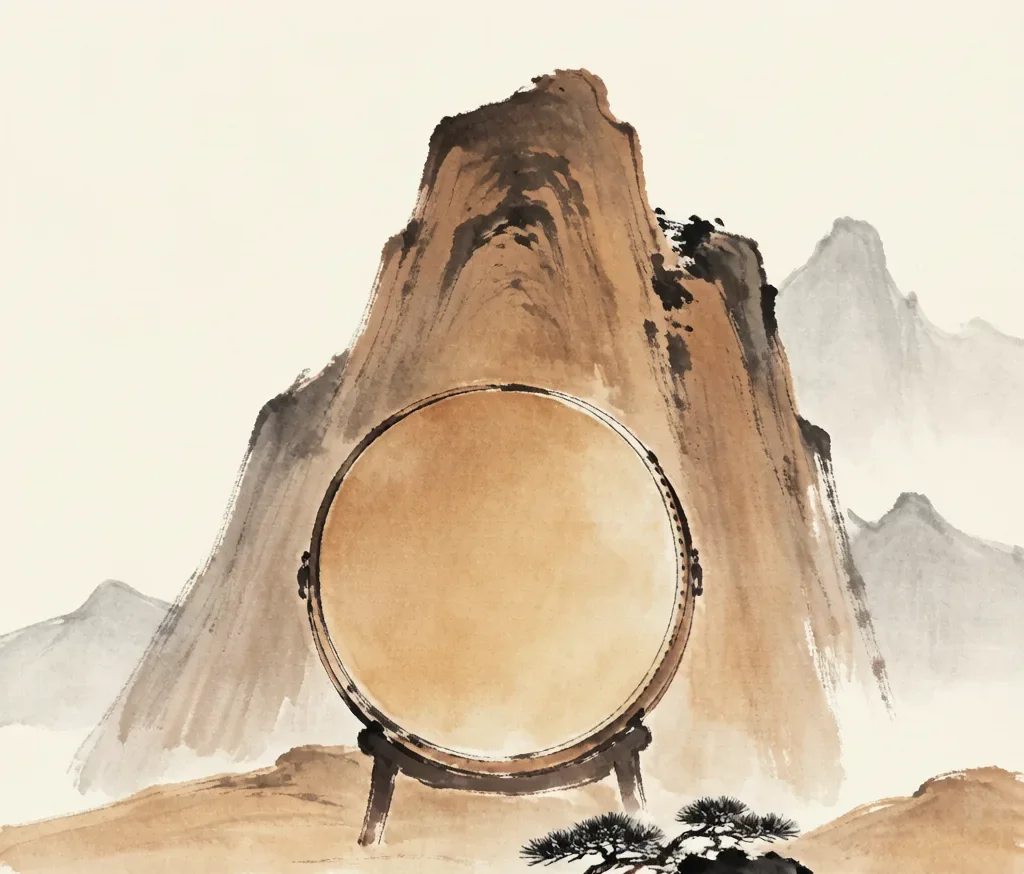
Shífāngǔ (十番鼓), the "ten-drum" music, is a southern percussion-and-wind suite of the Jiangnan region, especially Nanjing and Suzhou, that layers drums, gongs, and winds in intricate, ever-shifting patterns. Born of Buddhist ritual and folk religion, it is at once solemn and exhilarating — a music of processions, temple festivals, and the disciplined joy of amateur ensembles. Its alternating drum solos and gong-and-wind passages are a master class in rhythmic architecture, and its survival into the present is a quiet triumph of community music-making.
Origins in Ming Buddhism
Shifangu took shape during the Ming dynasty, growing out of earlier Buddhist and folk musical practices in the Jiangsu region. It was closely bound to the Buddhist monasteries of the lower Yangtze, particularly the famed Hanshan Temple in Suzhou, whose drum tradition has continued for more than four hundred years. Monks used the music in daily and festival ritual, and lay religious associations adopted it for temple fairs and street processions. In this doubled life — sacred and popular — shifangu found both its repertoire and its audience, and the discipline of the monastery gave its rhythms their formal precision.
The Meaning of "Ten"
The name "shi fan" (十番) suggests "ten alternations" or "ten variations." In practice a full performance is organized as a sequence of sections in which drum-led passages (gu) and gong-and-wind passages (luo) trade places, building and releasing tension like the movements of a suite. Importantly, "ten drums" does not mean ten physical drums but rather a set of ten characteristic rhythmic patterns; the same small battery of instruments realizes all of them. This economy — many patterns from few instruments — is part of what makes shifangu musically ingenious and technically demanding.
The Structure of a Performance
A shifangu performance typically unfolds in ten sections: an opening percussion flourish, a series of alternating wind-and-percussion movements, and a closing percussion piece. Each section has a prescribed rhythmic pattern and dynamic shape, and the whole is highly formalized. The percussion passages feature cross-rhythms played on matched pairs of gongs and drums, while the wind passages introduce melody on the suona and sheng. The alternation is not random; it follows a compositional logic that the ensemble's leader directs by gesture and by example, so that the suite feels both strict and alive.
The Instruments
The core battery of shifangu is percussion: several sizes of drum, a range of gongs (including the contrasting da luo and xiao luo), and cymbals (bo or cha). To these are added wind instruments — most characteristically the suona (double-reed horn) and the sheng (free-reed mouth organ) — for the melodic "luo" sections. Players arrange themselves in a fixed order and follow a designated leader who cues the transitions between drum and wind. Every instrument is hand-made to traditional specification, and the subtle differences in gong size and drum tension are what give a particular club its recognizable sound.
Performance Contexts
Shifangu belongs to the outdoors and the occasion. It sounds at Buddhist temple festivals — notably the Ullambana (Ghost) Festival and the Buddha's Birthday — and at folk religious observances in the streets. It is also played at funerals, where its measured rhythms are believed to guide the soul of the deceased and comfort the living. Because it is loud and processional, shifangu moves: through temple courtyards, along lanes, and around altar platforms. The music is thus inseparable from bodies in motion and from the calendar of the community's sacred year.
Regional Traditions
Different localities developed their own shifangu accents. Suzhou shifangu is admired for refinement and elegance, suited to its monastery origins. Yangzhou shifangu is more energetic, with complex cross-rhythms that show off the players' coordination. The broader Jiangsu tradition has been documented and protected as intangible cultural heritage, with temple music societies reestablished and young musicians apprenticed to older masters. Today shifangu also appears at cultural festivals and tourism events, where its spectacle of many gongs at once draws crowds who may never enter a temple.
Shifangu and Shifan Luogu
Readers sometimes meet the related term "shifan luogu" (十番锣鼓). The two names describe essentially the same family of southern percussion-and-wind suites, with the emphasis shifting between the drum (gu) and the gong (luo) depending on local usage and repertoire. Both share the principle of alternating drum and gong-wind leads, the ten-section logic, and the Buddhist-folk roots. Treating them as one tradition helps explain why a "drum" piece and a "gong" piece can belong to the very same performance and feel like two faces of one music.
A Living Amateur Art
What keeps shifangu alive is its amateur base. Unlike stage concert music, it is learned in clubs and temple societies where seniors teach juniors by rote and by ear, and where performance is its own reward. A single ceremony can run for up to three hours, demanding both stamina and memory from the players. In an era of recorded sound and short attention, this patient, collective, embodied art is a kind of resistance — a way of holding time together with rhythm. The Hanshan Temple and its sister ensembles are less museums than workshops, and the "ten drums" still count their patterns out loud on festival nights.
❓ Frequently Asked Questions
What does "ten variations" mean?
"Shifan" suggests ten alternating sections — drum solos (gu) and gong-and-wind passages (luo) traded in sequence, built from a set of ten rhythmic patterns.
Where is shifangu performed?
In the Jiangnan region's amateur music clubs and temple ensembles, as both ritual and concert repertoire, especially at Buddhist festivals.
Is it related to shifan luogu?
Yes — the two names describe the same family of southern percussion-wind suites with shifting drum and gong leads.
What instruments play shifangu?
A percussion battery of drums, gongs, and cymbals, plus wind instruments — typically the suona and the sheng — for the melodic sections.
Why was it used at funerals?
Its measured, processional rhythms were believed to guide the soul of the deceased and to comfort the living during rites of passage.
How is shifangu preserved today?
Through temple and amateur music societies, apprenticeship to elder players, and official intangible-heritage protection in Jiangsu province.