More About This Solar Term
This solar term has been observed in Chinese culture for thousands of years. Ancient Chinese farmers relied on these seasonal markers to plan their agricultural activities with remarkable precision. The 24 solar terms, originating in the Yellow River basin during the Zhou Dynasty (1046–256 BCE), represent one of humanity's earliest systematic approaches to understanding seasonal change.
In 2016, UNESCO recognized the Twenty-Four Solar Terms as an Intangible Cultural Heritage of Humanity, acknowledging their enduring importance in Chinese cultural identity and agricultural wisdom. Each solar term reflects a specific astronomical event or natural phenomenon — the sun's position at 15° intervals along the ecliptic — dividing the year into 24 equal segments of approximately 15 days each.
Traditional Chinese medicine closely aligns health practices with the solar terms. During each term, specific foods, exercises, and lifestyle adjustments are recommended to maintain harmony with nature. This philosophy, known as "yang sheng" (养生), or the art of nurturing life, remains widely practiced across China today. Seasonal ingredients are chosen not just for flavor but for their perceived medicinal properties — warming foods in winter, cooling foods in summer.
In literature and art, the solar terms have inspired countless poems, paintings, and musical compositions throughout Chinese history. Tang Dynasty poets like Du Fu and Li Bai frequently wove seasonal imagery into their verses, using the specific characteristics of each solar term to evoke mood and meaning. The famous Song Dynasty scroll painting "Along the River During the Qingming Festival" (清明上河图) takes its very name from one of the 24 solar terms — Qingming — capturing the vibrant life of a Chinese city during this spring moment.
Today, the solar terms continue to guide daily life in China. Farmers still consult the traditional calendar for planting and harvesting. Families observe customs passed down through generations — eating spring pancakes at Lichun (Start of Spring), honoring ancestors at Qingming (Clear and Bright), and gathering for family feasts at Dongzhi (Winter Solstice). Schools teach children about the solar terms, ensuring this ancient knowledge system remains alive for future generations. Weather forecasts on Chinese television often reference the current solar term, connecting modern meteorology with traditional wisdom.
Cold Dew (寒露, Hánlù) arrives as the seventeenth solar term, marking the moment when autumn's gentle coolness sharpens into genuine cold. Falling around October 8th or 9th, Hanlu is the first solar term to carry the character 寒 (hán) — "cold" — in its name, a linguistic signal that the season has crossed a threshold. The morning dew that once felt merely cool against bare feet now carries a distinct chill, and across northern China, the first frost paints the ground white before dawn. For the ancient Chinese, this was a moment of heightened awareness — the natural world was sending an unmistakable message that winter was approaching, and all of life must prepare accordingly.
The name Hanlu captures the physical experience of the season with poetic precision: 寒 (hán) means cold, and 露 (lù) means dew. Together they describe the cold dew that forms on grass, leaves, and spider webs in the early morning hours, glistening like scattered diamonds in the first light of dawn. When the sun reaches 195 degrees of celestial longitude, Cold Dew officially begins, and the transformation is palpable. The air grows crisp and clear, the sky deepens to an intense autumn blue, and the world seems to sharpen into greater focus — as if the haze of summer has finally been washed clean, revealing the landscape in all its stark, beautiful detail.
The Deepening of Autumn: Climate and Phenology
The climatic character of Cold Dew represents a decisive shift from the lingering warmth of early autumn to the genuine cold of the season's second half. In northern China, the first frost warnings become a regular feature of daily life, and farmers rush to complete the autumn harvest before the ground freezes. The temperature difference between day and night widens dramatically — a phenomenon Chinese meteorologists describe as "large diurnal temperature range" — meaning that while afternoons may still feel pleasantly warm, mornings and evenings demand heavy clothing. In the northeast, the first snow flurries are not uncommon, while in the Yangtze River basin, the autumn rains that have persisted since late summer finally begin to taper off, replaced by dry, bright days.
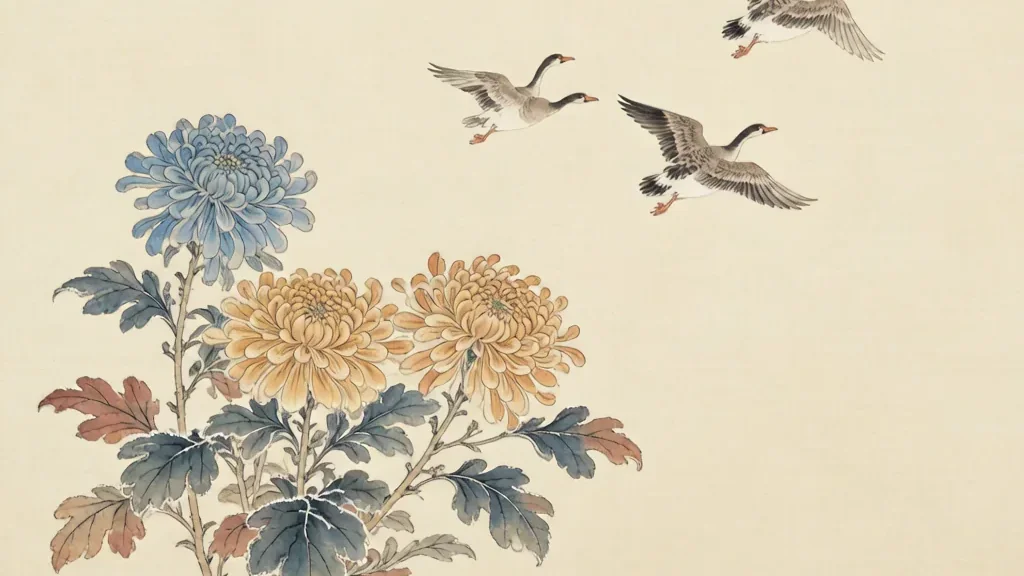
Ancient Chinese observers divided Cold Dew into three pentads, each marked by distinctive natural phenomena. During the first pentad, wild geese were said to arrive as guests — their great V-formations crossing the sky as they completed their southward migration, seeking warmer lands for the winter. In the second pentad, sparrows were observed to disappear from the fields while clams appeared along the seashore; the ancient Chinese, with their characteristic attention to pattern, believed the sparrows transformed into clams, noting that the stripes on clam shells resembled the markings on sparrow feathers. By the third pentad, chrysanthemums bloomed in brilliant yellow, their hardy flowers defying the cold that had withered all other blossoms. These phenological signs, recorded in texts like "The Book of Rites," represent a civilization's patient observation of the natural world across centuries.
The significance of Cold Dew for agriculture cannot be overstated. The saying "寒露时节人人忙,种麦摘花打豆场" (hánlù shíjié rénrén máng, zhòng mài zhāi huā dǎ dòu chǎng) — "during Cold Dew, everyone is busy: planting wheat, picking cotton, and threshing soybeans" — captures the intensity of this agricultural moment. Winter wheat must be planted before the ground freezes; cotton bolls must be harvested before frost destroys them; and soybeans must be threshed and stored. In the rice-growing south, the late rice crop enters its final ripening stage, and farmers carefully manage water levels in the paddies to protect the developing grain from the cold. The entire agricultural world operates at maximum intensity during Cold Dew, racing against the approaching winter.
Climbing Heights: The Double Ninth Tradition
Cold Dew frequently coincides with or falls near the Double Ninth Festival (重阳节, Chóngyáng Jié), celebrated on the ninth day of the ninth lunar month. This ancient festival, with roots stretching back to the Han Dynasty, centers on the custom of climbing to high places (登高, dēng gāo) — ascending mountains, hills, towers, or any elevated vantage point to take in the autumn scenery. The number nine, being the largest yang number in Chinese numerology, gives the festival its name (double nine, or 重阳) and its auspicious character, while the climbing custom represents rising above earthly concerns and drawing closer to the heavens.
The tradition of climbing heights during Cold Dew and the Double Ninth Festival carries multiple layers of meaning. On the most practical level, it is an opportunity to appreciate the spectacular autumn foliage — the hillsides ablaze with the red and gold of maple, gingko, and persimmon trees — before winter strips the branches bare. On a deeper level, climbing represents the human aspiration toward higher things: wisdom, virtue, and spiritual clarity. The crisp, clear air of Cold Dew is believed to sharpen the mind and cleanse the spirit, making this the ideal season for reflection and renewal of purpose. Many of China's most famous autumn poems were composed by scholars who had climbed to mountain pavilions during this season, their verses capturing the bittersweet beauty of a world preparing for winter.
In modern China, the climbing tradition remains vibrantly alive. Parks, scenic areas, and mountain trails fill with families, friends, and elderly citizens who maintain the custom as both a cultural practice and a health activity. The Double Ninth Festival has also been officially designated as China's Senior Citizens' Day, adding a contemporary dimension to the ancient tradition of honoring elders. Families bring their elderly parents and grandparents on autumn outings, combining the pleasure of nature appreciation with the Confucian virtue of filial piety. Picnics are spread on mountaintops, chrysanthemum wine is shared, and the generations come together in a ritual that links personal health, family bonds, and the eternal rhythms of the seasons.
Chrysanthemums and Chrysanthemum Wine
No flower is more intimately associated with Cold Dew and the Double Ninth Festival than the chrysanthemum (菊花, júhuā). Blooming defiantly as other flowers succumb to the autumn frost, the chrysanthemum has been celebrated in Chinese culture for over two thousand years as a symbol of noble character — the scholar who maintains integrity and principle even in adverse circumstances. The great poet Tao Yuanming of the Jin Dynasty, who abandoned official life to tend his chrysanthemum garden, immortalized the flower's association with reclusion, simplicity, and the quiet cultivation of virtue. His poems, still memorized by Chinese schoolchildren, established the chrysanthemum as the emblem of autumn and the spirit that endures.
Chrysanthemum appreciation (赏菊, shǎng jú) reaches its peak during Cold Dew. Gardens and parks across China stage chrysanthemum exhibitions, displaying hundreds of varieties in elaborate arrangements. The flowers range from tiny button-sized blooms to massive specimens the size of dinner plates, their colors spanning the full spectrum from pure white through every shade of yellow and gold to deep burgundy and purple. The art of chrysanthemum cultivation, refined over centuries by Chinese horticulturists, produces spectacular forms — cascading arrangements that spill like waterfalls, single-stem specimens trained into perfect spheres, and intricate bonsai chrysanthemums that mimic ancient trees in miniature. These exhibitions draw crowds of admirers who come not merely to see flowers but to participate in a cultural tradition that links them to poets, painters, and philosophers across the ages.
The drinking of chrysanthemum wine (菊花酒, júhuā jiǔ) during Cold Dew combines sensory pleasure with traditional medicine. The wine is made by steeping fresh chrysanthemum petals in rice wine or sorghum liquor, often with the addition of goji berries, dried longan, and rock sugar. The resulting beverage carries the flower's delicate fragrance and subtle bitterness, believed to clear heat from the liver, brighten the eyes, and dispel the internal "wind" that traditional medicine associates with autumn ailments. Drinking chrysanthemum wine during the Double Ninth Festival is thought to protect against illness throughout the coming winter, and the custom of toasting with this golden wine while admiring the autumn scenery represents one of Chinese culture's most elegant seasonal pleasures.
Seasonal Foods: Nourishing the Body for Winter
The cuisine of Cold Dew reflects the body's need for warmth, nourishment, and protection against the season's increasing cold. In northern China, the tradition of eating lamb (羊肉, yángròu) intensifies during this period, as lamb's warming nature — classified as "hot" (热性, rè xìng) in traditional food therapy — helps generate internal heat and strengthen the body's resistance to cold. Lamb hotpot becomes a beloved communal meal, with thinly sliced meat swished briefly in bubbling broth and dipped in sesame sauce. Lamb soup, simmered for hours with medicinal herbs like astragalus and angelica root, is consumed as a tonic against the coming winter.
Chestnuts (栗子, lìzi) emerge as the quintessential Cold Dew snack. Street vendors appear on city corners with their distinctive iron woks filled with dark sand and sugar, roasting chestnuts until their shells split to reveal the golden, sweet flesh within. The aroma of roasting chestnuts, drifting through the crisp autumn air, is one of the most evocative sensory experiences of the season. Chestnuts are prized in traditional medicine for their warming properties and their ability to strengthen the kidneys and nourish the digestive system. Hawthorn berries (山楂, shānzhā), another autumn specialty, appear candied on skewers as tanghulu or brewed into tea, their sour flavor stimulating the appetite and aiding digestion of the richer winter foods to come.
Warm porridges and soups dominate the Cold Dew kitchen. Millet porridge (小米粥, xiǎomǐ zhōu), simmered with red dates and goji berries, provides gentle, easily digestible nourishment that supports the spleen and stomach — organs particularly vulnerable to cold. Pear soup, prepared with snow pears, rock sugar, and sometimes fritillary bulb, moistens the lungs and throat against autumn dryness. The general principle of Cold Dew eating is captured in the saying "寒露不露脚,饮食多温补" (hánlù bù lù jiǎo, yǐnshí duō wēn bǔ) — "at Cold Dew, don't expose your feet, and eat more warming, nourishing foods." This holistic approach to seasonal eating represents the accumulated wisdom of generations who understood that health depends on living in harmony with nature's rhythms.
Health and Lifestyle in the Season of Cold
Traditional Chinese medicine identifies Cold Dew as a critical period for preventive health. The season's cold combines with autumn's inherent dryness to create a dual challenge: the cold can invade the body through exposed areas, while the dryness damages the lungs and respiratory tract. Practitioners emphasize three key protective measures during this period. First, the feet must be kept warm at all times — the saying "寒从脚下生" (hán cóng jiǎo xià shēng), "cold arises from beneath the feet," reflects the medical understanding that cold enters the body through the lower extremities and rises through the meridians. Warm socks, closed shoes, and foot soaks in hot water before bed are standard recommendations.
Second, the neck and upper back require protection, as these areas are believed to be the most vulnerable to invasion by pathogenic wind and cold. Scarves become essential accessories during Cold Dew, not merely for fashion but for the genuine protection they provide. Third, sleep patterns should adjust to the season's rhythm: going to bed earlier and rising earlier aligns the body with the contracting, inward-turning energy of autumn. Staying up late is considered particularly harmful during this period, as it depletes the yin energy that the body needs to conserve for winter. Afternoon naps, brief but restorative, help maintain energy levels as the days grow shorter.
The emotional dimension of Cold Dew health is equally important. Autumn is associated with the emotion of grief in Chinese medical philosophy, and the season's melancholy beauty — falling leaves, migrating birds, the year's visible decline — can stir feelings of sadness and loss. Practitioners recommend cultivating a calm, accepting state of mind, spending time outdoors in the autumn sunlight, and maintaining social connections as antidotes to seasonal melancholy. The climbing custom of the Double Ninth Festival serves this purpose beautifully, combining physical exercise, nature appreciation, and social gathering in a single health-promoting activity. In this way, the wisdom of Cold Dew encompasses body, mind, and spirit — a holistic approach to seasonal living that has guided Chinese health practices for millennia and continues to offer relevant guidance in the modern world.
Migration and the Three Pentads
Ancient Chinese observers divided Cold Dew into three pentads, each marked by a distinctive natural sign recorded in classical texts such as The Book of Rites. In the first pentad, wild geese arrive as guests, their great V-formations crossing the sky on the southward migration. In the second, sparrows were said to vanish from the fields while clams appeared along the shore, leading to the fanciful belief that sparrows transformed into clams because their shell markings resembled sparrow feathers. By the third pentad, chrysanthemums bloom in brilliant yellow, the lone flower defying the cold that has withered all others. These phenological notes show a civilization reading the season through patient, centuries-long observation of bird, shell, and blossom.
Cold Dew in Classical Poetry
Cold Dew and the deepening autumn it announces have inspired some of China's most beloved poetry. Du Fu and Li Bai, the twin giants of the Tang Dynasty, often wove the season's crisp air, migrating geese, and yellow chrysanthemums into verses about travel, friendship, and the passage of time. The clear, sharp light of the season was prized by poets as a mirror for a clear mind, and climbing a mountain pavilion at Cold Dew became a favored occasion for composing lines on mortality and resolve. These poems did more than describe weather; they taught readers to meet the approaching cold with composure, finding in the bare, bright landscape a model of dignity rather than loss.
❓ Frequently Asked Questions
📝 Chinese Vocabulary
- 寒露 (hán lù) — Cold Dew; the seventeenth solar term, the first with "cold" in its name
- 登高 (dēng gāo) — Climbing heights; the Double Ninth custom of ascending mountains
- 菊花 (jú huā) — Chrysanthemum; the flower of autumn, symbol of noble character
- 菊花酒 (jú huā jiǔ) — Chrysanthemum wine; a traditional autumn beverage
- 重阳节 (Chóngyáng Jié) — Double Ninth Festival; celebrated on the ninth day of the ninth lunar month
🎉 Fun Facts
- Cold Dew is the first solar term to include the character for "cold" (寒), making it a significant linguistic marker in the Chinese calendar.
- The Double Ninth Festival, often coinciding with Cold Dew, has been designated as China's official Senior Citizens' Day since 1989.
- Ancient Chinese believed that wearing dogwood (zhuyu) on Cold Dew and the Double Ninth Festival would repel evil spirits and prevent illness.
- The chrysanthemum was introduced to Japan from China during the Nara period and later became the imperial symbol of the Japanese emperor.
- Cold Dew is the time when the autumn fishing season reaches its peak along the coast, and the folk saying 'cold dew fish are fat' reflects that fish are at their richest before winter sets in.
- In traditional horticulture, Cold Dew is considered the best moment to plant chrysanthemum divisions, because the cooling soil helps the roots establish before winter without the stress of summer heat.