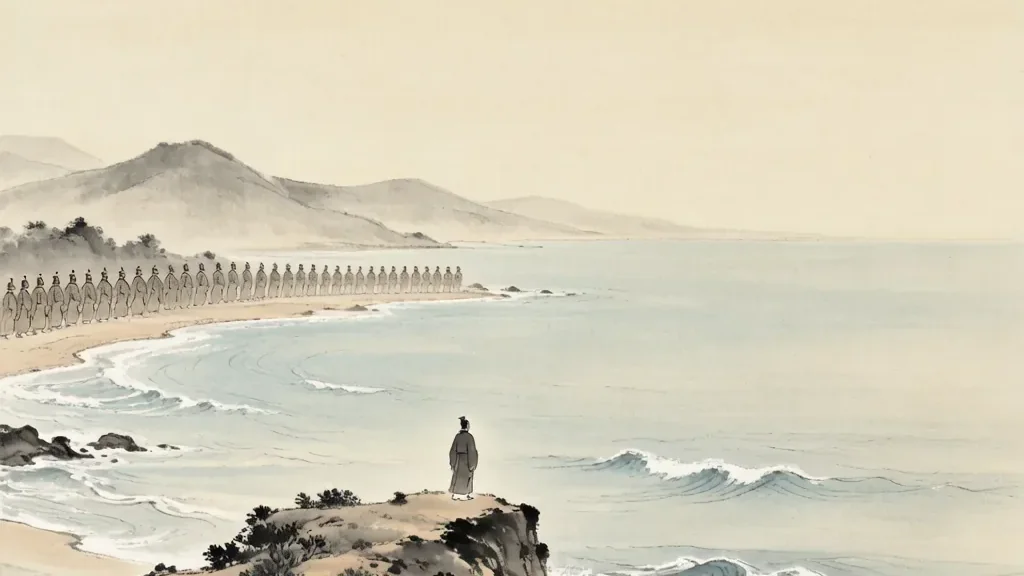
Qinhuangdao is a coastal city in northeastern Hebei province, named for the First Emperor of China, Qin Shi Huang, who is said to have visited this shore more than two thousand years ago in his lifelong quest for immortality. The city stands where the mountains of the northeast meet the Bohai Sea, and it is best known today as the place where the Great Wall of China runs down to the water at Shanhaiguan, the so-called First Pass Under Heaven, and where the wall's eastern end juts into the waves at the Old Dragon Head. Beyond its imperial legend, Qinhuangdao is a major seaport, a railway junction, and the gateway to the beach resort of Beidaihe, where modern Chinese leaders have long retreated in summer. In its compact coastline the city gathers together myth, military history, and the leisure of the modern state, making it a small but dense chapter in the story of China's northern frontier.
The First Emperor and the Search for Immortality
Qin Shi Huang, who unified China in 221 BCE and gave the country its name, was haunted by the fear of death and spent enormous effort seeking a potion or technique that would grant him eternal life. He dispatched emissaries to the eastern seas in search of the islands of the immortals, and he undertook tours of the empire that brought him to its eastern shores. The local tradition holds that he stopped at this point on the Bohai coast, and the city takes its name from that royal visit.
The emperor's obsession is well attested in the historical records, which describe his patronage of alchemists and his credulous reception of tales about magical mountains floating on the ocean. The sea to the east was, in the Han-era imagination, the home of the immortals, and the ruler of a unified world naturally looked there for the secret of endless reign.
Whether or not he physically stood on this exact beach, the association captures a real impulse of the Qin and Han courts: the projection of imperial ambition even beyond the edges of the mapped world, into the water where no army could march.
Xu Fu and the Voyage to the Eastern Seas
The most famous figure tied to the emperor's quest is Xu Fu, a court alchemist who is recorded as having led expeditions eastward in search of the immortal isles. According to the histories, Xu Fu reported that the islands were guarded by great fish and asked for skilled archers and ships; he then sailed away with a large party of youths and maidens and was never seen again. Later Korean and Japanese traditions claim he reached those lands and settled there.
The story of Xu Fu blends history and legend, but it reflects the genuine maritime outreach of the early Chinese court toward the eastern ocean. The coast around Qinhuangdao, with its harbors and its view toward the rising sun, was a plausible launching ground for such ventures and for the ritual observances that accompanied them.
In popular memory Xu Fu became a culture hero of migration and exploration, and his name is still invoked along the shores of the Bohai and beyond as a symbol of the Chinese reach toward the sea. The emperor's failure to find immortality only deepened the romance of the quest.
Shanhaiguan: The First Pass Under Heaven
The single most important monument near Qinhuangdao is Shanhaiguan, the great fortress where the Ming dynasty Great Wall meets the sea, known by the proud title the First Pass Under Heaven. Built in the fourteenth century as the eastern anchor of the wall, it guarded the narrow corridor between the mountains and the ocean through which armies from the northeast had always invaded the plains.
Shanhaiguan is more than a gate; it is a walled town with massive brick ramparts, watchtowers, and a central gate tower inscribed with its famous name. For centuries it was the linchpin of northern defense, the place where the cultivated heartland of China met the steppe and the forest, and where the wall could be held or broken.
The fall of Shanhaiguan in 1644, when the Ming general opened the pass to the Manchu, is one of the pivotal moments of Chinese history, allowing the conquest that founded the Qing dynasty. The pass therefore stands as both a marvel of fortification and a witness to the turning of dynasties.
The Old Dragon Head at the Sea
A short distance from the pass, the Great Wall does something found nowhere else: it extends into the ocean itself, ending at a stone platform called the Old Dragon Head, where the masonry appears to dip into the waves like the head of a dragon drinking. This striking terminus makes Qinhuangdao unique among the many places associated with the wall.
The seaward extension was built to deny enemy ships a landing at the wall's foot and to complete the symbolic enclosure of the realm. Standing at the Dragon Head, one sees the wall running west into the hills and east into the surf, a literal boundary between earth and water, between the defended and the foreign.
For visitors the Dragon Head is the photographic climax of the wall, a place where engineering, geography, and myth converge. The dragon, a creature of water in Chinese belief, meets the actual sea at exactly the spot the emperors feared most.
Beidaihe and the Summer Retreat
Just south of the old town lies Beidaihe, a seaside resort whose mild summer climate and broad beaches made it a favorite retreat from the late nineteenth century onward. Foreign residents, then Chinese officials, and eventually the top leadership of the communist state adopted Beidaihe as a place to work and rest away from the capital's heat.
Beidaihe acquired a semi-secret political importance, hosting informal meetings of the Party elite by the shore, where major decisions were sometimes prepared away from the formal venues of Beijing. Its villas, pine woods, and coastal paths became synonymous with power at leisure, a Chinese version of a coastal ruling-class sanctuary.
For ordinary tourists, however, Beidaihe is simply one of the most accessible beaches in the north, a place where city dwellers swim, stroll the pier, and watch the sunrise over the Bohai. The resort thus bridges the private world of the leadership and the public pleasure of the crowd.
The Port and the Modern City
Qinhuangdao is also a working port of national importance. Its deep, ice-free harbor on the Bohai makes it a major outlet for coal and goods from the northeast and the interior, and the city grew rapidly in the twentieth century as railways linked it to the industrial heartland. The port name often appears on shipping maps as a key node of northern China's trade.
The city's economy combines shipping, tourism, and light industry, and its universities and hospitals serve a sizable population. The contrast between the ancient pass and the modern container terminal captures the double identity of the place: a frontier of empire and a hinge of the contemporary economy.
Planning the modern city has meant balancing preservation of the wall and the beaches with the demands of industry and traffic, a tension visible in the coexistence of fortification and factory along the same coast.
The Geography of the Northern Frontier
The reason Qinhuangdao mattered to every dynasty is geographic. The coastline here bends, and the Yan Mountains fall toward the sea, leaving only a narrow coastal plain. Whoever controlled that plain controlled the only easy route between the northeast and the North China plain, the route armies used again and again.
This corridor explains why the wall was driven to the water here and why a mighty pass was built to seal it. The sea itself was no friend to defenders, since a fleet could land where the wall ended, so the Dragon Head answered that vulnerability with stone.
The same geography made the area a meeting point of peoples: farmers of the plain, herders of the steppe, fishers of the coast, and rulers from every direction. Qinhuangdao sits at the seam where China's agricultural core gives way to the wider northeast.
Legends of the Immortals and the Sea
The local culture of Qinhuangdao is steeped in the lore of the immortal isles. The eastern ocean was thought to hold Penglai and other magic mountains where the blessed lived free of death, and the emperor's search gave the region a permanent association with that hope. Temples and viewpoints along the coast still evoke the theme.
These legends are not mere fantasy; they shaped policy, sending fleets abroad and drawing the court's eye to the sea centuries before the great maritime voyages of the Ming. The coast of Qinhuangdao is thus a birthplace of Chinese maritime imagination, a place where the land first gazed outward and wondered.
In literature the search for immortality by the sea became a standard meditation on the limits of power, the emperor who ruled all under heaven yet could not rule his own mortality. The shore remembers that lesson in its very name.
Qinhuangdao in the Present Day
Today Qinhuangdao presents itself to visitors as a compact tourism circuit: the pass, the Dragon Head, the beaches, and the imperial legend, all within a short drive of one another. The city has invested in preservation and in amenities, and it draws both domestic travelers and history enthusiasts from abroad.
The challenge of the present is to keep the wall and the coast legible amid growth, and to tell the story without reducing it to slogan. The depth of the place lies in the layering of meanings: a emperor's dream, a wall's end, a pass's fall, a leader's rest, a port's labor.
For the traveler, Qinhuangdao offers the rare pleasure of standing where the Great Wall enters the sea and imagining the First Emperor gazing the same direction, toward islands that were never found, in a quest that built a city's name.
❓ Frequently Asked Questions
Why is the city called Qinhuangdao?
The name means the island or shore of Qin Huang, referring to the First Emperor Qin Shi Huang, who is said to have visited this coast while seeking immortality.
What is Shanhaiguan?
Shanhaiguan is the great Ming fortress where the Great Wall meets the sea, known as the First Pass Under Heaven and the eastern anchor of the wall's defense.
What is the Old Dragon Head?
It is the stone terminus where the Great Wall extends into the Bohai Sea, appearing to dip into the waves like a dragon drinking.
Who was Xu Fu?
Xu Fu was a court alchemist who led voyages eastward in search of the islands of the immortals for the First Emperor and never returned.
Why was this coast strategically vital?
A narrow corridor between mountains and sea here was the main route between the northeast and the North China plain, so controlling it meant controlling invasion routes.
What is Beidaihe?
Beidaihe is the beach resort south of the old town, long used as a summer retreat by Chinese leaders and now a popular public seaside destination.