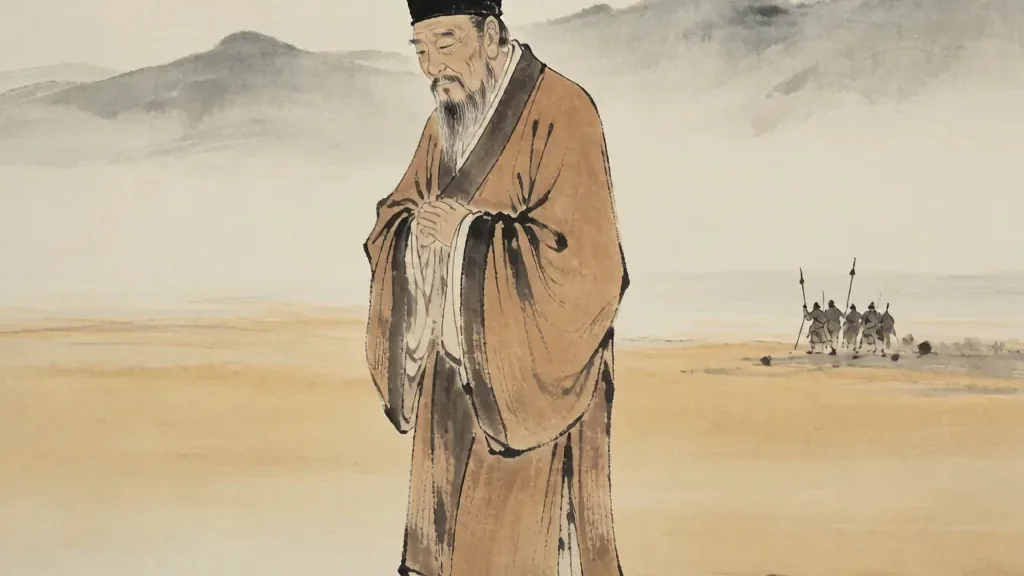
The An Lushan Rebellion (755–763 CE) was the deadliest upheaval of China's Tang dynasty and one of the most catastrophic wars in human history. Launched by the half-Sogdian, half-Turkic general An Lushan against the court of Emperor Xuanzong, the revolt tore the empire apart for nearly eight years, killed millions, and shattered the cosmopolitan golden age of Tang prosperity. Though the Tang eventually restored its throne, the dynasty never recovered its former wealth, confidence, or central control.
Origins of the Crisis
By the mid-eighth century the Tang state had grown complacent. The emperor Xuanzong, who had reigned since 712, surrendered much of his early vigor to pleasure and to the influence of his consort Yang Guifei and her adopted cousin Yang Guozhong. Frontier commands were entrusted to non-Chinese generals who commanded vast mixed armies of Tang regulars and steppe auxiliaries.
An Lushan, a charismatic and obese commander of border origin, held authority over three northern military districts and some 160,000 troops. Tension between An and the Yang clan at court provided the spark. When An feared he would be purged, he raised the banner of rebellion in the name of purging the corrupt Yang faction.
The Outbreak of War in 755
In December 755 An Lushan marched south from his base at Fanyang (near modern Beijing) toward the eastern capital Luoyang. Tang defenses collapsed with startling speed, and by early 756 Luoyang had fallen. An proclaimed himself emperor of a new "Yan" state.
The rebel advance on the western capital Chang'an forced Xuanzong to flee toward Sichuan. At Maweipo, midway on the road, the imperial guards mutinied and demanded the death of Yang Guozhong and Yang Guifei. The emperor consented, and the beloved consort was executed — a moment immortalized in poetry and drama for a thousand years.
The Siege of Chang'an and the Flight of the Court
With Chang'an itself abandoned, the Tang crown prince fled to Lingwu and was proclaimed Emperor Suzong, bypassing the traumatized Xuanzong. The loss of the great western capital was a blow to Tang prestige, but it also allowed the dynasty to rally loyalist forces in the northwest with the help of Uighur Turkic cavalry.
The Uighur alliance, though militarily essential, came at a price: the allies were granted license to plunder the recovered capital, deepening the suffering of its inhabitants and embedding a pattern of dependence on steppe horsemen.
An Lushan's Death and the Fragmentation of the Rebellion
An Lushan was murdered in 757 by his own son An Qingxu, who in turn was killed by the general Shi Siming. Shi then revived the rebellion under his own name, and after his death his son Shi Chaoyi carried it on. What began as a single man's revolt became a succession of warlord regimes.
This fragmentation weakened the rebel cause but also meant the war dragged on in shifting phases. Tang forces, aided by Uighur troops and by capable generals such as Guo Ziyi, gradually retook the great cities, finally crushing the last holdouts in 763.
The Human Cost
Contemporary and later estimates placed the death toll in the tens of millions. The household registration records of the Tang suggest a population drop from roughly 53 million to about 17 million over the conflict and its immediate aftermath, though these figures mix death, displacement, and tax evasion.
Whole regions of the north were laid waste, canal systems disrupted, and fertile land abandoned. The demographic center of China began a slow shift southward that would reshape the empire for centuries.
Political Consequences for the Tang
The rebellion exposed the danger of entrusting frontier commands to regional warlords. In response, the Tang court devolved more military authority to provincial governors (jiedushi), many of whom became semi-independent. The central government's ability to extract tax and project power weakened permanently.
The once-confident universalist empire gave way to a more fractured, defensive polity in which the emperor shared real authority with military strongmen and with the great eunuch factions of the palace.
Economic and Social Transformation
With the north devastated, the Yangtze delta and the southeast became the fiscal heartland of the state. The equal-field land system that had structured Tang agriculture broke down, replaced by a more market-oriented economy and the rise of a wealthy southern landlord class.
The rebellion also accelerated the shift toward a money and grain tribute system carried by the Grand Canal, a logistical lifeline that grew ever more central to keeping the capital fed.
Cultural Memory and Literature
The trauma of the rebellion saturated Tang poetry. Du Fu, who lived through the chaos, wrote searing accounts of abandoned villages and starving children, while Bai Juyi's "Song of Everlasting Sorrow" transformed the love of Xuanzong and Yang Guifei into the supreme romantic tragedy of Chinese literature.
In later memory the rebellion marked the dividing line between the glorious early Tang and the long slow decline, a cautionary tale about court corruption, frontier overreach, and the fragility of order.
Legacy in Chinese Historiography
Historians came to treat the An Lushan Rebellion as the great turning point of the medieval Chinese state. It prefigured the pattern of regional militarism that would trouble the Five Dynasties period and informed how later dynasties managed their own frontier commands.
The revolt's lessons about balancing civil and military power, and about the perils of favoring favorites at court, were repeated in the mirror of history to advise later rulers from the Song onward.
❓ Frequently Asked Questions
When did the An Lushan Rebellion take place?
It began in 755 CE and was finally suppressed in 763 CE, lasting just under eight years.
Who was An Lushan?
A frontier general of mixed Sogdian and Turkic ancestry who commanded three northern military districts before turning against the Tang court.
Why did the rebellion happen?
Court corruption under Emperor Xuanzong, the dominance of the Yang clan, and the personal insecurity of a powerful border commander combined to provoke open revolt.
How many people died?
Modern estimates suggest tens of millions, with registered population falling by tens of millions, though not all of that was direct death.
What ended the rebellion?
Internal murders among the rebel leadership, combined with Tang offensives backed by Uighur cavalry, gradually retook the cities and crushed the last forces in 763.
How did it change China?
It permanently weakened Tang central power, shifted the economic center southward, and left a legacy of regional militarism that shaped later dynasties.