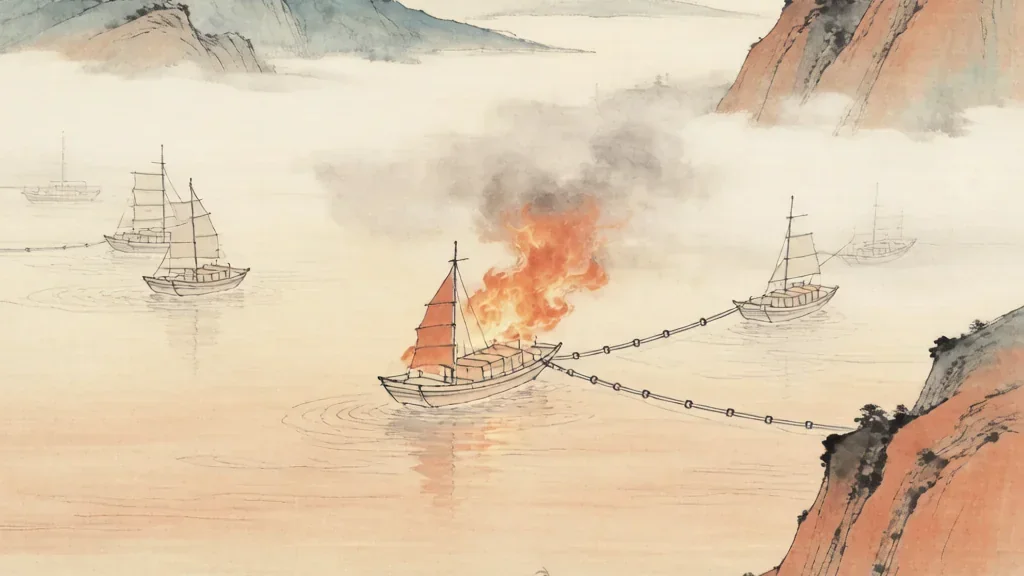
When a single spark can decide the fate of an empire, history remembers the wind that carried it. In the winter of 208 CE, on a mist-shrouded bend of the Yangtze River, a fragile alliance of two southern warlords confronted the largest army China had seen in generations. Their enemy, the brilliantly ruthless statesman Cao Cao, seemed unstoppable — master of the north, controller of the Han emperor, and poised to reunify a fractured realm by force. Instead, a handful of fire ships and an improbable southeastern gale turned the river red, shattered Cao Cao's fleet, and froze China into three competing kingdoms for the next seventy years. The Battle of Red Cliffs (赤壁之战, chì bì zhī zhàn) is the moment when geography, weather, and human cunning outweighed sheer numbers.
The Road to Red Cliffs
The Han dynasty had collapsed into chaos after the Yellow Turban Rebellion and the rise of regional warlords. By 208 CE the most successful of these, Cao Cao (曹操, Cáo Cāo), had crushed his rivals in the north and marched south to seize the strategic city of Jingzhou, gateway to the Yangtze. With the young Han emperor as his puppet, Cao Cao styled himself Chancellor and announced his intention to sweep the south and complete the reunification of China.
Two southern powers stood in his path. Sun Quan (孙权, Sūn Quán) commanded the hardened naval forces of the lower Yangtze around the city of Jianye (modern Nanjing). Liu Bei (刘备, Liú Bèi), a distant imperial kinsman with few troops but a reputation for virtue, had just been driven from his refuge and was seeking alliance. Cao Cao's greatest vulnerability was invisible: his northern soldiers were horsemen and infantry, hopelessly inexperienced on water, and many were already weakened by disease in the humid southern climate. Sun Quan's adviser Lu Su recognized that only a joint front could survive, and he brokered the alliance between Liu Bei's strategist Zhuge Liang and Sun Quan's commander Zhou Yu.
The Opposing Commanders
The personalities of Red Cliffs became legends. Cao Cao was a poet-general whose ambition knew no limit; he reportedly fielded claims of 800,000 men, though modern historians estimate a more realistic 200,000 to 250,000, still vastly outnumbering the allied force of roughly 50,000. Against him stood Zhou Yu (周瑜, Zhōu Yú), the young naval commander of Eastern Wu, cool and decisive; Zhuge Liang (诸葛亮, Zhūgě Liàng), Liu Bei's chief strategist, famed for reading Heaven and Earth; and Liu Bei himself, the underdog claimant to legitimacy.
The alliance was uneasy. Zhou Yu distrusted Zhuge Liang's talent and allegedly sought to have him removed, while Zhuge Liang is said to have calmly demonstrated his own insight into the coming winds. Whatever the personal tensions, the southern command agreed on a single plan: do not meet Cao Cao on land, but trap his fleet on the river. The stage was set at a cliff the locals called Red Cliffs, where the Yangtze narrows and the current turns.
Fire on the River
Desperate to steady his seasick troops, Cao Cao had his ships chained together with iron links and planked over, forming floating platforms that moved as one. To the southerners this was a gift. Zhuge Liang and Zhou Yu arranged a ruse: the officer Huang Gai pretended to defect, then sailed toward the enemy in twenty light vessels loaded with dry reeds, peat, and oil.
The decisive element was the wind. Winter on the middle Yangtze normally blows from the northwest, which would have pushed any fire attack back toward the southerners. Yet the allied strategists predicted a rare reversal — a southeastern wind born of a local cold-front pattern — and launched their assault when it came. The fire ships struck the chained hulls and, fanned by the gale, the flames raced across the locked fleet. Within hours Cao Cao's navy was a wall of fire. The survivors, demoralized and sick, were routed on shore, and Cao Cao burned his remaining camps and fled north.
Aftermath and the Three Kingdoms
Cao Cao returned to the north and never again mounted a full-scale southern invasion. He consolidated the Wei heartland and in 220 his son declared the state of Cao Wei, ending the Han in all but name. Sun Quan held the lower Yangtze and in 229 proclaimed Eastern Wu. Liu Bei, having used the breathing space to seize the fertile province of Yi (Sichuan), founded Shu Han in 221. Thus were born the Three Kingdoms (三国, sān guó) — Wei, Wu, and Shu — whose rivalry defined Chinese history until the Jin conquest of 280 CE.
For Liu Bei and Zhuge Liang, Red Cliffs was the foundation of everything they built; for Sun Quan it secured the independence of the southeast; for Cao Cao it was the limit of his dream of unity. The battle proved that the Yangtze was not merely a river but a civilizational frontier separating the ambitious north from the watery south.
Why Red Cliffs Still Matters
Red Cliffs endures because it is the founding myth of one of China's most beloved historical eras. The scholar-novelist Luo Guanzhong turned the episode into the centerpiece of the Romance of the Three Kingdoms (三国演义, sān guó yǎn yì), the novel that, alongside the Shiji and the historians, shaped how Chinese readers imagine loyalty, stratagem, and fate. Phrases from the battle — 「借东风」 (borrowing the east wind) and 「万事俱备,只欠东风」 (everything is ready except the east wind) — entered everyday speech to mean that a plan awaits only one crucial condition.
The site itself became a pilgrimage place for poets. Su Shi, the great Song writer, composed his famous lyric 「念奴娇·赤壁怀古」 (Charm of Niannu: Meditating on the Past at Red Cliffs) there, musing that the heroes of that fire are long gone while the river flows on. Militarily, Red Cliffs is studied as an early and near-perfect example of using environment — wind, current, disease, and chained ships — as a weapon. And culturally, it cemented the ideal of the outnumbered hero who wins through wisdom, a theme that echoes from Red Cliffs all the way to later southern defenses of the realm.
The romance of Red Cliffs never faded because it speaks to a deeper Chinese ideal: that the weak, properly led, can master the strong. Through the centuries the cliffs drew pilgrims who composed poems on the stone, and the names Zhou Yu and Zhuge Liang became archetypes of the brilliant young commander and the sage strategist who reads the will of Heaven in the weather. In opera and fiction the battle was retold countless times, each age finding its own lesson about alliance, timing, and the folly of a ruler who mistakes the size of his host for the strength of his cause. Modern historians, stripping away the novel's magic, still credit Red Cliffs with confirming the Yangtze as the great divide of Chinese geopolitics and with showing how climate, disease, and morale can outweigh raw numbers. Few single afternoons of fire have burned so long in a civilization's imagination, and the borrowed east wind remains, more than eighteen hundred years later, the perfect image of a plan that awaits only the right moment to ignite.