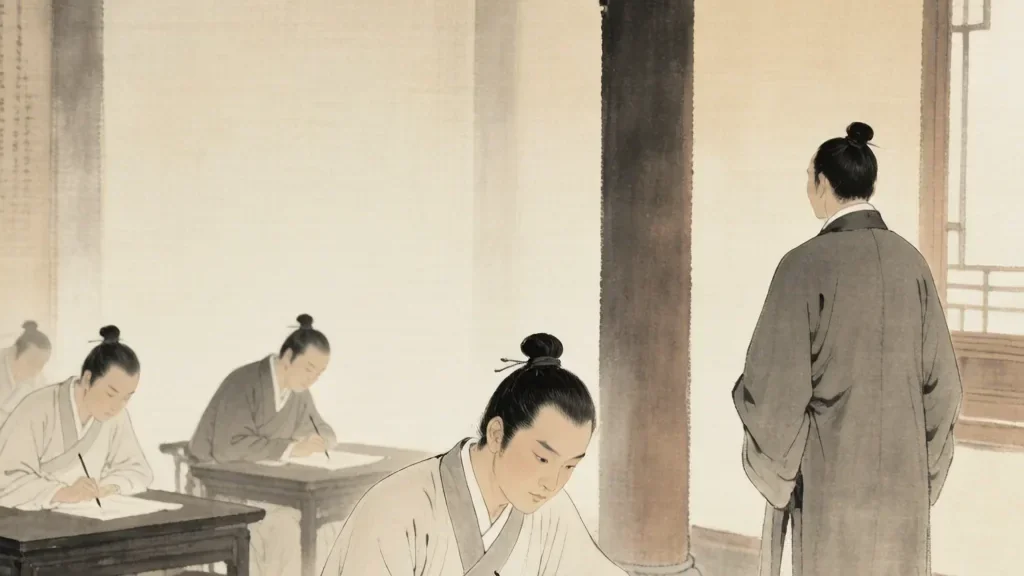
The imperial examination system (keju) was China's method of selecting officials by competitive written test, running in recognizable form from the Sui dynasty (581–618) until its abolition in 1905. More than a hiring procedure, it was the engine of social order: it bound ambitious families to the Confucian curriculum, created a shared elite culture, and gave the throne a bureaucracy loyal to the state rather than to clan. Few institutions have shaped a civilization so lastingly.
Origins in Recommendation
Before exams, the Han dynasty selected officials by local recommendation of the "filial and incorrupt," a system easily dominated by great families. The move toward testing reflected a wish to draw talent from beyond the aristocracy.
The recommendation method never fully vanished, but the ideal of measured merit slowly displaced birth as the stated basis of office.
Founding of the Imperial Exam
The Sui emperors created the civil examination to centralize recruitment, and the Tang developed it into regular metropolitan and palace tests. The jinshi degree in particular became the gateway to prestige.
Even then, Tang high society balanced exams with patronage, and many offices still went to the well-born; the system was a rising force, not yet dominant.
The Song Transformation
The Song dynasty made the exam the main road to office, expanding quotas and limiting the old aristocracy's grip. The founder Song Taizu preferred loyal civilians to fractious generals, and the literati class rose accordingly.
With printed books cheapening study materials, a broader stratum could prepare, and the examination became a genuine national institution.
Stages of the Exam Ladder
A candidate climbed from county and prefectural tests to the provincial (juren) exam, then the metropolitan (gongshi) exam in the capital, and finally the palace exam ranked by the emperor himself. Each level was a brutal filter.
The pyramid was steep: a county might produce one provincial graduate in years, and only a handful nationwide reached the top each cycle.
The Eight-Legged Essay
From the Ming onward, the policy essay was cast in the "eight-legged" (baguwen) form: a fixed sequence of paired, parallel sections arguing from the Confucian classics. Form was as judged as content.
Critics said it bred conformity, but defenders held that mastering its discipline proved both learning and moral training.
Who Could Take the Exam
In principle any free male commoner could sit the tests, a breadth unusual for its time. In practice, though, women were excluded, and the poor rarely had the years of leisure to study.
Still, the open ideal mattered: it let the dynasty claim that office rested on ability, and it gave families a concrete goal for education.
Examination and Society
Success brought exemption from labor service, social rank, and marriage ties to the elite. Clans funded promising boys, and villages celebrated new degree-holders as local glory.
The system thus wove the state's needs into the private life of families, making the classics the spine of Chinese culture.
Cheating and Security
The stakes invited fraud, so halls used identity checks, copied answer sheets to hide handwriting, and locked candidates in small cells for days. Severe punishments awaited cheaters.
These elaborate controls show how seriously the state treated impartial testing as the source of its legitimacy.
Abolition in 1905
Facing defeat by foreign powers, the Qing abolished the exams to build modern schools teaching science, law, and languages. The link between classical learning and office was severed overnight.
The end of keju ended a thousand-year continuity and helped birth the new professions of the twentieth century.
Global Influence
European observers admired the Chinese merit system, and it helped inspire civil service reforms in Britain and elsewhere in the nineteenth century. The idea of recruiting by exam spread worldwide.
China's invention thus became a global model for bureaucratic fairness, even as the original was being dismantled at home.
The Examination and the Classics
The curriculum centered on the Confucian classics, histories, and later the Neo-Confucian commentaries of Zhu Xi, ensuring that officials shared a common intellectual frame. Mastery of these texts was held to form both mind and character.
Because the same books were studied everywhere, the exam created a uniform elite culture that bridged China's many regions and dialects.
Local Examinations and Community Pride
Success at any level brought honor to the candidate's home county, and communities erected archways and inscribed steles to commemorate their graduates. The exam thus tied personal ambition to local identity.
Such public celebration turned the abstract ideal of merit into a visible, shared aspiration across villages and towns.
The Cost of Preparation
The long road to a degree demanded years of rote memorization, often beginning in childhood and sustained at the expense of other trades. Families weighed the slim odds against the prize of office, and many sons never passed.
Yet the discipline itself shaped a culture that prized patience and textual mastery, traits that outlasted the exam system and still mark approaches to learning in China today.
Echoes in the Modern World
The exam's spirit survives in today's fiercely competitive college entrance tests, where a single score can still steer a young life. The belief that a fair written test opens the door to office endures, even after the old system is gone.
❓ Frequently Asked Questions
What was the imperial examination?
A competitive written test system for selecting government officials, based on Confucian classics.
How long did it last?
From the Sui dynasty founding in the seventh century until its abolition by the Qing in 1905.
What were the exam levels?
County, prefectural, provincial, metropolitan, and finally the palace exam before the emperor.
Who could take it?
Free male commoners in principle, though the poor and women were effectively excluded.
What was the eight-legged essay?
A fixed-format policy essay on the classics required in later dynasties, prized for form and orthodoxy.
Why was it abolished?
The Qing ended it in 1905 to adopt modern schools and meet foreign pressures for reform.