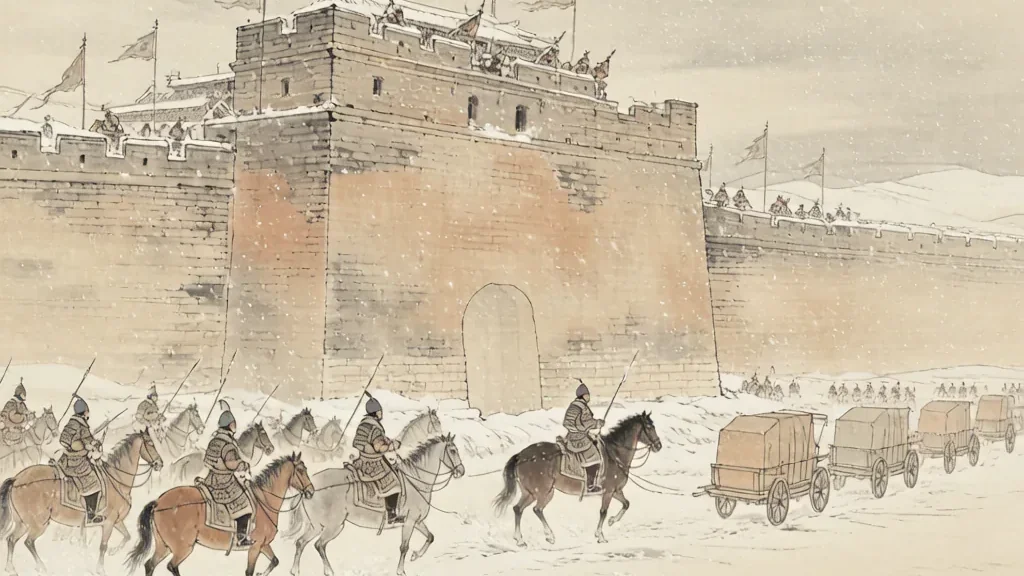
The Jingkang Incident (Jingkang zhi bian, 靖康之变) of 1127 was the catastrophic fall of the Northern Song dynasty's capital, Kaifeng, to the Jurchen Jin army and the capture of two reigning emperors. It stands as one of the deepest humiliations in Chinese historiography, severing the northern heartland from Chinese rule for over a century and forcing the Song court to flee south and rebuild as the Southern Song. Beyond its political shock, the event reshaped literature, identity, and the geographic and cultural balance of China, accelerating a southward turn of wealth, talent, and population that would define the next era.
The Song–Jin Alliance Against the Liao
In the early 12th century, the Song ruled northern China as the Northern Song, while the Khitan Liao dynasty held the northeast. The rising Jurchen people, under the leader Aguda, broke from Liao and founded the Jin dynasty in 1115.
Seeing opportunity, the Song court struck the "alliance of the sea" (hai shang zhi meng) with the Jin around 1118–1120, agreeing to jointly destroy the Liao. The plan was to split Liao territory between them, with the Song regaining the Sixteen Prefectures long held by northern nomads.
The alliance proved fatal miscalculation: Jin forces proved far more capable than the decaying Liao, while Song armies revealed their military weakness. The Jurchen now saw the fragility of their southern neighbor.
The First Siege of Kaifeng (1126)
After the Liao fell, the Jin turned on the Song. In 1126, Jurchen armies marched on Kaifeng, the prosperous Northern Song capital. The city, though enormous and wealthy, was unprepared for determined siege.
Emperor Huizong, a renowned artist and calligrapher but ineffectual ruler, abdicated in panic to his son, who became Emperor Qinzong. The court bought off the first siege with tribute and territorial concessions, and the Jin withdrew—briefly.
This reprieve bred complacency. The Song failed to reform its defenses or purge treacherous officials, setting the stage for disaster the following year.
The Fall of the Capital (1127)
In 1127, the Jin returned and breached Kaifeng. What followed was systematic plunder: the imperial treasury, libraries, ritual bronzes, and artworks were carted north, and the city was stripped of wealth.
Emperors Huizong and Qinzong were both captured, along with thousands of palace women, officials, and craftsmen. The Jurchen staged a ritual humiliation, deposing the emperors and carting the imperial clan into captivity in the north.
Huizong died in captivity in 1135; the event became a symbol of dynastic shame. The Northern Song had ended, its line of emperors broken and led away in chains.
The Abdicated Prince and the Southern Song
One imperial prince, Zhao Gou, happened to be outside the capital and escaped capture. He was proclaimed Emperor Gaozong, founding the Southern Song in 1127, with his court first at Nanjing (modern Shangqiu) and later at Hangzhou (Lin'an).
The Southern Song retained the rich Yangtze-region economy and a truncated but vibrant state. Gaozong's reign stabilized the south but permanently ceded the north to Jin and later to the Mongols.
The dynasty's survival owed much to capable generals such as Yue Fei, whose campaigns against the Jin became legendary—and whose eventual execution by a peace-minded court remains a enduring grievance in popular memory.
Cultural and Psychological Trauma
The Jingkang Incident seared itself into the Chinese cultural memory as the archetype of national disgrace. Poets and scholars of the Southern Song wrote lamentations expressing grief for the lost north and the captured emperors.
The female poet Li Qingzhao, whose family collections were destroyed in the chaos, produced some of her most moving work in its aftermath, her personal loss mirroring the dynastic one.
This trauma shaped a centuries-long northern irredentism—the longing to recover the lost territories—that recurred in later Southern Song and Ming loyalist literature.
The Southern Turn of Chinese Civilization
With the court's flight, the economic and cultural center of China shifted decisively south of the Yangtze. The lower Yangtze and Fujian regions, already prosperous, became the new core of Chinese wealth and scholarship.
This migration accelerated rice cultivation, maritime trade, and the commercialization of the south, laying groundwork for the remarkable economic sophistication of the Southern Song described by later observers.
The incident thus did not merely end a dynasty; it reoriented the map of Chinese civilization toward the south and the sea for generations.
Diplomacy and Tribute Under the Jin
The Southern Song's relations with the Jin settled into an uneasy peace punctuated by war. The Song paid annual silver and silk tribute and accepted a subordinate diplomatic status, a bitter compromise for a court claiming universal kingship.
These arrangements, however humiliating, bought the south decades of stability in which commerce, printing, and the arts flourished. The tension between dignity and survival defined Southern Song statecraft.
The eventual replacement of Jin by the Mongols would, within a century, bring an even more total conquest—the end of the Song altogether.
Legacy in Popular History
In Chinese opera, fiction, and television, the Jingkang Incident remains a touchstone of betrayal and lost glory. The treacherous official Qin Hui, blamed for Yue Fei's death and for appeasing the Jin, is eternally cast as a villain.
Iron statues of Qin Hui and his wife, kneeling in penance, still stand before Yue Fei's tomb in Hangzhou, a rare case of historical punishment enacted in bronze for eight centuries.
The episode endures as a lesson in the costs of military neglect and diplomatic folly, taught alongside the artifacts and poems it generated.
❓ Frequently Asked Questions
What was the Jingkang Incident?
The 1127 capture of the Northern Song capital Kaifeng by the Jurchen Jin, who took Emperors Huizong and Qinzong prisoner and ended the Northern Song.
Why did the Song ally with the Jin?
To recover the Sixteen Prefectures from the Khitan Liao, but the alliance revealed Song weakness and invited Jin invasion.
What happened to the captured emperors?
Both were deported to the north; Huizong died in captivity in 1135, becoming enduring symbols of dynastic shame.
How did the Southern Song begin?
Prince Zhao Gou escaped capture and was proclaimed Emperor Gaozong in 1127, establishing the Southern Song at Hangzhou.
Who was Yue Fei?
A Southern Song general who fought the Jin and became a national hero; he was executed by a peace-seeking court and blamed official Qin Hui.
Why is the incident still remembered?
It is the archetype of national humiliation in Chinese memory, shaping literature, irredentist longing, and lessons on military readiness.