Not every revolution is led by a mob; some are led by an accountant with a whip. In the mid-fourth century BCE, the border state of Qin was poorer, rougher, and more despised by the polished eastern courts than any of its rivals in the Warring States. Within a single generation, that changed completely — and the man who changed it was Shang Yang (商鞅, Shāng Yāng), a cold-eyed theorist of power. His reforms turned Qin into a disciplined war-machine in which every farmer's surplus and every soldier's head fed the state. The system he built did not just win battles; it unified China. Without Shang Yang, there might never have been a Qin Shi Huang.
Qin on the Eve of Reform
The state of Qin occupied the Wei River valley in the west, a tough, semi-frontier society long regarded by the central states as "barbarian." It had been weakened by internal noble factions and lacked the cultural prestige of rivals like Qi, Chu, or Wei. When the young Duke Xiao (孝公, Xiào Gōng) came to the throne around 361 BCE, he issued a call for men who could strengthen the state. Shang Yang, a protégé of the Legalist thinker Li Kui of Wei, answered.
Shang Yang's philosophy was Legalism (法家, fǎ jiā): the belief that human nature responds only to clear rewards and harsh punishments, and that the ruler's job is to concentrate power and align every subject's self-interest with the state's need for food and soldiers. He debated the virtue-minded Confucians at court and won the duke's backing to impose his program.
The Reforms Themselves
Shang Yang's changes struck at the roots of aristocratic privilege. First, he abolished the inherited ranks and lands of the old nobility; from then on, honor and office came only from military merit, measured by enemy heads taken in battle. A noble with no kills became a commoner. Second, he broke large patriarchal clans into smaller taxable households and registered every family, making evasion of tax and conscription far harder.
He tied the economy to the state. Agriculture and weaving were rewarded with exemptions; commerce, crafts, and idleness were discouraged and taxed. To keep the population controllable, he organized it into groups of five and ten households whose members were mutually responsible for one another's crimes — failure to report a offense meant the same punishment as committing it. The law, crucially, applied to nobles and commoners alike, a radical claim in a hereditary world.
Power Through Fear and Order
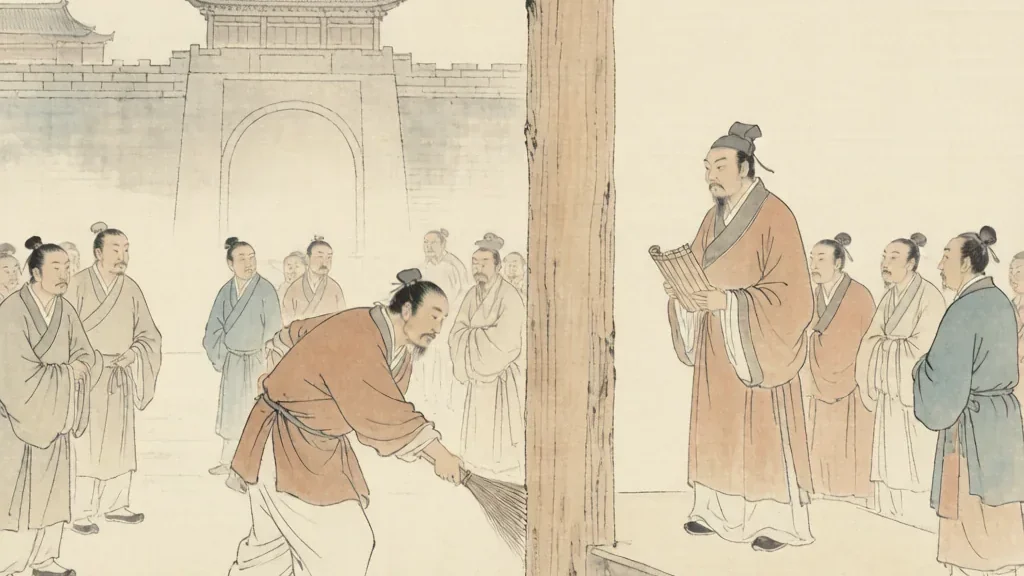
To prove the law was no bluff, legend says Shang Yang first enforced it against the duke's own relatives and even punished a royal prince by mutilating his tutor. He standardized weights and measures, built a clear legal code posted for all to see, and made punishments certain and severe. Crime rates fell, and Qin's farms and arsenals filled.
The result was a state with no wasted energy. Every peasant knew that surplus grain bought tax relief and that a son's valor could raise the family's rank; every soldier knew promotion came only by enemy heads. This single-minded mobilization let Qin field armies its softer rivals could not match, and to fund them with a steadier tax base. The eastern states began to fear the "tiger of the west."
The Cost and the Builder's Death
Shang Yang's system was ruthlessly effective but personally dangerous. When Duke Xiao died in 338 BCE, the new ruler was a prince Shang Yang had once punished. Old enemies accused the reformer of treason; he fled, but the very household-registration laws he had created meant inns refused him shelter without papers. Captured, he was executed by being torn apart by chariots (车裂, chē liè). Yet the laws survived him — the new ruler kept the system because it worked.
Over the next century, Qin, under a line of Legalist-influenced rulers, ground down the other six Warring States. The reforms' emphasis on merit, central taxation, and a professional army became the backbone of Qin's expansion, culminating in 221 BCE when Qin Shi Huang (秦始皇, Qín Shǐ Huáng) unified China and declared himself First Emperor.
Why Shang Yang Still Matters
Shang Yang is the architect of the Chinese imperial state's centralizing logic. The Qin model — standardized law, uniform administration, merit over birth, agriculture and warfare as the state's two pillars — was inherited and refined by the Han and every dynasty after. The very idea that a government could be engineered by policy, rather than inherited through ritual, owes much to him.
His legacy is double-edged. Later Confucian historians condemned Legalism as cruel and credited Shang Yang with the "short reign" of Qin, yet they governed using his administrative tools. The tension between humane Confucian ideals and efficient Legalist methods became a permanent theme of Chinese statecraft, debated for two thousand years. And the phrase 「商鞅变法」 remains shorthand for sweeping, top-down reform — the prototype of every later Chinese attempt to remake the state by decree, from Wang Anshi to the modern era.
The institutions Shang Yang built outlived both his life and the Qin dynasty that executed him. The Han, who overthrew Qin, publicly condemned Legalism yet quietly kept its administrative core: uniform laws, a registered population, a tax system that reached the village, and an army rewarded by merit. Every later dynasty inherited this centralizing logic, even while paying lip service to Confucian virtue. The tension between the two — the humane ideal and the efficient machine — became the permanent debate of Chinese statecraft, and reformers from Wang Anshi to the modern era reached back to Shang Yang as the original engineer of the state. His hometown and tomb became sites where later officials reflected on the price of radical reform. Whatever one thinks of his cruelty, Shang Yang answered, for better and worse, the oldest question of government: how to turn a scattered people into a single, governable whole.
His reforms also set the precedent that the state, not birth, should decide rank — a radical idea that slowly eroded the old aristocracy and opened, however narrowly, the possibility that talent might rise from anywhere, a principle later codified in the examination system.