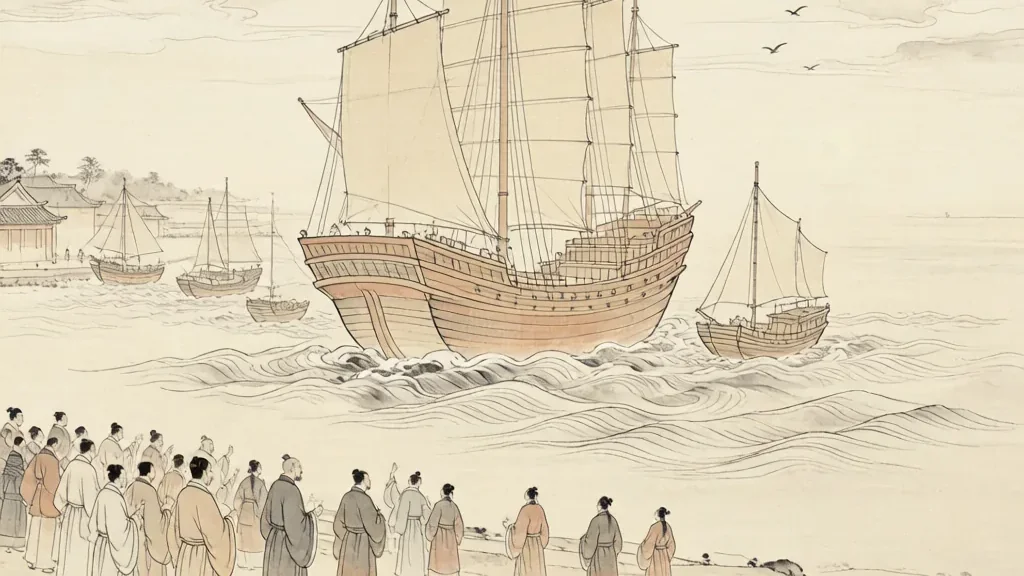
Imagine a fleet so vast it darkened the horizon — hundreds of ships, the largest longer than a football field, crewed by nearly thirty thousand sailors, navigating by the stars from China to the coasts of Arabia and Africa. Now imagine that this happened in the early 1400s, nearly a century before Columbus, and that the ships belonged not to Europe but to Ming China. The voyages of Zheng He (郑和下西洋, Zhèng Hé xià xī yáng) are one of history's great "what ifs": a moment when China, not the West, commanded the world's oceans — and then chose to go home. The story of the treasure fleets is at once a saga of maritime genius and a riddle about the paths civilizations choose.
The Yongle Emperor's Ambition
The Ming dynasty had just overthrown the Mongol Yuan and, under the usurper Yongle (永乐, Yǒnglè), was asserting China's supremacy. Yongle moved the capital to Beijing, built the Forbidden City, and looked outward. He chose as his instrument Zheng He (郑和, Zhèng Hé), a trusted palace eunuch of Muslim, Yunnan-born background whose grandfather had made the hajj — a man comfortable across cultures and languages.
The emperor's motives mixed glory and policy. The fleets were to "proclaim the majesty of the Middle Kingdom" (宣威, xuān wēi), receive foreign tribute that confirmed China's centrality, and perhaps locate a vanished rival heir. Unlike later European voyages driven by trade and conquest, Zheng He's expeditions were fundamentally about status and diplomacy backed by overwhelming force.
The Admiral and His Fleet
Zheng He led seven voyages between 1405 and 1433, reaching Southeast Asia, India, the Persian Gulf, the Red Sea, and the Swahili coast of East Africa. The flagship "treasure ships" (宝船, bǎo chuán) were reported at roughly 120 meters long with nine masts — dimensions modern scholars debate, but the scale was plainly enormous. A typical voyage fielded more than 300 ships and close to 28,000 people: sailors, soldiers, interpreters, doctors, and artisans.
The technology was superb. Chinese shipwrights used watertight bulkheads, stern-mounted rudders, and the magnetic compass, while navigators combined Arabic charts with Chinese stellar navigation. The fleet could fight when needed — Zheng He suppressed the pirate Chen Zuyi near Malacca and intervened in succession disputes in Ceylon and Sumatra — but its default mode was the gift exchange of tribute and reward.
The Course of the Seven Voyages
The first voyage (1405–1407) planted China's presence across the South China Sea and India; later ones pushed to Hormuz and Aden. Envoys from thirty-odd states traveled back to Nanjing and Beijing, bearing giraffes (mistaken for the auspicious qilin), zebras, ivory, and exotic goods. Zheng He erected steles in Sri Lanka and Malacca proclaiming peaceful intent and Ming overlordship, and his maps — preserved in the Wubei Zhi — show a detailed grasp of the Indian Ocean world.
Each return strengthened the tribute system: foreign rulers acknowledged the Ming emperor and received titles, silk, and porcelain in return. For a brief generation, the Indian Ocean was a Chinese lake in prestige, policed by a fleet that wanted no territory, only recognition.
The Sudden End
After Yongle died in 1424, the political wind shifted. Confucian officials at court argued the voyages were a waste of silver that produced only curiosities, while the real danger — Mongol raiders on the northern frontier — went underfunded. The great ships were laid up; the Nanjing shipyards declined; and crucially, the detailed logs of Zheng He's voyages were ordered burned or locked away, so thoroughly that much of the record survives only through a single abridged account.
When the seventh voyage returned in 1433, it was the last. China turned its face inland, invested in the Great Wall and the northern army, and let the seas fall to others. Zheng He himself died on the final voyage and was buried at sea.
Why the Voyages Still Matter
The treasure fleets are the great counterfactual of world history. Had China continued, the first global maritime empire might have been Chinese, not European — altering colonization, trade, and the modern world beyond recognition. Instead, the episode became a symbol of a road not taken, cited by later Chinese reformers and, in our time, by those who ask why a technologically advanced China stepped back from the ocean just as the West stepped onto it.
Culturally, Zheng He is celebrated as a hero of peaceful outreach and maritime skill, a Hui Muslim who embodied China's cosmopolitan reach. His voyages left a lasting diaspora and trade links across the "Maritime Silk Road," and his name now headings museums, ships, and even a space program's lore. The lesson drawn is double: of what Chinese ingenuity could achieve on the seas, and of how a civilization's choices — not its capacity — decide its destiny.
The ending of the voyages has haunted Chinese historical imagination ever since. Within a few decades of Zheng He's death, the Ming banned private ocean-going ships, tore down the Nanjing yards, and let the maps rot — even as Portuguese caravels rounded Africa and reached India. A civilization that had commanded the Indian Ocean voluntarily withdrew from it, ceding the sea to others who would later arrive on China's coast with cannon. Later reformers and nationalists pointed to Zheng He as proof that China, not the West, had possessed the capacity for global mastery, and asked bitterly why that capacity was squandered. In our own time the treasure fleets have been reclaimed as a symbol of peaceful outreach and maritime heritage, inspiring museums, films, and the very language of a 'Maritime Silk Road.' The voyages thus pose a question that still resonates: not whether China could lead the seas, but whether a state chooses to, and what it loses when it turns away.
Seen whole, the voyages were both a triumph and a missed turning: a display of Chinese seamanship and diplomacy unmatched in their age, abandoned not by failure but by choice, leaving later generations to wonder what the world might have become had the treasure fleets kept sailing.