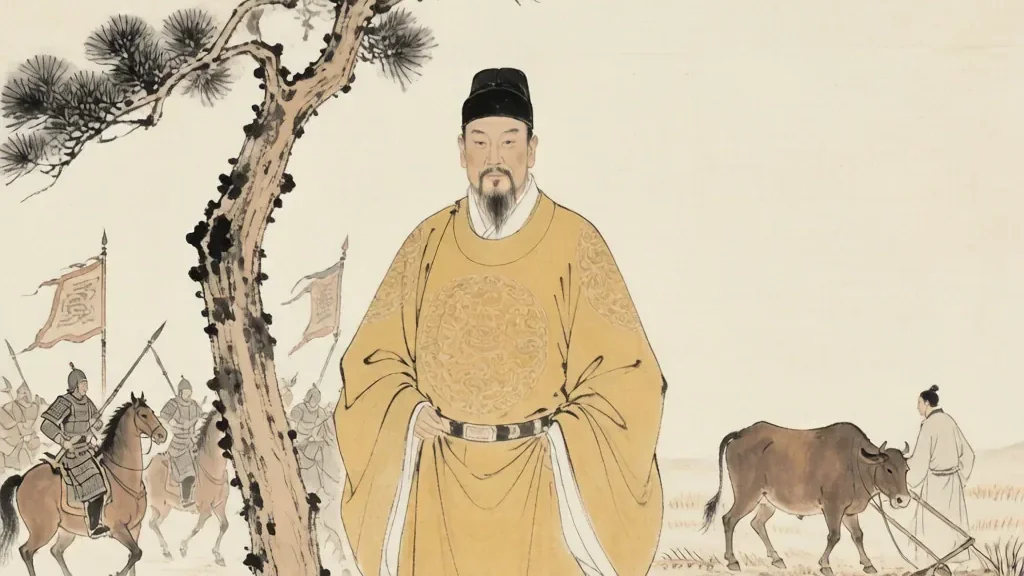
Zhu Yuanzhang (朱元璋, 1328–1398) rose from utter poverty—orphaned by plague, a begging Buddhist novice, then a rebel soldier—to found the Ming dynasty and rule as its first emperor, the Hongwu (洪武) Emperor. In 1368 his armies drove the Mongol Yuan dynasty from China and took its northern capital, ending nearly a century of foreign rule and opening a native Chinese imperial house that would last nearly three hundred years. A brilliant strategist and a suspicious, ruthless autocrat, Zhu rebuilt the state from the village up, crushed his former comrades, and concentrated power in his own hands to a degree unseen for centuries. His reign set the Ming's character: strong, centralized, agrarian, and wary of both officials and the outside world.
From Beggar Monk to Rebel
Zhu was born to a poor peasant family in Anhui in 1328. When famine and plague killed his parents, the boy entered a Buddhist monastery for shelter, and when the monastery starved, he wandered as a mendicant monk, begging across the countryside.
In 1352 he joined the Red Turban Rebellion (红巾军), a millenarian uprising against the failing Yuan. His talent for leadership quickly surfaced; from a foot soldier he became a commander, marrying the adopted daughter of a key leader and building a loyal following of able men.
Conquest of the Yangtze Heartland
Zhu based himself in the rich Yangtze region, taking Nanjing as his capital. He defeated rival rebel chiefs one by one, most importantly Chen Youliang at the great naval battle of Poyang Lake (1363), the largest engagement of the civil wars.
By eliminating Zhang Shicheng and other contenders, he united the lower Yangtze and central China under his rule. His combination of disciplined troops, good intelligence, and shrewd alliances let him outlast competitors who were richer or better placed at the start.
Overthrowing the Yuan
The Yuan (Mongol) dynasty had weakened through famine, factionalism, and falling revenue. In 1367 Zhu launched a northern campaign, and in 1368 his armies captured Dadu (大都, modern Beijing), the Yuan capital, sending the last Mongol ruler fleeing to the steppe.
Zhu proclaimed the Ming ("Brilliant") dynasty and took the reign title Hongwu, "Vast Martial." Though the Mongols kept a northern state (the Northern Yuan), their rule over China proper was over, and a native dynasty again sat on the throne.
The Hongwu System of Rule
As emperor, Zhu Yuanzhang built a highly centralized state. He abolished the post of chief councillor (丞相), taking all major decisions into his own hands, and expanded the role of the secretariat only as a clerical aid. Power flowed upward to the throne as never before.
He relied on military households (军户), a hereditary system that supplied soldiers, and on "commanderies" of settled soldier-farmers to feed the armies. His administration was austere, agrarian, and obsessed with stability and the suppression of disorder.
To man the frontiers he perfected the weisuo (卫所) garrison system, stationing soldier-farmers who grew their own food and rotated to service, lowering the cost of permanent armies. This self-supplying militia buttressed the northern and coastal defenses for generations, embodying his preference for a state that sustained its own strength without heavily taxing the peasantry he sought to protect.
Purges and the Secret Police
Hongwu was famously suspicious of the very officials and generals who had helped him. Late in his reign he launched bloody purges, executing tens of thousands—including founding heroes—on charges of conspiracy, to secure the throne for his descendants.
He created the Embroidered Uniform Guard (锦衣卫), a secret police and imperial bodyguard with powers of arrest and torture. The climate of fear kept the bureaucracy obedient but also left a legacy of arbitrary, personal rule at the apex of the state.
Economic and Social Policies
Zhu favored the peasantry that produced his armies. He promoted land reclamation after the wars, reduced some taxes, and tried to register households accurately through the "Yellow Records" (黄册) population surveys and the "fish-scale" land maps (鱼鳞图册).
He also reinforced harsh laws on vagrancy and bound people to their occupations and localities. His vision was a static, self-sufficient agrarian realm, orderly and loyal, in which commerce and officialdom were kept firmly subordinate to the village and the throne.
Hongwu enforced strict sumptuary laws and the lijia (里甲) mutual-responsibility system, grouping households for tax collection and policing, while restricting the travel and dress of merchants. He distrusted large cities and trade, preferring a realm of registered, settled villagers—a social vision that traded dynamism for the order he prized above all else.
Law, Religion, and Culture
The emperor promulgated the Great Ming Code (大明律) and a set of admonitory "Placard" instructions for the people, blending law with moral exhortation in the Confucian mode. He supported neo-Confucian orthodoxy while keeping a personal interest in Buddhism and Daoism.
He was also a noted writer of plain, forceful proclamations aimed at commoners, unusual for a ruler. These "sacred edicts" foreshadowed later state moral instruction and reveal a sovereign intent on governing minds as well as lands.
The Succession Problem
Hongwu outlived his chosen heir, the crown prince, and named the late prince's son as successor—the Jianwen Emperor. But Zhu's surviving sons, especially the powerful Prince of Yan (later the Yongle Emperor), held great regional military power.
After Hongwu died in 1398, the succession quickly fractured: Yongle rebelled and seized the throne by 1402, moving the capital north to Beijing. The founder's centralization thus passed to a usurping son who would project Ming power outward, not inward as the old emperor had preferred.
Legacy of the Founder
Zhu Yuanzhang's rise is one of history's most extraordinary rags-to-emperor stories, and his institutions shaped Ming China for generations. He restored native rule, rebuilt agriculture, and forged a strong, centralized bureaucracy.
Yet his tyranny and suspicion cast a long shadow, and his inward, agrarian rigidity left the dynasty poorly prepared for the maritime and commercial age dawning elsewhere. He remains a figure of awe—founder, farmer-emperor, and fearsome autocrat in one.
❓ Frequently Asked Questions
Who was Zhu Yuanzhang?
A former peasant and monk (1328–1398) who founded the Ming dynasty in 1368 and ruled as the Hongwu Emperor.
How did he come to power?
He joined the Red Turban Rebellion, defeated rival warlords, and in 1368 captured the Yuan capital, ending Mongol rule in China.
What kind of ruler was he?
A centralizing autocrat who abolished the chief councillor post, used secret police, and purged tens of thousands of officials.
What were his economic policies?
He favored peasants, promoted land reclamation, cut some taxes, and registered households and land through detailed surveys.
Why is his reign significant?
He restored native rule and built a strong centralized Ming state whose institutions lasted nearly three centuries.
What happened after he died?
His heir Jianwen was overthrown by the Prince of Yan, who became the Yongle Emperor and moved the capital to Beijing.