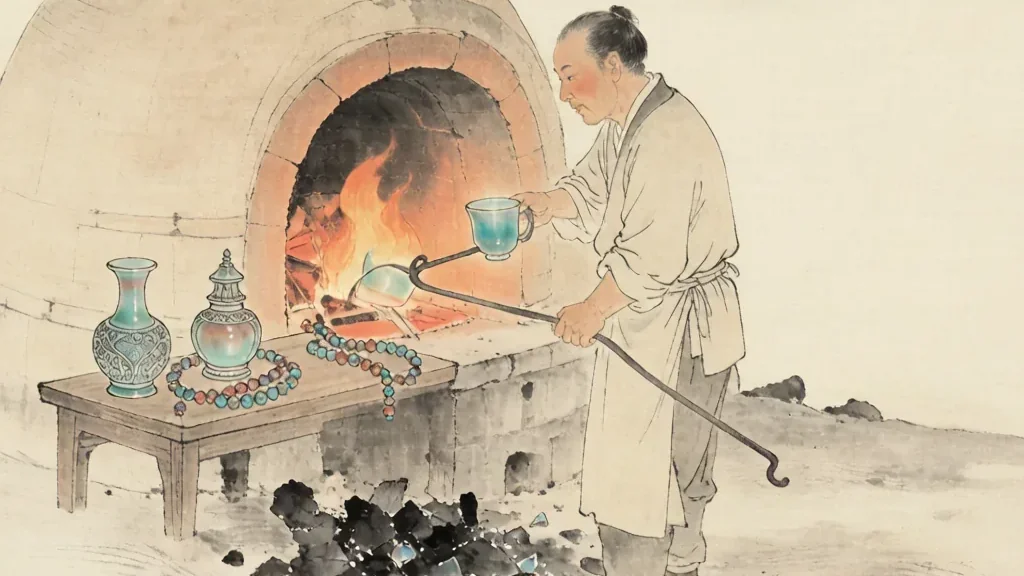
Liuli (琉璃) is the Chinese term for coloured glaze and decorative glass, a material prized in China for more than two thousand years. Distinct from ordinary window glass, traditional liuli is a translucent, lustrous substance made by fusing silica with lead and barium compounds and tinting it with mineral oxides. It was used for imperial roof tiles, Buddhist ritual objects, and ornamental wares, and its glowing, jade-like quality made it a symbol of prestige. Though glass-making techniques reached China from abroad, Chinese artisans developed their own recipes and aesthetics, turning liuli into a uniquely Chinese craft that still flourishes in centres such as Boshan and in the historic Beijing district of Liulichang.
What Liuli Actually Is
Traditional Chinese liuli is not the soda-lime glass common in the West. Analysis of ancient fragments shows a lead-barium-silicate composition, which gives the material its characteristic heaviness, depth of colour, and soft inner glow. The recipe was deliberately different from both Western glass and true porcelain.
In everyday usage the line between liuli and boli (玻璃, plain glass) was not always sharp, but artisans and patrons treated liuli as a luxury material associated with colour, light, and ritual, not mere transparency.
Early Origins
Beads and small ornaments of glass-like material appear in China from the Zhou dynasty, often buried with the elite. These early pieces show that Chinese workshops were already experimenting with vitreous substances long before large-scale glassmaking.
During the Warring States and Han periods, coloured glaze was used for jewellery, inlays, and ceremonial objects. Some techniques and raw ideas travelled along the Silk Road, but Chinese makers adapted them into local styles rather than merely copying foreign goods.
Liuli and Buddhism
The spread of Buddhism brought new meaning to liuli. The Buddhist "seven treasures" (七宝, qibao) listed in sutras include liuli, usually translated from the Sanskrit vaidurya (often understood as lapis lazuli or a glowing crystal). Devotional objects thus gained spiritual value.
Monasteries and pilgrims commissioned liuli lamps, reliquaries, and decorative tiles, and the material became linked with the idea of purity and radiant light. This religious patronage helped sustain the craft through many dynasties.
Imperial Glazed Architecture
The most visible legacy of liuli is on Chinese rooftops. From the Ming dynasty onward, imperial buildings — above all the Forbidden City and temple complexes — were crowned with yellow, green, and blue glazed tiles made of liuli. Yellow was reserved for the emperor.
These tiles were fired in dedicated kilns, shaped, glazed, and then fixed to sweeping rooflines. The glaze protected the tile and announced status through colour. A single imperial roof could require tens of thousands of pieces.
Colour and Chemistry
The glowing colours of liuli come from metal oxides added to the melt. Copper yields greens and reds, iron and cobalt give blues, and manganese can produce purples. Controlling the furnace atmosphere was as important as the recipe itself.
Because the lead-barium base is sensitive to heat, achieving an even, brilliant colour demanded great skill. Imperfect batches were common, which is one reason fine liuli remained expensive.
The Boshan Tradition
Boshan in Shandong became one of China's great centres of glass and liuli working, producing beads, snuff bottles, and decorative objects for the court and the market alike. Its artisans developed specialised blowing and moulding methods.
By the Qing dynasty, Boshan glassware was famous across the empire, and its techniques were documented by scholars interested in useful manufactures. The town remains associated with the craft to this day.
Liulichang and the Art Market
In Beijing, the district of Liulichang (literally "glaze factory") grew up around the imperial tile kilns and later became a celebrated street of bookshops, ink, and art supplies. Its name preserves the memory of the glaze industry.
Though the kilns eventually moved, Liulichang endured as a cultural marketplace where scholars bought supplies and exchanged ideas, linking the material craft to China's literary life.
Modern Revival
In recent decades a renewed interest in traditional liuli has produced studio artists who cast coloured glaze using lost-wax and pâte-de-verre methods. These works echo ancient forms while speaking to contemporary tastes.
Workshops in Taiwan and the mainland have turned liuli into a recognised art brand, exhibiting sculptural pieces that play with light and translucency — a modern chapter of a very old craft.
Beads, Inlays, and Early Trade
Beyond grand roof tiles and Buddhist ritual objects, liuli circulated as beads, pendants, and small inlays traded along the Silk Road. Such pieces, found in tombs far from any known workshop, reveal a craft economy that linked makers to distant markets.
Foreign glass also reached China through the same routes, and Chinese artisans sometimes imitated or refined imported styles. This two-way exchange kept the craft technically alive and visually varied, preventing it from freezing into a single formula.
Colour and Symbolism
Different liuli colours carried distinct meanings. Greens and blues evoked water and sky, while yellow was reserved for the imperial household; colour choice was rarely mere decoration but spoke of rank, dynasty, and cosmic order.
Because colour depended on carefully controlled furnace chemistry, a fine piece advertised both the patron's wealth and the maker's mastery of heat and mineral. It was, characteristically, a union of art and empirical science.
From Craft to Industry
Over the centuries liuli moved from palace luxury toward broader production, with regional kilns supplying tiles, beads, and vessels to a widening market. State workshops guarded the finest recipes while folk kilns innovated cheaper versions.
This spread let liuli enter everyday architecture and devotion, not just the emperor's roofs, and ensured that the knowledge of glaze-making survived dynastic change and disruption.
❓ Frequently Asked Questions
Is liuli the same as glass?
Not exactly. Traditional liuli is a lead-barium-silicate coloured glaze, valued for colour and glow rather than transparency like ordinary glass.
Why are Chinese palace roofs yellow?
Yellow glazed tiles were reserved for imperial buildings, signalling the emperor's supreme status.
How old is Chinese liuli?
Glass-like beads and ornaments appear from the Zhou dynasty, with the craft developing strongly through the Han and later periods.
What does liuli have to do with Buddhism?
It is counted among the Buddhist seven treasures, giving glaze objects a devotional and symbolic meaning.
Where was liuli made?
Major centres included Boshan in Shandong and the imperial kilns near Beijing, now remembered by Liulichang.
Is liuli still made today?
Yes. Studio artists and workshops produce cast liuli sculpture, continuing and reinventing the ancient craft.