← Back to Ancient Science
🔬 Ancient Science
Zhang Heng's Seismograph (地动仪) — The World's First Earthquake Detector
✍️ by xiaoyu luo
🗓️ Updated Jul 29, 2026
By Xiaoyu Land · 12 min read
In the year 132 CE, during the Eastern Han Dynasty, a polymath named Zhang Heng (张衡, Zhāng Héng) presented to the imperial court a device so extraordinary that it would not be replicated in the West for another 1,700 years — the world's first seismoscope. Known as the Houfeng Didong Yi (候风地动仪), or 'Instrument for Measuring the Seasonal Winds and Earth's Movements,' this magnificent bronze vessel was designed not merely to register that an earthquake had occurred locally, but to detect seismic events happening hundreds of kilometers away and to indicate their precise direction. Zhang Heng's seismograph stands as one of the most remarkable achievements in the history of science — a triumph of mechanical engineering, geological insight, and sheer intellectual audacity that established China as the birthplace of instrumental seismology.
The Man Behind the Machine: Zhang Heng's Extraordinary Mind
Zhang Heng (78–139 CE) was the quintessential Renaissance man nearly 1,300 years before the Renaissance. Born in Nanyang, in present-day Henan Province, he demonstrated prodigious talents from an early age, mastering the Confucian classics by age 12 before devoting himself to the study of astronomy, mathematics, mechanics, and literature. Over his remarkable career, Zhang served as Chief Astronomer of the Han court, where he catalogued over 2,500 stars in a comprehensive star chart, correctly explained lunar eclipses as the result of the Earth's shadow falling upon the moon, and calculated pi with impressive accuracy. He also constructed the world's first water-powered armillary sphere — a rotating celestial globe driven by a water clock — that could simulate the movements of heavenly bodies with astonishing precision. Zhang was equally accomplished as a poet, philosopher, and cartographer, producing some of the finest fu (赋) rhapsodies of the Han era and creating detailed maps using a grid system that anticipated modern cartographic conventions. It was this unique combination of theoretical knowledge and practical ingenuity that enabled Zhang to conceive of a device that could detect earthquakes invisible to human senses — a device that would, in a single dramatic demonstration, prove its worth and secure Zhang's place in scientific history.
The Design and Mechanism of the Houfeng Didong Yi
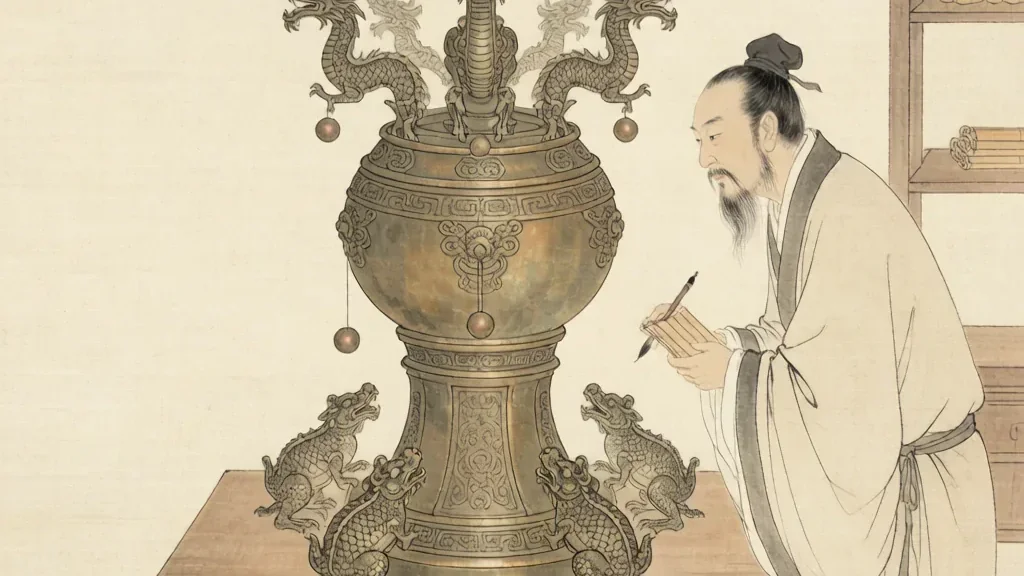
According to the 'Book of Later Han' (后汉书, Hòu Hàn Shū), the primary historical source describing the instrument, Zhang Heng's seismoscope was a magnificent bronze vessel approximately 1.8 meters in diameter, shaped like a wine jar (酒樽, jiǔ zūn) with a domed lid. Around the circumference of the vessel, eight dragon heads faced outward in the eight cardinal and intercardinal directions — north, northeast, east, southeast, south, southwest, west, and northwest. Each dragon held a bronze ball in its mouth, and directly below each dragon head crouched a bronze toad with its mouth open wide, ready to catch the ball should it fall. The internal mechanism, though not described in complete detail in surviving texts, is believed to have consisted of a central pendulum — a heavy, inverted column suspended within the vessel — surrounded by an intricate system of levers, cranks, and catch mechanisms connected to the eight dragon heads. When a seismic wave from an earthquake arrived, the ground motion would cause the pendulum to swing in the direction of the epicenter. This swing would trigger a lever mechanism that released the bronze ball from the corresponding dragon's mouth into the waiting toad's jaws below, producing a loud clang that announced both the occurrence of the earthquake and the direction from which it originated. The ingenious aspect of the design was that the mechanism would release only one ball — the one aligned with the earthquake's direction — while the other seven remained in place, thus providing directional information about an event that might have been entirely imperceptible to the people standing next to the instrument.
The Famous Test: Proving the Impossible
The historical record preserves a dramatic account of the moment when Zhang Heng's seismograph proved its worth to a skeptical court. According to the 'Book of Later Han,' on one occasion a bronze ball fell from the dragon facing west, and the toad caught it with a resounding clang — yet no one in the capital city of Luoyang had felt any tremor whatsoever. The court scholars and officials, many of whom had doubted Zhang's claims, began to mock him, insisting that the device must have malfunctioned. But Zhang Heng remained calm and confident. Several days later, a messenger arrived from Longxi Commandery — located in present-day Gansu Province, over 600 kilometers west of Luoyang — reporting that a major earthquake had struck the region on precisely the day and at precisely the hour when the ball had fallen. The entire court was astounded. 'From that time on,' the historical record notes, 'it became the duty of the officials of the Bureau of Astronomy and Calendar to record the directions from which earthquakes came.' This remarkable validation — detecting an earthquake at such a great distance that it was not felt at the capital — demonstrated not only the sensitivity of Zhang's instrument but also his profound understanding that seismic waves propagate through the Earth over vast distances, a concept that would not be fully appreciated in Western science until the 19th century.
The Scientific Legacy and Modern Reconstructions
The original Houfeng Didong Yi was lost to history, likely during the chaotic period that followed the collapse of the Han Dynasty in 220 CE. For centuries, scholars debated whether such a device could actually have functioned as described, with some dismissing the account as exaggerated legend. However, beginning in the 20th century, Chinese and international researchers undertook systematic efforts to reconstruct Zhang's seismoscope based on the descriptions in the 'Book of Later Han' and other historical texts. In 1951, Chinese scholar Wang Zhenduo proposed a reconstruction featuring an inverted pendulum mechanism, which became the basis for the widely recognized model of the device displayed in museums. In 2005, a team led by the Chinese Academy of Sciences' Institute of Geophysics developed a working reconstruction that successfully detected simulated earthquakes in laboratory conditions, conclusively demonstrating the physical feasibility of Zhang Heng's design. These reconstructions have confirmed what the historical record suggested: that Zhang Heng's seismoscope was a genuine scientific instrument of remarkable sophistication, capable of detecting distant earthquakes and indicating their direction with practical accuracy. The device represents not just a single inventor's genius but the culmination of Chinese traditions in bronze casting, mechanical engineering, and astronomical observation — traditions that had been developing for centuries before Zhang Heng synthesized them into this extraordinary achievement.
❓ Frequently Asked Questions
Q: Who invented the seismograph?
A: The first known seismograph was invented by Zhang Heng (张衡), a Chinese astronomer and inventor, in 132 CE during the Han Dynasty—over 1,700 years before the first modern seismograph.
Q: How did Zhang Heng's seismograph work?
A: Zhang Heng's device was a bronze urn with eight dragon heads holding bronze balls. When an earthquake occurred, a pendulum inside triggered a ball to drop into a frog's mouth below, indicating the direction of the quake.
Q: Did Zhang Heng's seismograph detect earthquakes accurately?
A: Yes. Historical records describe an event where the device dropped a ball even though no shaking was felt locally. Days later, a messenger reported an earthquake hundreds of kilometers away, confirming the device's accuracy.
Q: Why is Zhang Heng's seismograph important?
A: Zhang Heng's seismograph was the first instrument in history to detect earthquakes from a distance. It demonstrates the sophistication of Han Dynasty science and Zhang Heng's extraordinary ingenuity.
Q: How did Zhang Heng's seismograph work?
A: Zhang Heng's device was a bronze urn with eight dragon heads holding bronze balls. When an earthquake occurred, a pendulum inside triggered a ball to drop into a frog's mouth below, indicating the direction of the quake.
Q: Did Zhang Heng's seismograph detect earthquakes accurately?
A: Yes. Historical records describe an event where the device dropped a ball even though no shaking was felt locally. Days later, a messenger reported an earthquake hundreds of kilometers away, confirming the device's accuracy.
Q: Why is Zhang Heng's seismograph important?
A: Zhang Heng's seismograph was the first instrument in history to detect earthquakes from a distance. It demonstrates the sophistication of Han Dynasty science and Zhang Heng's extraordinary ingenuity.
Key Terms
张衡 (Zhāng Héng)
zhāng héng · 'Zhang Heng' · 东汉著名科学家、天文学家、文学家 (Renowned Eastern Han scientist, astronomer, and writer)
地动仪 (dì dòng yí)seismograph, an instrument for detecting earthquake direction
候风地动仪 (hòu fēng dì dòng yí)Houfeng seismograph, the formal name of Zhang Heng's device
龙 (lóng)dragon, the bronze dragon heads mounted around the instrument
蟾蜍 (chán chú)toad, the bronze toads beneath the dragons that caught falling balls
都柱 (dū zhù)central pillar, the inverted pendulum at the device's core
京师 (jīng shī)capital, the city of Luoyang where the instrument stood
灵台 (líng tái)spirit platform, the imperial observatory complex
Fun Facts
- Zhang Heng was so versatile that he is honored in multiple fields: a lunar crater is named after him, asteroid 1802 Zhang Heng bears his name, and his contributions to astronomy, mathematics, literature, and seismology are all celebrated in modern China.
- The first modern seismograph capable of detecting distant earthquakes was not invented until 1880, when John Milne, James Ewing, and Thomas Gray developed their instrument in Japan — nearly 1,750 years after Zhang Heng's device.
- Zhang Heng also invented the world's first odometer — a cart with a mechanical figure that struck a drum every li (approximately 500 meters) traveled — demonstrating his fascination with automated measurement devices.
- Zhang Heng also built a mileage carriage whose wooden figures struck a drum automatically at set intervals of road, an early form of distance measurement.
- Modern teams have built working replicas from the surviving written description, and tests show the pendulum-and-toad design can indeed point to a distant quake's direction.
- As Chief Astronomer, Zhang Heng's reports on earthquakes and portents were taken seriously at court and sometimes shaped imperial decisions on relief and policy.
Zhang Heng's Wider Inventions
The seismograph is only one highlight of a remarkably wide career. Zhang Heng improved the armillary sphere used to model the heavens, wrote a famous literary ode to the capital, and served as an official who proposed reforms in astronomy and calendar. He also designed the south-pointing chariot, a wheeled vehicle whose geared figure always pointed south regardless of turns, and the mileage carriage that counted distance by drumbeats. A scholar of both science and letters, he argued that careful observation should guide belief, and he criticized colleagues who preferred old authority to evidence. This blend of practical invention, poetic skill, and public service made him a model literatus-scientist whose name still stands for the heights of Han learning. Later ages remembered him as a rare union of poet and practical inventor.
How the Pendulum Detects Direction
At the heart of the device stood a central pendulum free to sway with ground motion. Around it, eight dragon heads each held a bronze ball above a matching toad. When a quake shook the capital, the pendulum swung toward the tremor's direction and tripped a latch on that side, releasing its ball into the open mouth of the toad below with a clear clang. The other seven dragons stayed still, so observers knew at once which quarter the shock had come from. Because the capital itself might feel nothing, the instrument could report a distant event the court would otherwise miss. The elegance of the design lies in using a single moving core to choose among eight fixed directions.
Debates Over the Original Design
No original seismograph survives; we know the device only from passages in official histories and later commentaries, so its exact workings are still debated. Scholars disagree on whether the core was a true inverted pendulum or a suspended bob, and on how the latches engaged the dragons. Over the past century several teams have built reconstructions using different interpretations, and some versions successfully indicate direction while others fail. These experiments show the description was plausible but incomplete, leaving room for rival models. The debate is healthy: it pushes researchers to test ancient claims against physics rather than accept them on faith, and each new replica refines our picture of what Zhang Heng likely built in Luoyang around the year 130.
The Seismograph in Modern Memory
Zhang Heng's seismograph has become a proud emblem of China's early scientific creativity. Replicas stand in museums and science centers, and the story of a machine that 'heard' distant quakes is taught to schoolchildren as proof that systematic observation flourished long before the modern era. On stamps, textbooks, and public monuments the instrument stands for a tradition of inventiveness worth remembering. At the same time, historians use it to argue that Han China had the craft and theory to attempt instruments we now call scientific. The device thus lives in two worlds: as a reconstructed mechanism tested by engineers, and as a cultural symbol of a civilization that prized the careful study of nature. It remains a favorite example in classrooms about early Chinese science.