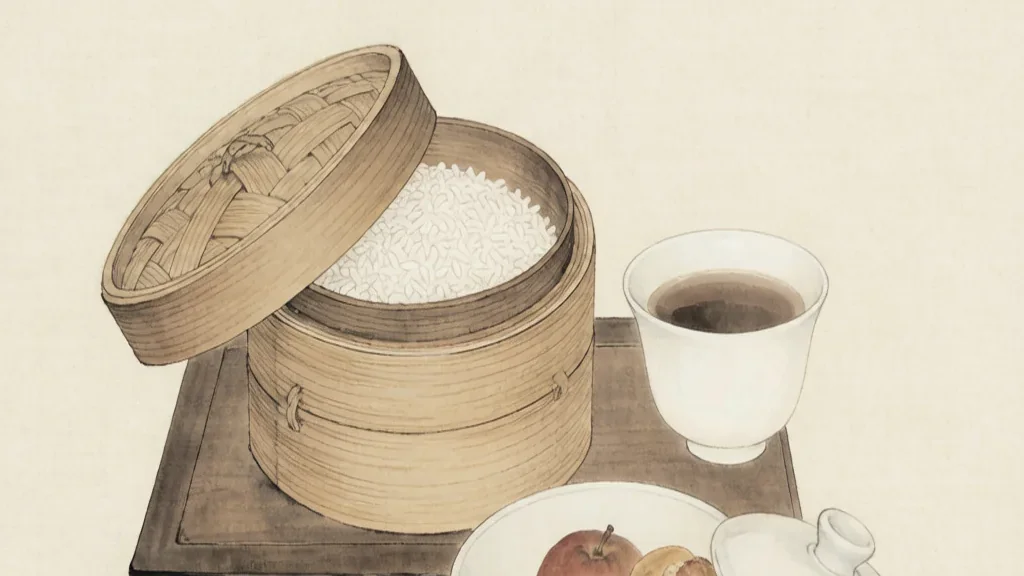
Food is written deeply into Chinese. A large family of characters describes grains, meals, cooking, and the social act of eating, and these words carry far more than nutrition—they encode agriculture, ritual, and the central Chinese value of the shared table. The food radical 食 (shí, "to eat/food"), written 饣 when simplified, heads dozens of characters, while the grain radical 禾 (hé) and specific pictographs for rice, meat, fish, and tea build out the menu of the language. From 米 (rice) to 茶 (tea) to 酒 (alcohol), the food characters are a guide to how China fed, celebrated, and defined itself. This article surveys the main food characters, their forms, and their cultural weight.
The food radical 食 (饣)
食 (shí) means "food" and "to eat," and as a radical (simplified to 饣 on the left) it organizes a whole category of characters: 饭 (cooked rice, meal), 饱 (full), 饿 (hungry), 饺 (dumpling), 饼 (flatbread/cake), 馆 (restaurant). The element itself is a pictograph of a bowl with food, later stylized, and it marks anything about eating and meals.
Recognizing 饣 instantly tells a learner that a character is about food or the state of eating, making it one of the most useful radicals for navigating daily vocabulary from the market to the menu.
Rice and grain: 米, 饭, 禾, 谷
米 (mǐ) is a pictograph of rice grains scattered—the staple that defines Chinese cuisine, especially in the south. 饭 (fàn) pairs the food radical with 反 and means "cooked rice" or a "meal" generally. 禾 (hé) pictures a grain plant with a drooping head and is the radical for cereal crops; 谷 (gǔ, grain) names the harvested seed.
Because rice and grain were the foundation of survival, these characters are among the most frequent in the language, and 米饭 (rice) or simply 饭 is the center of most traditional meals. The script literally puts grain at the grammatical core of "eating."
Noodles and flour: 面
面 (miàn, also 麵 in traditional for the wheat-noodle sense) means "flour," "noodles," and "face." The wheat form 麵 joins 麦 (wheat) with 面, showing that noodles belong to the northern, wheat-eating culture as opposed to the southern rice culture. Noodles (面条) are a birthday staple symbolizing long life.
The double meaning of 面 as "face" and "noodles" is a happy coincidence of form, but it points to how central both flour foods and social "face" (面子) are in Chinese life—two kinds of sustenance, one character.
Meat and fish: 肉, 鱼
肉 (ròu, meat) is a pictograph of a cut of flesh with sinews, and in its radical form 月 (the "moon/meat" radical) it appears in many body and meat words. 鱼 (yú, fish) is a clear pictograph of a fish with head, body, and tail, and it heads a family of fish-name characters.
Meat and fish were important protein and ritual offerings; the 月 radical's double duty (moon vs. meat) is a classic trap for learners, since 脚 (foot) and 肝 (liver) use the "meat" 月, not the "moon" 月.
Vegetables and dishes: 菜
菜 (cài) joins the grass radical 艹 with 采 (cǎi, "to pick") and means "vegetable" or "dish/cuisine." It covers both the greens of the garden and the prepared dishes of a meal—中菜 is "Chinese cuisine." Vegetables were the bulk of the traditional diet, with meat as a seasoning rather than the main portion.
The character's "pick" component reflects gathering wild and garden plants, an old layer of food culture where foraged greens mattered as much as farmed grain. 菜 thus ties the menu to the land.
Tea: 茶
茶 (chá, tea) is a relative latecomer in form: it derives from an earlier character 荼 (a bitter herb) by dropping one stroke, a change dated to the Tang dynasty when tea culture flourished. It joins the grass radical with a sound component, and Lu Yu's Classic of Tea (茶经) cemented its place in literature.
Tea is more than a drink in Chinese culture; it is hospitality, medicine, and art. The single character 茶 therefore opens a vast world of ceremony, trade (the Tea Horse Road), and daily etiquette.
Alcohol: 酒 and the wine jar 酉
酒 (jiǔ, alcohol) pairs the water radical 氵 with 酉 (yǒu), a pictograph of a wine jar. 酉 is itself the tenth Earthly Branch (Rooster) and the root of many fermentation words—酿 (to brew), 醉 (drunk), 醒 (sober). The water radical signals the liquid, the jar signals the vessel and process.
Alcohol was central to sacrifice and friendship; 酒 appears in ancient bronze inscriptions recording ritual offerings. The character links the farm (grain for brewing) to the altar and the feast.
Seasonings: 盐, 糖, 油, 醋, 酱
The basic seasonings each have their characters: 盐 (yán, salt) pairs a "salt-indicating" component with 卤; 糖 (táng, sugar) uses the "sugar-cane" sense under a meaning part; 油 (yóu, oil) pairs water with 由; 醋 (cù, vinegar) uses 酉 (wine jar) with 昔; 酱 (jiàng, paste/sauce) also draws on 酉. Soy sauce, vinegar, and fermented pastes are the soul of Chinese flavor.
These characters show how fermentation (酉) and plant sources (艹, 酉) combined to build the seasoning shelf. The radical choices quietly record which ingredients were farmed, brewed, or extracted.
Eating and feasting: 餐, 宴
餐 (cān, to eat a meal) is a complex character involving "food" and "to finish," used for meals and banquets. 宴 (yàn, banquet) pairs a roof with 妟, naming the feast held under a host's roof. Dining is a social institution, and these characters mark the meal as event, not just fuel.
The importance of the shared table appears in idioms like 民以食为天 ("the people take food as heaven"), expressing how eating is treated as a near-sacred necessity and a primary form of relationship.
Modern legacy
Food characters dominate daily life: menus, markets, festivals (dumplings 饺子 at New Year, mooncakes 月饼 at Mid-Autumn), and the constant question 吃了吗 ("have you eaten?") as a greeting. Learning the food radical and its companion grain radical 禾 opens a huge, practical vocabulary.
For anyone studying Chinese, the food characters are both useful and revealing: they show a civilization that turned agriculture into art and the daily meal into a bond of family and state.
❓ Frequently Asked Questions
What does the food radical 食/饣 cover?
It heads characters about eating and meals—饭 (meal), 饱 (full), 饿 (hungry), 饺 (dumpling), 饼 (bread), 馆 (restaurant)—so any 饣 character is likely food-related.
How did the character for tea (茶) arise?
茶 was separated from the older character 荼 (a bitter herb) by removing one stroke, a change associated with the Tang dynasty flowering of tea culture.
Why does 酒 (alcohol) use a wine-jar component?
酒 pairs the water radical with 酉, a pictograph of a wine jar and the root of fermentation words, reflecting that alcohol is a brewed liquid.
What is the difference between 米 and 饭?
米 is uncooked rice/grain, while 饭 is cooked rice or a meal; 饭 is the everyday center of the traditional diet, especially in the south.
How do north and south differ in food characters?
South centers on 米 (rice), north on 面 (wheat noodles/flour); both are encoded in basic characters and shape regional cuisine and idiom.
Why is the "meat" radical confusing?
The meat radical is written 月, identical to the moon radical; body and meat words like 肝 (liver) use the meat 月, so learners must tell them apart by meaning, not shape.