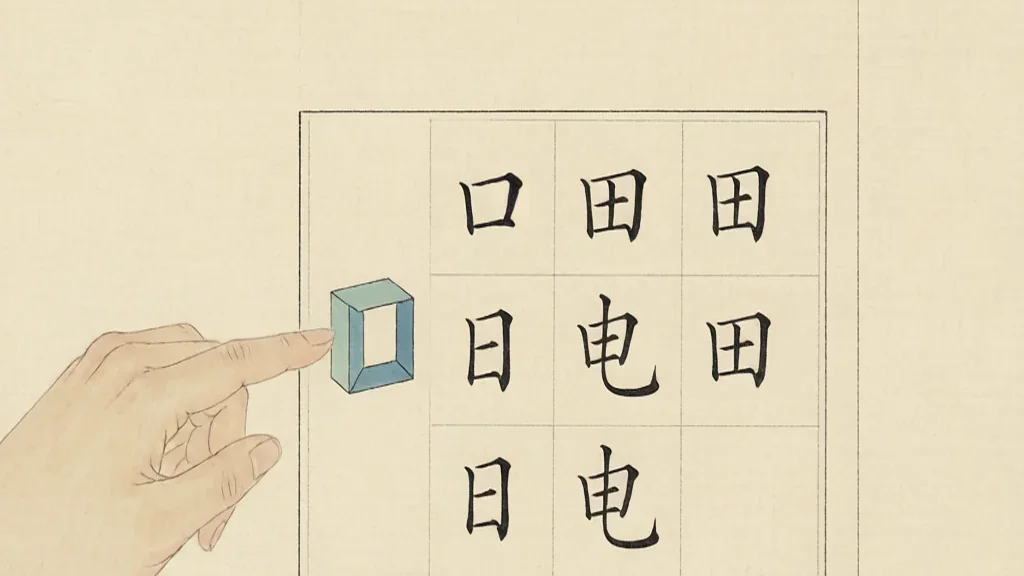
Radicals are the organizing atoms of the Chinese writing system. A radical (部首, bùshǒu) is a recurring component — usually a simple pictograph or ideograph — that anchors a character to a semantic category and serves as its address in traditional dictionaries. Almost every character contains one radical, and that radical tells you what corner of human experience the character inhabits: water, fire, the body, plants, speech, or metal. Learning radicals is less about memorizing shapes than about acquiring a map; once the map is in your head, tens of thousands of characters stop looking like noise and start looking like classified entries in a vast, ancient library.
What Exactly Is a Radical?
A radical is the component under which a character is filed in a dictionary. Historically this was the left, top, or surrounding element that gave the character its meaning family. In the character 河 (hé, "river"), the water radical 氵 tells you the word concerns water; the rest is the phonetic.
It is important to separate "radical" from "component." A character may contain several reusable parts, but only one is its official radical for dictionary lookup. The radical is the钥匙 that opens the drawer where the character is stored.
A Short History of the Concept
The radical system was formalized by Xu Shen in his Shuowen Jiezi around 100 CE, where he grouped about ten thousand characters under 540 radicals. He chose components that were themselves meaningful primitives, so the classification doubled as a philosophical map of the world.
Later lexicographers streamlined the list. The Zihui of 1615 reduced radicals to 214, a count kept by the famous Kangxi Dictionary of 1716. Those 214 Kangxi radicals remain the standard reference set used by scholars and by many modern dictionary indexes today.
The 214 Kangxi Radicals
The Kangxi radical set runs from single strokes — 一 (one), 丨 (vertical), 丿 (slash) — up to complex forms like 龍 (dragon) and 龜 (turtle). They are ordered roughly by stroke count, so a dictionary user first counts the strokes in the radical, finds that radical's section, then counts the remaining strokes of the character.
This two-step counting method is why learning to count strokes matters even for readers who rely on electronic dictionaries. The physical Kangxi list is the backbone of nearly every printed Chinese character dictionary produced in the last three centuries.
Radicals as Meaning Families
Radicals cluster characters by domain. The wood radical 木 gathers tree and plant words: 林 (forest), 枝 (branch), 桌 (table). The heart radical 心 (or its 忄 form) gathers feeling words: 怒 (anger), 思 (think), 愛 (love). The woman radical 女 appears in many kinship and gender terms.
These families are not random; they reflect how classical Chinese speakers categorized reality. Reading a radical is therefore a small act of cultural archaeology, revealing what was considered a basic, nameable kind of thing.
Radicals Versus Phonetics
In a phonetic compound, the radical supplies meaning while a different component supplies sound. The two coexist in most characters: 海 (hǎi, "sea") has water radical 氵 and phonetic 每 (měi). The radical answers "what about," the phonetic answers "how does it sound."
Some simple characters, though, are pure radicals used as words in their own right — 木 means both "wood" as a radical and "tree" as a word. These primitive characters blur the line between component and standalone sign.
How to Learn Radicals
The most efficient path is to learn the hundred or so most frequent radicals first. These cover the overwhelming majority of daily characters. Flashcards that pair the shape, the name, and a few example words build quick recognition.
Learners benefit from noticing how a radical changes form in position: 心 becomes 忄on the left, 水 becomes 氵, 火 becomes 灬 at the bottom. Spotting these variant shapes is key to identifying the radical inside unfamiliar characters.
Radicals in Dictionaries and Software
Traditional dictionaries are indexed by radical then stroke count, but modern tools extend this. Input methods let users type by component, and etymology databases display a character's radical prominently. Unicode and font rendering rely on component structure behind the scenes.
Even so, the radical remains the conceptual anchor. When a student looks up an unknown character by its radical, they are performing exactly the lookup Xu Shen designed two millennia ago, now assisted by search boxes instead of paper indexes.
Misconceptions to Avoid
A common beginner error is assuming the radical gives the full meaning of the character. It only gives a domain. 婚 (marriage) has the woman radical, but the word is about a social institution, not literally "woman." Context and the phonetic fill in the rest.
Another error is thinking every visual piece is a radical. Only the dictionary-classified component counts for lookup, even if other parts look separable. Precision here saves time when searching.
Why Radicals Still Matter
In an age of pinyin input and voice typing, you might wonder whether radicals are obsolete. They are not. Radicals remain the fastest way to browse related characters, the basis of handwriting recognition, and a direct line into the classical organization of knowledge.
For learners, radicals convert a flat list of characters into a tree. That structure is what makes the script learnable at scale, and it is what connects modern readers to the categorical thinking of the scholars who first mapped the characters.
Radicals and the Simplified Script
Simplification changed the shapes of many radicals, and learners must know both forms. The speech radical 言 became 讠, the food radical 食 became 饣, the metal radical 金 became 钅, and the hair/long radical 長 became 镸 then 长. These compressions keep the radical identifiable while shedding strokes.
Because traditional, simplified, and Japanese kanji share the same underlying radical logic, a reader who knows the Kangxi set can usually find a character in any of the three systems, adjusting only for the abbreviated left forms. The radical is thus a stable bridge across regional variants of the script.
❓ Frequently Asked Questions
What is a Chinese radical?
A radical is the component under which a character is filed in a dictionary, usually indicating its meaning category. It acts as the character's address.
How many radicals are there?
The traditional Kangxi system lists 214 radicals, though Xu Shen's earlier work used 540. Modern simplified indexes sometimes use fewer.
Is the radical the same as the meaning?
No. The radical gives a semantic domain, not the full meaning. It tells you the topic area, while other components add detail.
Can a character have more than one radical?
For dictionary lookup a character has exactly one official radical, even though it may contain several reusable components.
How do I find a character's radical?
Identify the meaning-related component, count its strokes to find the radical section, then count the remaining strokes of the character.
Do radicals still matter with pinyin input?
Yes. They remain essential for browsing related characters, handwriting recognition, and understanding the classical organization of the script.