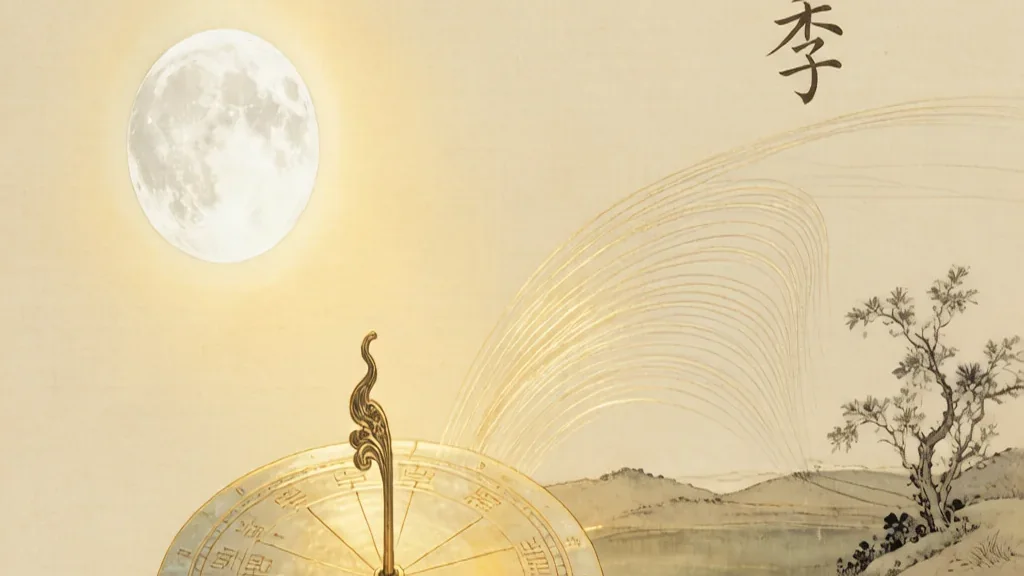
Time is one of the oldest and most abstract ideas human beings needed to write down, and Chinese characters offer a remarkable window into how classical speakers conceived it. From the sun tracking across the sky to the cycles of seasons, months, and dynasties, the script encodes time through celestial markers, natural rhythms, and built measuring units. This article explores the characters for time and its parts — day, night, season, year, moment — the radicals and components that carry temporal meaning, and the cultural worldview of cyclical time embedded in the writing.
The Sun as Timekeeper
The most basic time character is 日 (rì), originally a pictograph of the sun with a dot or line in the middle. It means both "sun" and "day," showing that the day was measured by one solar circuit. The same glyph underlies 时 (shí, "time" in modern use).
Relatives cluster around it: 旦 (dàn, "dawn") shows the sun rising above the horizon line; 暮 (mù, "dusk") originally showed the sun in the branches of trees; 明 (míng, "bright") pairs sun and moon. Time, in these characters, is literally sunlight moving through the world.
The sun's daily arc also yielded finer temporal words. 昃 (zè) shows the sun past the meridian, marking mid-afternoon, while 昏 (hūn, dusk) originally pictured the sun sinking below the horizon. The measurement of a day's divisions, tied to sundial shadows, reflects the same solar observation, and even words for "old" or "worn" draw on the idea of the sun's long passage. Timekeeping in early China was, concretely, a practice of watching the sun's position and naming each station along its path, with the script preserving those stations as individual characters.
Day and Night Characters
Day is 日; night is 夜 (yè), a character whose components suggest a person and the darkness of the moonless period. 晚 (wǎn, "evening") uses the sun radical with a phonetic, marking the late-day turn. 晨 (chén, "morning") pairs the sun with a phonetic indicating the early hours.
The day's divisions were also written with specific characters: 午 (wǔ) for noon, 朝 (zhāo) for early morning. These show a culture attentive to fine gradations of the daily cycle, each with its own written sign.
Months and the Moon
The moon radical 月 (yuè) gives us 月 itself meaning both "moon" and "month," because the lunar cycle was the natural month. A month was, concretely, one moon. The shared glyph reveals that the calendar was originally observed, not computed.
Characters for phases and time-by-moon include 期 (qī, "period, deadline"), which pairs the moon with a phonetic. The moon's regular visibility made it the second great celestial clock after the sun, and the script records both.
Years and the Harvest Cycle
The character 年 (nián, "year") is a pictograph of a person carrying grain, originally meaning "harvest." A year was the time from one harvest to the next, tying the calendar to agriculture. This root shows time reckoned by the land's productivity.
Relatedly, 岁 (suì, "year") and 载 (zǎi, "year," in classical usage) also mark annual cycles, the former possibly linked to an agricultural or sacrificial term. The plurality of "year" words reflects different historical and regional reckonings.
Seasons and Nature
Seasons appear through nature radicals. 春 (chūn, "spring") contains sprouts breaking ground; 夏 (xià, "summer") originally depicted a large figure, later a person in the heat; 秋 (qiū, "autumn") shows a cricket or fire over grain, the harvest burning; 冬 (dōng, "winter") shows the end, with ice markers.
These characters tie the year's quarters to what is visibly happening in fields and weather. Time is not an abstract number but a sequence of natural events, each inscribed in its glyph.
The Time Radical 日 in Compounds
The sun radical heads most temporal compounds. 时 (shí, "time"), 早 (zǎo, "early"), 晚 (wǎn, "late"), 晴 (qíng, "clear," weather-time), and 昔 (xī, "past") all use 日. The radical acts as a flag for "when."
Some temporal words instead use 月 (month) or other elements, but 日 is the dominant temporal marker in the character system, confirming the sun as the primaryclock of classical life.
Moments, Instants, and Duration
For finer units, Chinese uses characters like 刻 (kè, a quarter of a two-hour watch), 分 (fēn, a minute/division), and 秒 (miǎo, a second), the last originally a grain of wheat, later a tiny time unit. 瞬 (shùn, "an instant") uses the eye radical, "a blink."
These show a scale from the astronomical (sun, moon) down to the merely human (a blink, a breath). The vocabulary of time spans cosmic cycles and fleeting moments within a single coherent network of characters.
Cyclical Versus Linear Time
The classical Chinese view, encoded in these characters, leans cyclical: days, months, seasons, and years return. The ten heavenly stems and twelve earthly branches (干支) combine into sixty-year cycles used to name years, a system still referenced in zodiac and date reckoning.
This cyclical sense differs from a strictly linear timeline. Characters like 复 (fù, "to return, repeat") and 轮 (lún, "to rotate, a cycle") reinforce a worldview where time is a wheel of recurrences rather than an arrow.
Time in Modern Usage
Today 时间 (shíjiān) is the standard word for "time," and clock and calendar terms blend old radicals with new needs. Yet the ancient characters survive intact in daily speech — saying "today" (今天), "tomorrow" (明天), "year" (年) invokes the same sun, moon, and harvest imagery.
Learning time characters thus teaches both vocabulary and a philosophy: that to the classical mind, time was the visible, repeating dance of sun, moon, grain, and season, written into the very bones of the language.
Time in Idioms and Philosophy
Chinese idioms package the temporal worldview into memorable phrases. 光阴 (guāng yīn, "time") literally means "light and shadow," casting time as the moving shade of the sun. 岁月 (suì yuè) pairs "year" and "month" for the long march of seasons, while 时不我待 (shí bù wǒ dài) warns that time waits for no one.
Such phrases show time spoken of as a visible, flowing substance rather than an abstract number line. The classical habit of marking moments by sun, moon, and grain survives in everyday expression, so that even a casual saying quietly carries the same cosmic imagery written into the characters themselves.
❓ Frequently Asked Questions
Why does 日 mean both sun and day?
Because the day was measured by one circuit of the sun, so the pictograph of the sun naturally also meant a day.
How is the year written and what does it mean?
年 shows a person carrying grain and originally meant "harvest," revealing that the year was reckoned by the agricultural cycle.
Why do moon and month share a character?
The lunar cycle was the natural month, so 月 served for both the moon and the month in the calendar.
Which radical marks time most?
The sun radical 日 heads most temporal compounds, confirming the sun as classical China's primary timekeeper.
Was Chinese time seen as linear or cyclical?
Largely cyclical; days, months, seasons, and sixty-year stem-branch cycles were seen as repeating, like a wheel.
What character means an instant?
瞬, originally "a blink," uses the eye radical to convey a fleeting moment.