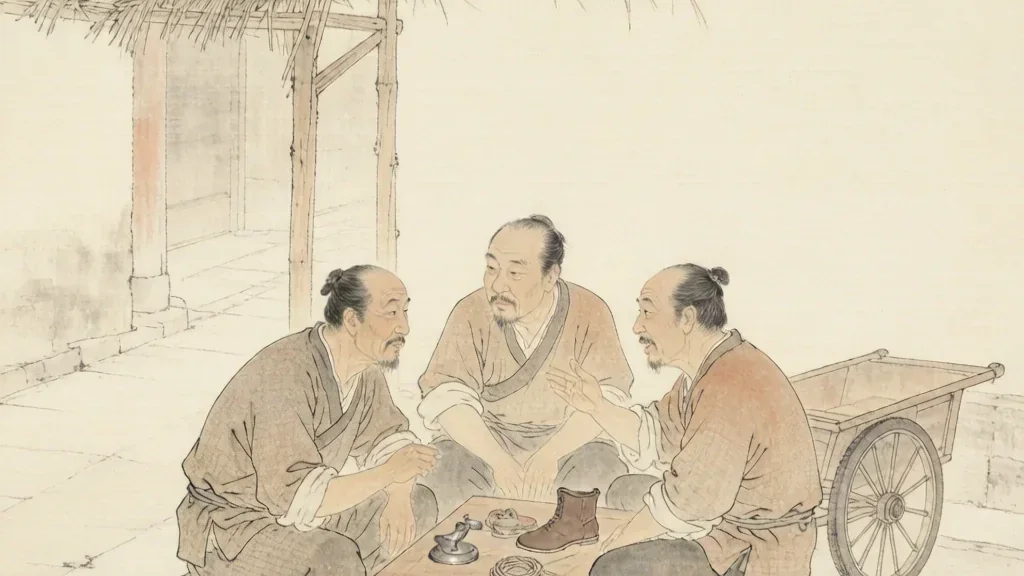
Most Chinese proverbs honor the sage, the general, or the diligent student — but 三个臭皮匠,顶个诸葛亮 (sān gè chòu píjiàng, dǐng gè Zhūgě Liàng) flips the script. "Three stinky cobblers equal one Zhuge Liang," it says, setting the humblest workers in the marketplace against the most celebrated genius in Chinese history. The joke is affectionate, the math impossible, and the message radical: ordinary people, pooling their small wits, can out-think even a mastermind. In a culture that also venerates the lone hero, this proverb stands as a democratic counterweight — a folk hymn to teamwork, humility, and the quiet power of many minds.
Literal Meaning and the Cobbler's Humor
The line is a single playful equation. 三 (sān) is "three"; 个 (gè) is a measure word for people; 臭 (chòu) is "smelly" or "lowly"; 皮匠 (píjiàng) is a "cobbler" or leather worker — a trade associated with sweat, dust, and modest status. 顶 (dǐng) means "to match," "to equal," or "to stand up to"; the second 个 is another measure word; and 诸葛亮 (Zhūgě Liàng) is the fabled strategist. So literally: three lowly cobblers, together, are a match for Zhuge Liang. The 臭 is self-mocking humor about the cobblers' unglamorous work, not a real insult — it sharpens the contrast that makes the saying funny and memorable.
The structure is a classic underdog comparison: take the cheapest inputs, multiply them, and they rival the most expensive output. The absurdity is the point, which is why the proverb sticks in the ear like a punchline with a lesson.
Who Was Zhuge Liang?
To get the joke you must know the legend. 诸葛亮 (Zhūgě Liàng, 181–234 CE) served as chancellor and chief strategist of the Shu-Han state during the 三国 (Sān Guó, Three Kingdoms) era, a time of warring successor states after the Han collapse. In both history and the novel 三国演义 (Sānguó Yǎnyì, Romance of the Three Kingdoms), he is portrayed as the peerless master of strategy — inventor of clever devices, author of flawless plans, the very emblem of 智慧 (zhìhuì, wisdom). Setting "three cobblers" against him is precisely the joke: even he can be matched by humble collective effort.
Because Zhuge Liang is the gold standard of individual brilliance in Chinese culture, the proverb uses him as the highest possible bar. To say the cobblers "equal" him is to say collective effort can reach the summit of human cleverness — a bold, almost cheeky claim that only a folk saying could make.
Cultural Context: Many Minds Over One Genius
The proverb belongs to a current of Chinese thought that values 集思广益 (jí sī guǎng yì, "gather ideas and broaden benefit") — the practice of drawing on many viewpoints. While Confucianism honors the wise teacher, practical Chinese life has always relied on family councils, village meetings, and guild cooperation, where survival depended on pooling knowledge. The cobblers' saying gives that cooperative instinct a cheerful slogan.
It also gently warns against over-revering experts. A single brilliant advisor can be wrong, biased, or blind to what ordinary people see; three cobblers, each with a different slice of experience, cover more ground. The proverb thus democratizes wisdom: it is not the property of the robed sage but something anyone can contribute to, simply by adding their mind to the pile.
How It Is Used Today
Modern usage is the language of teamwork. A manager invokes it to justify a brainstorming session or a cross-functional team; a teacher uses it to show that group projects beat lone study; a family calls on it when several relatives solve a problem none could crack alone. It is the Chinese cousin of "two heads are better than one," but scaled up and pointed at the humblest workers, which makes it especially encouraging to people who doubt their own expertise.
In an age of complex, fast-moving problems — from climate to software — the proverb reads almost like modern advice about 众包 (crowdsourcing) and diverse teams. It reminds organizations that the smartest person in the room is often the room itself. To quote 三个臭皮匠 is to insist that humility and collaboration beat solitary genius more often than we admit.
The Cobblers and the Limits of Genius
The proverb quietly questions the cult of the lone hero. A single brilliant advisor — a Zhuge Liang — can be wrong, overconfident, or blind to ground-level realities that ordinary people see every day. Three cobblers, each carrying a different slice of practical experience, cover more angles and catch more mistakes. The saying thus anticipates modern findings about 群体智慧 (qúntǐ zhìhuì, the wisdom of crowds): diverse, independent perspectives often beat a single expert, however gifted. It is a folk intuition dressed as a joke.
There is also a lesson about status. The cobblers are "smelly" precisely to make the point that worth is not measured by rank or robe. The proverb licenses everyone in the room to contribute, which is why it thrives in workshops and classrooms where hierarchy might otherwise silence good ideas. By laughing at the gap between cobbler and chancellor, it dissolves that gap in practice — reminding us that the next breakthrough may come from the person least expected to deliver it.
Modern open-source software and citizen science are the proverb operating at scale: thousands of unpaid, unknown contributors, none of them a Zhuge Liang, collectively build tools no single genius could. The cobblers' logic has never been more visible. It suggests a humble but powerful stance for any team — assume the room is smarter than its most impressive member, and design your process to let every voice add its thread to the weave.
Legacy and Closing
三个臭皮匠,顶个诸葛亮 has survived because it is both funny and true. It teases the arrogance of expertise and the shame of ordinariness at the same time, telling the genius he is matchable and the cobbler he is needed. In doing so it performs a small piece of social magic: it makes collaboration feel like a victory rather than a compromise. To live by it is to believe that the next good idea may come from the person least expected to have it — and that three modest minds, working together, can indeed stand toe-to-toe with a legend.