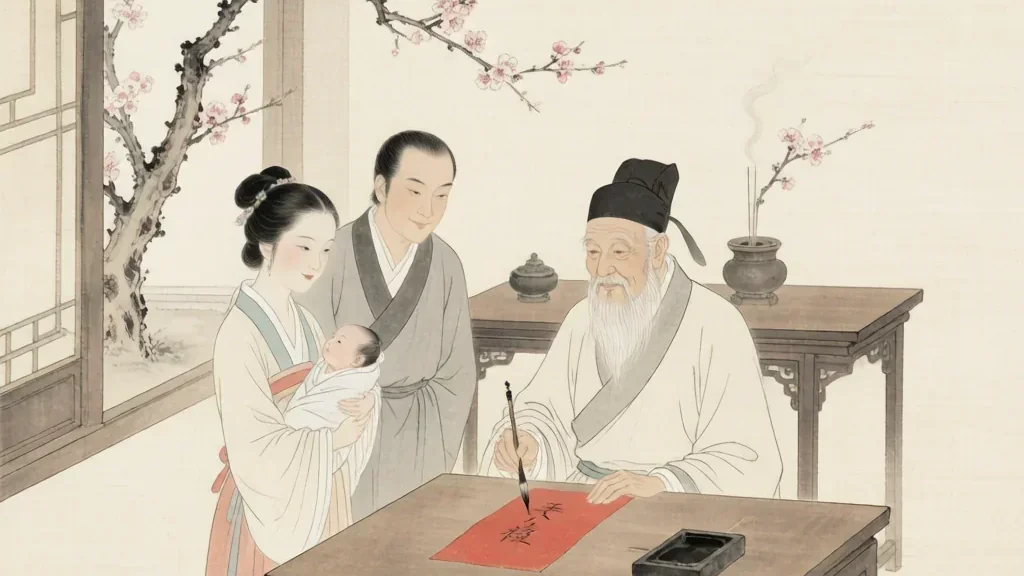
To name a Chinese child is to write a small poem and a quiet prayer at once. A full traditional name carries the hereditary surname (姓, xìng), the given name (名, míng) chosen at birth, and often a courtesy name (字, zì) granted at adulthood — three layers that together speak of family, aspiration, and social role. The study of this practice, xingming xue (姓名学, "the study of names"), treats the personal name not as a label but as a crafted object, balanced for sound, meaning, and fate.
The Three Parts of a Name
The surname comes first and is never chosen — it is inherited, the anchor to the ancestors. The ming is the given name, usually one or two characters, selected by the parents. The zi (字), or courtesy name, was traditionally conferred at the coming-of-age ceremony (冠礼, guàn lǐ) for men and used by peers and in writing; it was considered disrespectful to call a gentleman by his ming once he had a zi. Thus the poet 李白 (Lǐ Bái) is also known by his zi, 太白 (Tàibái).
This three-part structure shows the Chinese view that a person has a public family identity, a private intimate name, and a social name for equals — a graduated self revealed differently to different circles.
Historically the zi also softened the intimacy of the ming. The given name was considered almost sacred, used by parents and the state, while the courtesy name was the one friends and colleagues spoke — so that calling a peer by his ming after adulthood was a breach of manners, a small arrogance that implied the speaker stood in a parent's place. The name system thus encoded etiquette as much as identity, teaching respect through grammar.
The same etiquette survived into the modern era in softer form. Even today, using a person's given name too freely with an elder or a superior can feel presumptuous, while the surname plus a title (Li laoshi, Wang jingli) is the safe, respectful default. The old three-part name thus lives on in everyday politeness, long after the courtesy name itself has faded from common use.
Generation Names and the Family Poem
One of the most elegant features of Chinese naming is the zi bei (字辈, "generation character"). A clan's genealogy often embeds a hidden poem; each generation in the lineage takes one designated character from that poem as the first (or second) character of its given name. Two strangers who meet and share a surname can compare the generation character in their names and instantly know who is senior.
These poems can run for dozens of generations, a verbal calendar of the family's future. To choose a child's name within this system is to place them precisely in a centuries-long queue of ancestors and descendants — a remarkable way of making kinship visible in everyday speech.
Meaning, Aspiration, and Avoided Sounds
Because Chinese characters each carry meaning, a given name is a tiny wish. Parents reach for characters like 伟 (wěi, "great"), 秀 (xiù, "elegant"), 安 (ān, "peace"), 慧 (huì, "wise"), or 强 (qiáng, "strong"). Two-character names can form a phrase — "morning jade," "clear river" — turning the name into a miniature landscape or blessing.
Just as important is what to avoid. Names are checked for unlucky homophones (a name that sounds like "death" or "loss" is rejected), for clashing with an ancestor's name (a breach of respect), and for awkwardness when read with the surname. The careful naming of a child is, in part, the careful avoidance of a lifetime of teasing.
Because characters carry meaning, the same sound can be written many ways, and families sift the possibilities like poets. The syllable "jie" might be 杰 (outstanding), 洁 (pure), or 捷 (victory) — each a different blessing. This is why two children with the same pronunciation can have entirely different names, and why a parent poring over a dictionary of characters is really composing a tiny wish, character by character, for the life ahead.
Fate, the Five Elements, and Fortune
Many families consult a specialist who calculates the baby's birth moment against the wuxing (五行, the Five Elements of wood, fire, earth, metal, water). If the chart shows a deficiency — say, too little water — the name is "corrected" with characters bearing the water radical (氵) or water-associated meanings. Stroke-count numerology (笔画, bǐhuà) is also weighed, on the theory that the total strokes of the name influence fortune.
This is where naming meets cosmology. The name is treated as a harmonizing instrument, a way to tune the child's destiny at the very start of life. Even families who do not believe firmly in the arithmetic often keep the habit as a gesture of care — a cultural reflex as much as a迷信 (míxìn, superstition).
Famous Bearers and the Living Art
History is full of telling names. The strategist 诸葛亮 (Zhūgě Liàng) carries the compound surname Zhuge and the given name Liang ("bright"). The reformer 王安石 (Wáng Ānshí) bears "An" (peace) and "Shi" (stone). Modern Chinese naming has shifted toward fresh, individualistic two-character names, but generation characters and element-balancing still flourish in the countryside and among overseas communities.
In the end, the art of the Chinese name is the art of hope made legible. Every character is chosen, every sound tested, every element balanced — so that the moment a child is called, the family's wishes for a good life are spoken aloud, again and again, for a lifetime.
Names in a Changing Age
Modern China has loosened some old rules while keeping the spirit. One-child families chose given names more freely, often inventing unusual two-character combinations to make a child stand out in a sea of Wangs and Lis. Yet the generation poem and the Five-Element check survive in countless villages and among overseas clans, and "name masters" (起名先生) still do brisk business in cities, blending tradition with a taste for fresh, aspirational characters.
The surname itself, though, has hardly moved. Centuries of law and sentiment keep the father's line as the default, so that the xing still opens the name as it did three thousand years ago. In that continuity lies the quiet point of the whole art: a Chinese name is a small bridge across time, carrying the ancestors in its first character and the family's hopes for the future in the rest — a poem the child will hear, and answer to, for life.