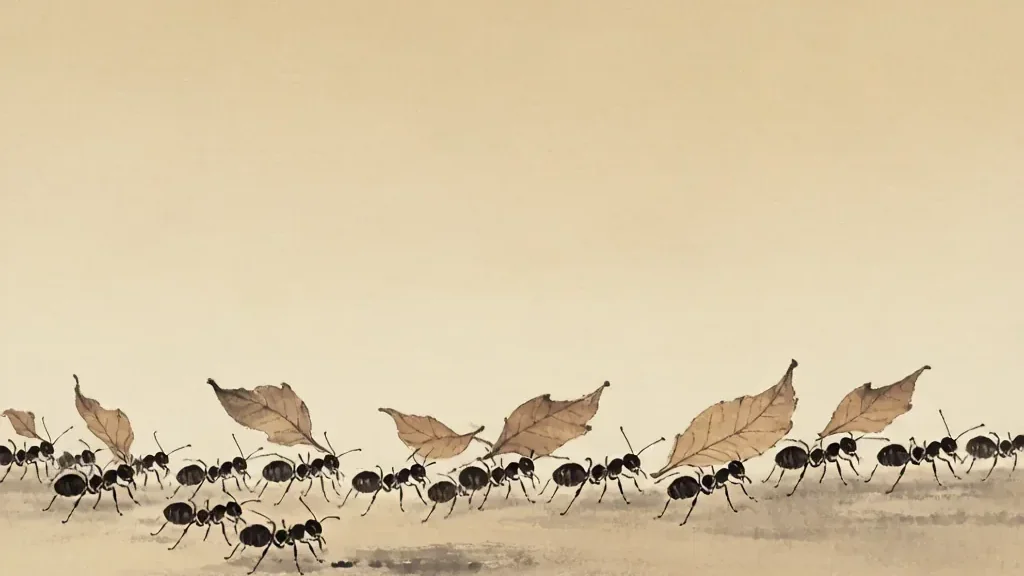
The ant (蚂蚁, mǎyǐ) is the most populous creature in Chinese literature — a tiny protagonist in a vast civilization that human beings can barely perceive. Chinese philosophers and poets have long been fascinated by the ant's collective organization, its extraordinary strength relative to its size, and its ceaseless labor. In a culture that valued social harmony, hard work, and humility, the ant was a natural moral exemplar. But the ant also raised uncomfortable questions: if ants can organize themselves into complex societies without language, without laws, without individual ambition, what does that say about the necessity of human institutions? The ant's underground cities, its division of labor, its apparent selflessness — all challenged Chinese thinkers to consider whether civilization was a uniquely human achievement or a pattern that nature had already perfected in miniature.
The Ant in Chinese Philosophy
The Zhuangzi contains a famous passage that uses ants to illustrate the relativity of perspective: "From the point of view of the ant, a blade of grass is a forest; from the point of view of the human, an ant is insignificant. Yet the ant and the human share the same Dao." This observation undermines human arrogance by reminding us that our sense of scale is arbitrary — a universe exists beneath our feet that is as complex as our own, and the ants that inhabit it perceive us as little as we perceive the gods that may inhabit a larger reality.
The Confucian tradition took a different lesson from the ants. The Xunzi, a Confucian text, praises ants for their division of labor and their willingness to sacrifice individual interests for the colony. Xunzi argues that human beings are weaker than ants in many respects — we lack their natural tools (mandibles, exoskeletons, chemical communication) — and must therefore rely on culture and social organization to survive. The ant colony was thus a model for human society: not because ants are virtuous in the human sense, but because they demonstrate the survival value of cooperation. Xunzi's ant is a pragmatic example, not a moral one, and this distinction is crucial for understanding the Chinese view of the ant.
The Ant in Chinese Poetry and Literature
Chinese poets have written about ants with a combination of scientific curiosity and poetic empathy. The Tang poet Wang Wei observed ants building a nest and wrote: "A line of ants carries a dead beetle / Through the gates of their underground city / They do not know that above them / A poet watches and feels small." The poem captures the ant's obliviousness to the human scale — the ants go about their business unaware that a being a thousand times their size is observing them. This perspective shift — from human to ant — is a poetic technique that Chinese writers used to cultivate humility and to question human assumptions about importance.
In Chinese fables, the ant often appears as the character who succeeds through industry rather than intelligence. A typical tale tells of an ant that saves a drowning bird by dragging a leaf to it, and the bird later repays the favor by warning the ant of an approaching flood. The ant's virtue is not cleverness but reliability — the ant can be counted on to do its part, and this dependability is the foundation of the community. The fable reflects a value system in which consistency and cooperation are prized above individual brilliance.
Ants in Chinese Medicine and Cuisine
Ants have a significant place in traditional Chinese medicine, particularly the Asian weaver ant (Oecophylla smaragdina). Dried ants are used as a treatment for arthritis, rheumatism, and sexual dysfunction, based on the belief that the ant's strength and activity can be transferred to the patient. Ant powder is sometimes combined with other ingredients to make a tonic wine. The practice has some support from modern research, which has found that certain ant species contain anti-inflammatory compounds and substances that stimulate the immune system.
Ant eggs — particularly the larvae and pupae of weaver ants — are eaten as a delicacy in parts of Yunnan and Guangxi provinces. Known as mǎyǐ dàn (ant eggs) or huáng kàng (yellow ant eggs), they are typically stir-fried with eggs, garlic, and chili, creating a dish with a nutty, slightly sour flavor. Ant-egg harvesting is a traditional livelihood in some ethnic minority communities, though overharvesting has led to population declines in certain areas. The practice has gained some international attention through culinary tourism, but it remains a niche taste within China as well.
The Ant in Chinese Language and Idiom
The Chinese language contains numerous idioms featuring ants. 蚂蚁搬泰山 (mǎyǐ bān Tàishān) — "ants move Mount Tai" — describes the power of collective effort, suggesting that even the most daunting task can be accomplished through cooperation. 热锅上的蚂蚁 (rè guō shàng de mǎyǐ) — "ants on a hot pot" — describes someone who is extremely anxious or agitated. 蚁穴溃堤 (yǐ xué kuì dī) — "an ant colony collapses a dike" — warns that small problems can become catastrophes if neglected, a proverb with obvious political implications for the imperial bureaucracy.
The ant's name in Chinese — mǎyǐ — is interesting for its redundancy: mǎ means "horse" and yǐ means "ant," so the compound is literally "horse-ant." The "horse" prefix is used in Chinese for several large or impressive insects (e.g., mǎfēng, "horse-wasp" for hornet), suggesting that the ant was perceived as a kind of "horse among insects" — carrying heavy loads, working in teams, and serving a master. The linguistic connection between ants and horses reveals an unsuspected dimension of Chinese animal classification: the ant is, metaphorically, a very small horse.
Ants and Chinese Ecological Awareness
Ants play a crucial role in Chinese ecosystems as soil engineers, seed dispersers, and predators of pest insects. Chinese ecologists have studied the role of ants in forest regeneration and agricultural pest control, finding that ant-rich ecosystems are more resilient to disturbances. The traditional Chinese practice of transplanting ant nests into citrus orchards to control pests — documented as early as the fourth century CE — represents one of the earliest examples of biological pest control in world agriculture. The practice continues in parts of southern China, where farmers maintain "ant bridges" between trees to allow ants to move freely through the orchard.
The ant's decline in urban and agricultural areas due to pesticide use and habitat fragmentation has become a concern for Chinese conservation biologists. Some ant species are now monitored as bioindicators of ecosystem health, their populations reflecting the state of the soil and the broader environment. The ant, which has lived alongside Chinese farmers for thousands of years, has become a measure of the health of the land itself — a role that would have surprised the old philosophers who used ants to teach lessons about society and virtue.
Ants in Chinese Children's Education
For centuries, Chinese parents and teachers have used the ant to teach values of diligence, patience, and cooperation. Proverbs such as 'ants move Mount Tai' appear in school readers and moral primers, where the tiny insect becomes a stand-in for persistence against overwhelming odds. Picture books and cartoons recast the ant as a cheerful, hard-working character who finishes the task the louder, stronger animals abandon. In rural classrooms, teachers point to ant lines as a live demonstration of teamwork. The ant's appeal as an educational symbol lies in its smallness: a child can identify with a creature that succeeds not by strength or cleverness but by steady, collective effort. In this way the ant carries the Confucian emphasis on self-cultivation from folk philosophy into the nursery.
The Ant in Chinese Observational Science
Long before modern entomology, Chinese scholars recorded careful observations of ant behavior. Agricultural writers noted the seasonal timing of nest-building and linked it to weather prediction, a folk meteorology still quoted in rural almanacs. Farmers read the height of ant hills as a sign of coming rainfall, and a colony's sudden move was taken as a warning of floods. Within traditional natural history, ants were classed among the 'insects that work' and contrasted with locusts and pests that destroy. These observations fed a practical ecology: knowing ant habits helped orchardists use them for pest control centuries before the term biological control existed. Today Chinese researchers study ant cognition, navigation, and colony organization with tools the old almanac writers could not imagine, yet the curiosity of reading the small world beneath our feet is continuous with a very old native tradition.
Ant Colonies as Social Models
Chinese political and social thinkers have long used the ant colony as a mirror for human society. The ant's division of labor, with workers, soldiers, and a single queen, offered a natural image of an ordered state in which each member fulfills a fixed role for the common good. In times of famine or war, the colony's discipline was held up both as a model to admire and, more darkly, as a warning against the erasure of individual will. Daoist and Buddhist writers drew a different lesson, noting that the ant pursues no personal ambition yet the colony thrives, suggesting that desire itself may be the source of human suffering. The contrast between the ant's effortless cooperation and humanity's contested institutions recurs from the Zhuangzi to modern essays, making the ant colony a compact thought-experiment about how a society can function when individuals subordinate themselves to a larger whole.
❓ Frequently Asked Questions
📝 Chinese Vocabulary
蚂蚁 — : ant; literally "horse-ant."
蚂蚁搬泰山 — : "ants move Mount Tai"; an idiom for the power of collective effort.
热锅上的蚂蚁 — : "ants on a hot pot"; describing extreme anxiety.
蚁穴溃堤 — : "ant colony collapses a dike"; warning that small problems can become disasters.
雄蚁 — : male ant; also called yǐ wáng (ant king).
工蚁 — : worker ant; the sterile female caste that gathers food and tends the colony.
蚁后 — : queen ant; the single reproductive female at the centre of a colony.
蚁群 — : ant colony or swarm; the whole social group rather than a single insect.
🎉 Fun Facts
- Chinese citrus farmers have been using ants for biological pest control since at least 340 CE, when Xi Han's Record of the Plants and Trees of the Southern Region described the practice.
- The word mǎyǐ (ant) contains the character for "horse" (mǎ) because the ant was considered the "horse among insects" for its strength and usefulness.
- Some Chinese ant species can lift objects up to 50 times their own body weight — the equivalent of a human lifting a fully loaded SUV.
- Weaver ants organize raids by laying scent trails of pheromones and by tapping one another with their antennae, letting hundreds coordinate the transport of food many times an individual's size.
- The 'ant war' (yǐ zhàn) was a popular pastime in late imperial China in which children and adults pitted two colonies against each other inside a ring, a game recorded in Ming and Qing folklore.
- Some Chinese desert ants count their steps and read the sun's position to find the way home, abilities that have made them a subject of interest for researchers studying insect navigation.