Cultural Animals
49 articles — Real animals and the symbolic meanings they carry in Chinese culture, from the crane of long life to the swallow of home.
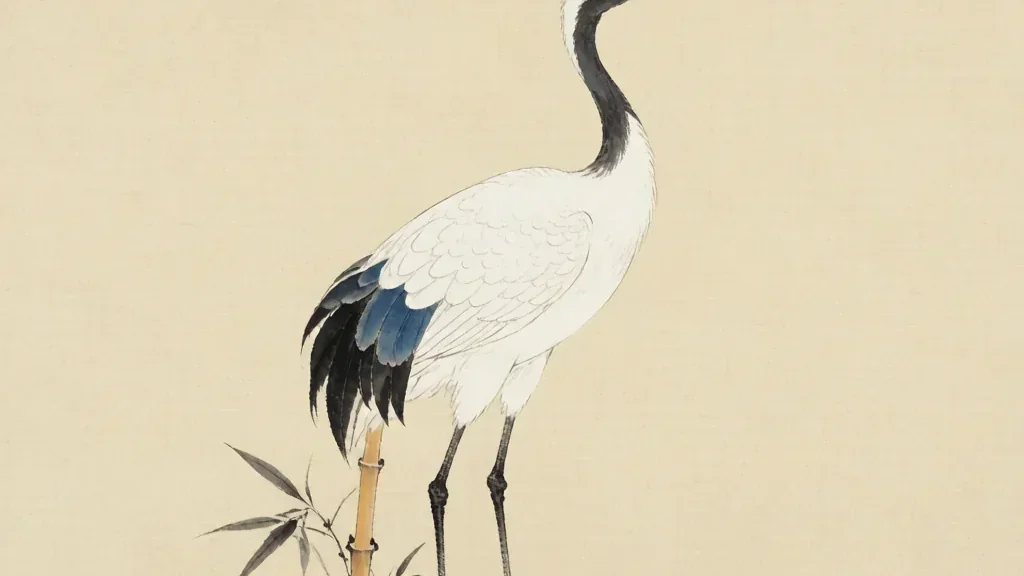
The Crane: Symbol of Longevity and Noble Spirit (鹤)
Among the birds of China none carries more weight than the crane. With its snow-white body, black neck trim, and a crown of bare red skin, the red-crowned crane (丹顶鹤, dān dǐng hè) walks the wetlands of the northeast with a poise that early observers read as pride held in check.
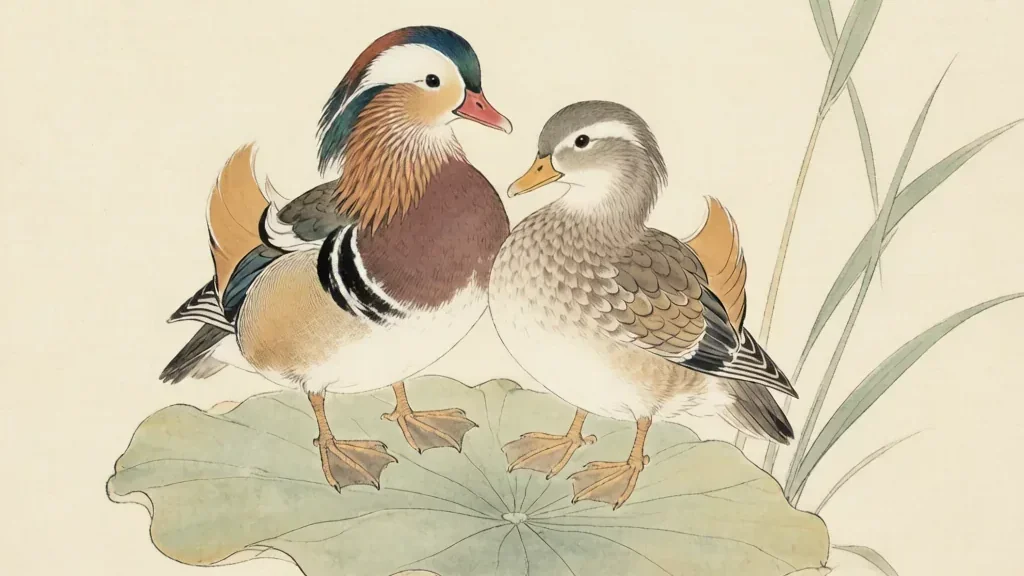
The Mandarin Duck: Emblem of Conjugal Love (鸳鸯)
If the crane stands for a long life and the magpie for good news, the mandarin duck stands for something more tender: the love between husband and wife. The yuanyang (鸳鸯, yuān yāng) is a small East Asian perching duck whose male wears a plumage of orange, green, and white like a court robe, while the female is dressed in modest brown.
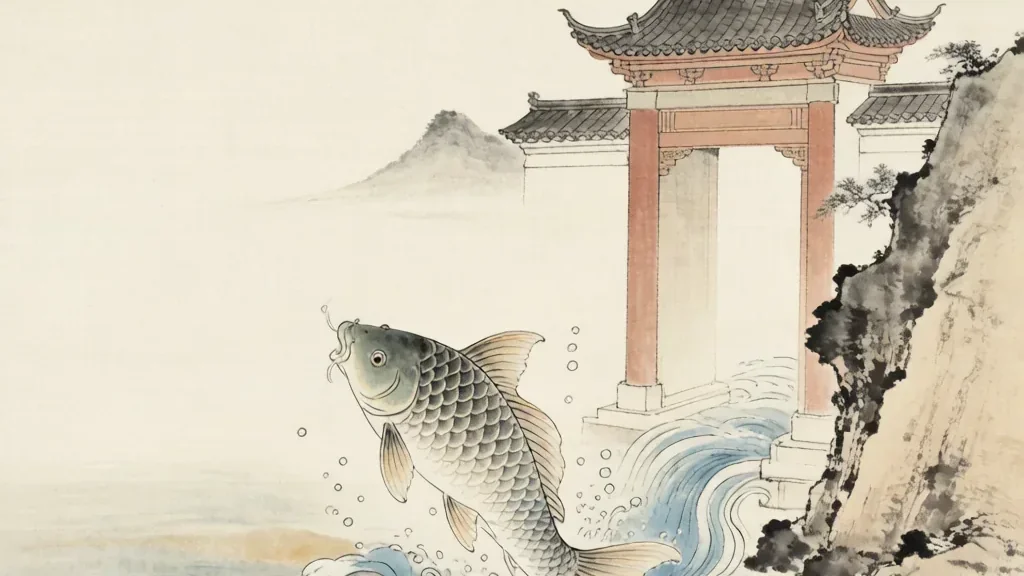
The Carp: Leaping the Dragon Gate (鲤鱼)
Of all the animals in the Chinese symbolic world, the humble carp carries one of the most hopeful stories. A common fish of rivers and ponds, the liyu (鲤鱼, lǐ yú) is prized not for rarity but for what it does: it swims against the current.
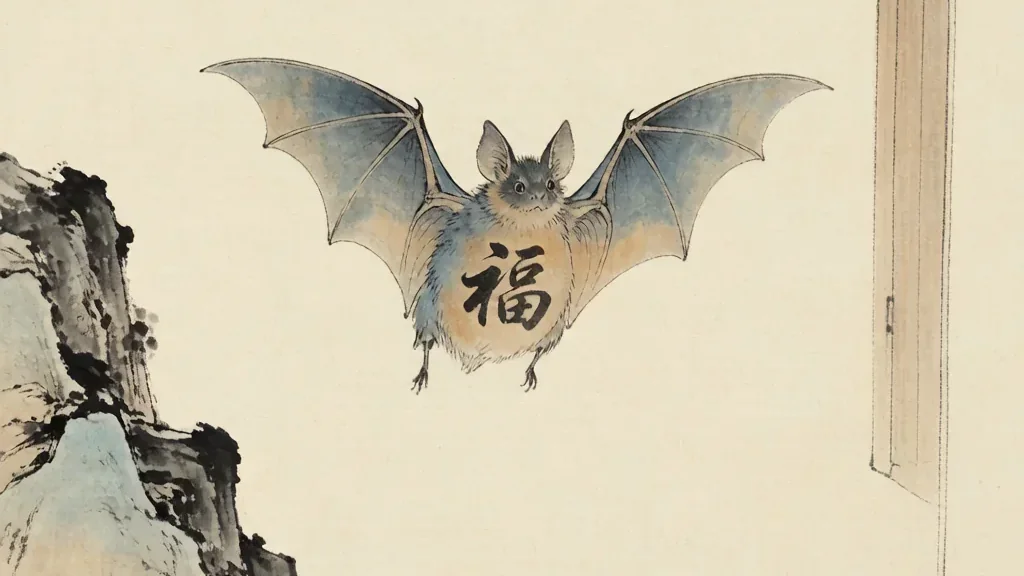
The Bat: A Homophone for Good Fortune (蝙蝠)
In the West the bat is a creature of caves and dread, but in China it is welcome at the door. The reason is a pun.

The Magpie: Bringer of Good News (喜鹊)
Where the European magpie is a thief and an omen of ill luck, the Chinese magpie is a welcome guest. The bird's very name, xǐquè (喜鹊), opens with xǐ (喜), the word for joy and happiness, and its long, rattling call was heard not as a warning but as an announcement.

The Toad: Liu Hai and the Money Toad (蟾蜍)
The toad is not the first animal one would expect to find on a shop counter or in the palace of the moon, yet in China it sits in both places. The chánchú (蟾蜍) is a creature of two fortunes: in the sky it is the toad that lives on the moon, and on earth it is the three-legged Money Toad that spits coins.

The Horse: Dragon-Horse Spirit and Valor (马)
The horse holds a place in Chinese symbolism that few real animals reach: it is at once a work-beast of the empire and a creature of myth. The mǎ (马) carried generals into battle, couriers across a thousand miles, and the sage Fu Xi's diagram out of the Yellow River.
The Swallow: Herald of Spring and Home (燕)
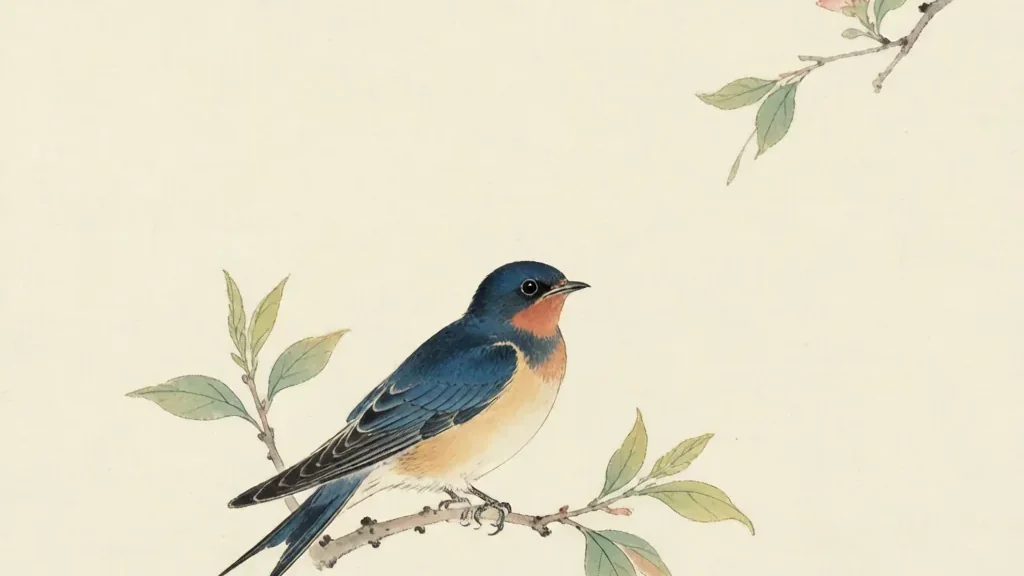
No bird announces the Chinese spring like the swallow. With its swept wings and forked tail, the yàn (燕) slips back from the south each year just as the cold breaks, and for two thousand years its arrival has meant the season has turned.
The Ant: Industry and the Power of the Collective
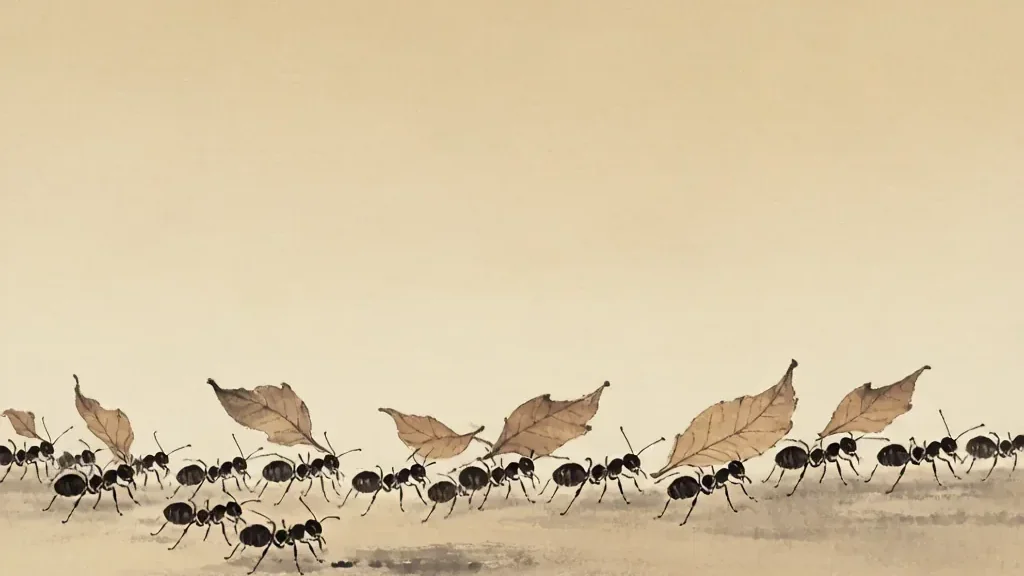
The ant (蚂蚁, mǎyǐ) is the most populous creature in Chinese literature — a tiny protagonist in a vast civilization that human beings can barely perceive. Chinese philosophers and poets have long been fascinated by the ant's collective organization, its extraordinary strength relative to its size, and its ceaseless labor. In a culture that valued social harmony, hard work, and humility, the ant was a natural moral exemplar. But the ant also raised uncomfortable questions: if ants can organize themselves into complex societies without language, without laws, without individual ambition, what does that say about the necessity of human institutions? The ant's underground cities, its division of labor, its apparent selflessness — all challenged Chinese thinkers to consider whether civilization was a uniquely human achievement or a pattern that nature had already perfected in miniature.
The Badger: The Joyful Spirit of Reunion
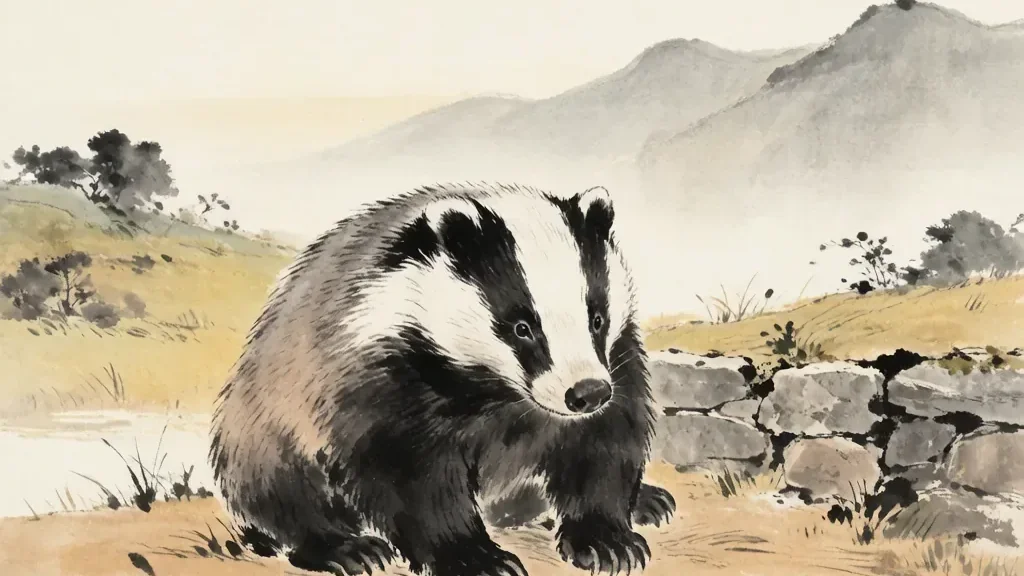
Among the smaller mammals of the Chinese countryside, the badger (獾, huān) holds an unusual position: it is a creature both hunted and honored, eaten and worshipped. The badger's nocturnal habits, its powerful digging claws, and its distinctive black-and-white facial markings made it a creature of mystery in traditional China, associated simultaneously with wealth (because of its burrowing, which was thought to uncover hidden treasure) and with danger (because of its fierce bite and its tendency to carry rabies). The badger's Chinese name is a homophone for "joy" or "happiness" in certain contexts, and its image appears in Chinese folk art as a symbol of good fortune. Yet the badger also suffers from its unfortunate physical resemblance to the weasel and the ferret, animals with which it is often confused in Chinese folk classification, and its reputation varies dramatically from one region to another.
The Bear: The Guardian of the Mountains
The bear (熊, xióng) in Chinese culture is a creature of raw power and unpredictable temperament — strong enough to crush a man's skull with a single swipe, yet capable of dancing for the amusement of crowds. Chinese bears include the giant panda (a bear, despite its misleading name), the Asian black bear with its distinctive white chest crescent, and the brown bear of the Tibetan plateau. Unlike the tiger, which was mythologized as a king, or the fox, which was spiritualized as a trickster, the bear remained stubbornly material in Chinese tradition: it was meat to be eaten, a gallbladder to be used in medicine, a hide to be slept on, and a spectacle to be enjoyed. The bear's lack of elaborate mythological development is itself revealing — the Chinese had no need to invent stories about a creature whose brute reality was already overwhelming enough.
The Bee: Diligence and the Sweetness of Society
In Chinese culture, the bee (蜜蜂, mìfēng) is the most virtuous of insects, a tiny embodiment of diligence, cooperation, and productive labor. The bee asks nothing from the world that it does not repay with interest — it takes nectar from flowers and returns honey, wax, and pollination. Yet the bee also carries a sting, and its aggressive defense of the hive made it a symbol of righteous anger against those who threaten the community. The bee in Chinese culture is a creature of sweetness and danger, productivity and sacrifice, a flying factory that transforms the raw materials of nature into something more valuable than the sum of its parts.
The Wild Boar: Untamed Strength of the Forest
The wild boar (野猪, yězhū) is the dark ancestor of the domesticated pig, a creature of bristle and tusk that has haunted the margins of Chinese civilization for millennia. Where the domesticated pig represents wealth and contentment, the wild boar embodies everything that Chinese farmers feared: the destruction of crops, the mutilation of bodies, the savage indifference of nature to human labor. A single sounder of wild boars could destroy a season's harvest in a single night, rooting up sweet potatoes and trampling rice paddies with their relentless foraging. Yet the wild boar was also admired for its courage — it was one of the few animals that would fight a tiger or a hunter to the death — and its tusks were worn as talismans by warriors who hoped to absorb its ferocity. The boar in Chinese culture is fear made flesh, but fear that could be transformed into power.
The Butterfly: Dreams, Freedom, and Illusion
In Chinese culture, the butterfly (蝴蝶, húdié) is the emblem of joy in movement — a creature so light, so colorful, and so transient that it seems to belong more to the realm of dreams than to the material world. The butterfly's metamorphosis from caterpillar to winged beauty made it a natural symbol of transformation in Daoist philosophy, and its habit of flitting from flower to flower associated it with romantic love and the pursuit of pleasure. Chinese poets and painters have celebrated the butterfly for over two thousand years, using it to express everything from philosophical insight to erotic desire. The butterfly in Chinese culture is never merely an insect; it is a theorem about the nature of reality — as Zhuangzi famously discovered when he woke from a dream uncertain whether he was a man who had dreamed of being a butterfly or a butterfly dreaming of being a man.
The Camel: The Silk Road Ship of the Desert
The camel (骆驼, luòtuo) is the ship of the Gobi Desert, an animal whose peculiar anatomy — the humps, the long eyelashes, the split upper lip — inspired both wonder and ridicule in Chinese dynastic histories. For over two millennia, the st, the Bactrian camel carried the tea, silk, and porcelain of Chinese civilization across the vast emptiness of Central Asia, linking Chang'an to Samarkand, Dunhuang to Baghdad. No other animal was so essential to the functioning of the Silk Road, and no other animal so perfectly embodied the Chinese encounter with the foreign, the arid, and the extreme. The camel in Chinese culture is a symbol of endurance, adaptability, and the commercial enterprise that connected China to the wider world long before the age of sail.
The Chicken: The Herald of the Dawn
The chicken (鸡, jī) is the most common bird in Chinese culture and one of the most symbolically rich. From its role in the zodiac to its presence in every Chinese kitchen, from its use in divination to its crow that marks the hours of the night, the chicken is woven into the fabric of Chinese daily life more deeply than any other bird. The chicken's crow — which divides the night and announces the dawn — made it a symbol of vigilance and moral clarity in Chinese literature. Its domestication gave it associations with civilization and the settled life, in contrast to the wild birds of the forest. And its role as the primary source of meat and eggs for the Chinese populace made it an economic fact as much as a cultural symbol. The chicken in Chinese culture is the everybird — common, useful, and full of meaning precisely because of its ordinariness.
The Cicada: The Song of Summer and Rebirth
For Chinese poets, the cicada (蝉, chán) is the voice of summer itself — a droning, insistent sound that comes from the treetops and fills the air with its palpable presence. No insect has inspired more Chinese poetry than the cicada, whose song was interpreted as an expression of purity, nobility, and righteous indignation in a corrupt world. The cicada's life cycle — emerging from the ground after years underground, shedding its shell, singing through the summer, and dying with the frost — made it a symbol of transcendence and the soul's journey. In Chinese burial practices, cicada-shaped jade amulets were placed on the tongue of the deceased to ensure resurrection, and the cicada's emergence from its pupal shell was seen as a natural image of the soul escaping the body at death. The cicada is the insect of immortality in Chinese culture, a tiny creature that holds the secret of eternal life.
The Clam: Humble Shell, Perfect Pearl
The clam (蛤蜊, gélí) lies buried in the tidal flats of Chinese coastal culture — a creature hidden beneath the surface, its meat concealed between two tightly clamped shells. In Chinese medicine and philosophy, the clam's body structure — hard outside, soft inside — became a metaphor for the relationship between the external and internal self, between the protective facade and the vulnerable interior. The clam's ability to close itself off from the world was both admired (as a model of self-protection) and criticized (as a symbol of closed-mindedness). In Chinese cuisine, the clam is prized for the sweetness of its meat and the umami-rich broth that it releases when cooked, a taste that the Chinese describe as xiān — a word that means both "fresh" and "savory" and that represents one of the fundamental categories of Chinese gastronomic appreciation.
The Crab: The Armored Scout of the Shore
The crab (螃蟹, pángxiè) scuttles sideways through Chinese culture, a creature whose peculiar gait and formidable claws made it a symbol of both comedy and danger. In Chinese culinary culture, the crab — particularly the hairy crab of Shanghai and Jiangsu — is one of the most prized seasonal delicacies, a food so revered that its arrival marks a social season as much as a gastronomic one. In Chinese folklore, the crab's sideways walk was explained by a story involving the legendary general Yue Fei, and the crab's hard shell conceals a soft interior that the Chinese interpret as a lesson about the contrast between external toughness and internal vulnerability. The crab is the emperor of Chinese seafood, a creature of contradictions: aggressive but delicious, armored but delicate, comical in its gait but deadly with its claws.
The Cricket: The Singing Warrior of Autumn
Of all the insects that have shared Chinese homes with human beings, the cricket (蟋蟀, xīshuài) has the most intimate relationship with Chinese culture. For over a thousand years, Chinese men from emperors to peasants have kept crickets for two purposes: to sing and to fight. Cricket song was prized as a form of natural music, and cricket fighting was — and remains — a passionate sport involving elaborate training regimens, specialized implements, and substantial wagers. The cricket in Chinese culture is a creature of paradox: the same insect that provides the gentle background music of autumn nights can become a gladiator in a miniature arena, driven by an instinctive aggression that Chinese cricket masters have studied and exploited for centuries. The cricket is both the poet's companion and the gambler's tool, a tiny creature that bridges the gap between art and sport, contemplation and competition.
The Deer: The Celestial Mount of Immortals
In Chinese mythology, the deer (鹿, lù) is the only animal that can find the Lingzhi mushroom of immortality — or so the Daoist immortals believed. With its graceful antlers and gentle gaze, the deer has carried symbolic weight in Chinese culture for over three millennia, representing everything from political power to spiritual transcendence. The deer appears on Shang dynasty bronze vessels, in Han dynasty poetry, in Tang dynasty paintings, and on contemporary New Year prints, always bearing associations of grace, longevity, and prosperity. Unlike the powerful dragon or the fierce tiger, the deer rules through elegance rather than force, offering a different model of how to move through the world: with sensitivity, alertness, and effortless poise.
The Dragonfly: The Grace of the Ponds
The dragonfly (蜻蜓, qīngtíng) hovers at the edges of Chinese ponds and the surfaces of Chinese poetry, a creature of such delicate precision that it seems to have been designed by a calligrapher. Its four wings — each a separate structure that can move independently — allow it to fly in any direction, hover motionless, and accelerate with a speed that baffled the Chinese naturalists who classified it among the "pure and agile" insects. The dragonfly in Chinese culture is a symbol of summer, of the surface tension between water and air, and of the quality that the Chinese call qīng — clarity, purity, lightness. Its large compound eyes, which can see in nearly every direction simultaneously, gave it associations with spiritual vision and the ability to perceive hidden truths. The dragonfly is the flying jewel of Chinese nature poetry, a creature whose beauty is inseparable from its motion.
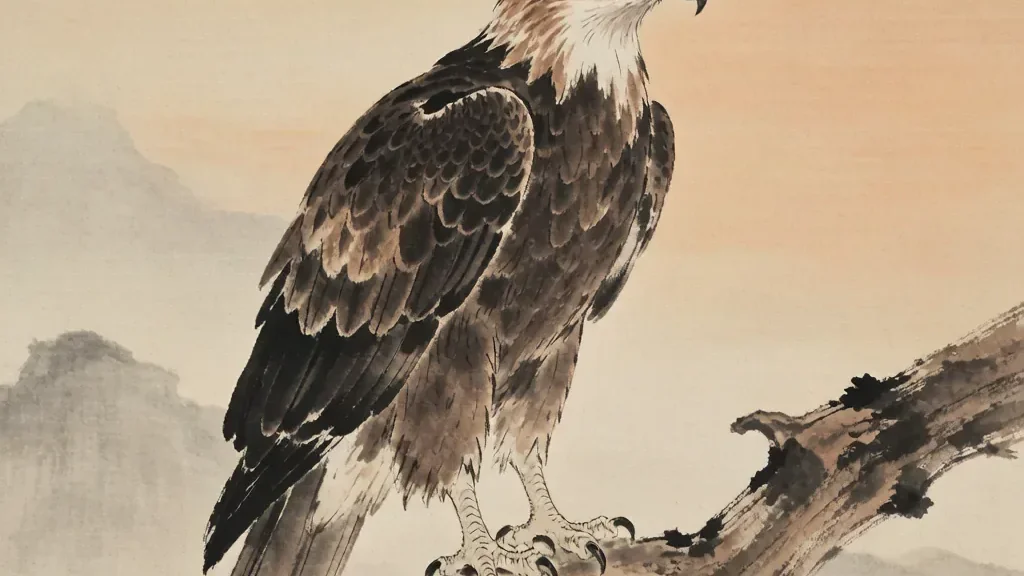
The Eagle: The King of the Skies
The eagle (鹰, yīng) commands the Chinese sky with a majesty that no other bird can match. Its ability to soar at altitudes beyond the range of human vision, to strike with devastating precision, and to fix its prey with an unblinking gaze made the eagle a symbol of the supreme power — of the emperor, of the general, of the sage who sees all things from a superior perspective. In Chinese culture, the eagle is the bird of war and the bird of vision, associated with the military virtues of courage, decisiveness, and strategic clarity. But the eagle also has a dark side — its predation on smaller birds and domestic animals made it a figure of oppression in Chinese folk tradition, and its fierce independence made it difficult to incorporate into the Confucian system of mutual obligation and social harmony.
The Elephant: White Omens of Peace
During the Shang dynasty, elephants roamed the Yellow River valley, and their ivory was carved into the most exquisite ritual objects in Chinese antiquity. Today, the elephant (象, xiàng) survives in China only in the tropical forests of Yunnan, a tiny remnant population of Asian elephants that once ranged from Beijing to Burma. Yet the elephant's symbolic presence in Chinese culture has never waned. As an emblem of strength, wisdom, and peace, the elephant appears in Buddhist iconography, imperial regalia, and popular folk art. The Chinese word for "elephant" is also a homophone for "appearance" or "phenomenon" (象), linking the great beast to the very structure of Chinese cosmology. This linguistic coincidence has given the elephant a philosophical dimension unique to Chinese culture.
The Firefly: Light Against the Summer Dark
The firefly (萤火虫, yínghuǒchóng) is the smallest lantern in Chinese literature, a living spark that blinks through the summer nights of a thousand Tang poems. For Chinese poets and philosophers, the firefly's cold, chemical light — so different from the warm glow of flame — raised questions about the nature of illumination itself. Is the firefly's light real, or is it an illusion? Is it a form of fire without heat, or a form of life pretending to be fire? The firefly in Chinese culture is a symbol of intellectual ambition (the student who studies by firefly light), of the fleeting beauty of summer, and of the boundary between the visible and the invisible, the material and the immaterial.
The Fox: Trickster of the Chinese Forest
In the shadowy borderlands where Chinese villages meet wild bamboo groves, the fox (狐狸, húlí) has haunted the Chinese imagination for over two thousand years. No animal in Chinese folklore straddles a more ambiguous line between menace and allure, wisdom and wickedness. The fox-spirit, or húxiān, can appear as a beautiful woman who seduces scholars, a wise old sage who dispenses cryptic advice, or a trickster who leads travelers astray. Classical texts like Strange Tales from a Chinese Studio by Pu Songling contain hundreds of fox-spirit stories, reflecting a cultural obsession that shows no sign of fading. The fox in Chinese culture is never just an animal — it is a mirror held up to human desire, fear, and longing.
The Gibbon: The Elegant Mount of the Immortals
For the classical Chinese poet, the gibbon (猿, yuán) was a voice, not a body. The mournful cry of the gibbon echoing through the gorges of the Yangtze River was the most emotionally charged sound in the Chinese soundscape — a call that signified exile, loneliness, and the passage of time. Thousands of Tang and Song poems mention the gibbon's cry, making this small, long-armed ape one of the most frequently referenced animals in Chinese literature. Yet the gibbon has been almost entirely absent from Chinese painting, its place in the visual arts taken by the macaque (hóu), a very different creature. The disjuncture between the gibbon's literary prominence and its artistic invisibility is one of the strangest puzzles in Chinese animal symbolism, a mystery that reveals how Chinese culture selected and shaped animal images to fit spiritual and emotional needs rather than biological reality.
The Goat: The Nimble Climber of the Cliffs
In Chinese culture, the line between goat and sheep (羊, yáng) is drawn not in biology but in language — a single character covers both animals, and the distinction between shān yáng (goat, literally "mountain sheep") and mián yáng (sheep, literally "cotton sheep") is a matter of habitat and wool rather than kind. The yáng is one of the most important symbolic animals in Chinese tradition, associated with filial piety, gentleness, beauty, and auspiciousness. The character yáng (羊) forms the radical for the character "beauty" (美, měi), which literally means "large sheep" — a visual etymology that reveals how deeply the sheep-goat is embedded in Chinese aesthetic philosophy. In a culture that has valued wool, milk, and meat from these animals for thousands of years, the sheep-goat is a creature of foundational significance, its symbolism reaching from the pastures of the steppe to the heart of the Chinese writing system.
The Golden Monkey: The Treasure of the Mountains
The golden snub-nosed monkey (金丝猴, jīnsīhóu) is a creature of high-altitude fantasy, a primate wrapped in fur that ranges from pale gold to fiery orange, with a face of startling blue-white skin that gives it an almost otherworldly appearance. Endemic to the temperate mountain forests of central and southwestern China, this monkey has no tail to speak of — its vestigial stump betrayed its evolutionary past — and its upturned nostrils are an adaptation to the thin air of elevations above 3,000 meters. Unlike the ubiquitous macaque of Chinese temples and tourist sites, the golden monkey was little known to traditional Chinese culture, confined to remote mountains that few poets or painters ever visited. Its rise to symbolic prominence is a modern story of conservation, scientific discovery, and national pride, transforming this extraordinary animal into a living emblem of China's commitment to preserving its unique natural heritage.
The Goldfish: Beauty Cultivated for a Thousand Years
No animal better illustrates the Chinese talent for shaping nature to human purposes than the goldfish (金鱼, jīnyú). From an inconspicuous gray-green carp, Chinese breeders created over two hundred distinct varieties of goldfish — creatures with bubble eyes, double tails, flowing fins, and color patterns that shimmer like sunset clouds. The goldfish in Chinese culture is both a living work of art and a symbol of wealth and abundance. Its Chinese name means "golden fish," and gold rhymes with the word for "prosperity" in Chinese, making the goldfish a standard motif in New Year imagery and business decorations. A bowl of goldfish is not merely a decoration; it is a statement of hope — hope for financial success, for fertility, for a life as colorful and graceful as the fish that swim in endless circles around their glass world.
The Leopard: The Painted Speed of the Forest
The leopard (豹, bào) in Chinese culture carries the weight of imperial majesty and military prowess. Its distinctive spotted coat, which the Chinese interpreted as a pattern of overlapping circles resembling coins, made the leopard a symbol of wealth and status from the earliest dynasties. While the tiger was the king of beasts in Chinese mythology, the leopard was its herald — a creature almost as powerful but more fleet-footed, more elusive, and more closely associated with the martial virtues of speed, precision, and deadly grace. Leopard skins adorned the thrones of emperors, leopard tails decorated the banners of generals, and the leopard's image was carved into the seals of the highest officials. The leopard in Chinese culture is power made visible, a pattern of spots that announces rank and commands respect.
The Loach: The Slippery Survivor of the Mud
The loach (泥鳅, níqiū) is the humble inhabitant of China's rice paddies and muddy waterways, a small, eel-like fish that most people never see unless they are looking for it. Yet the loach has sustained Chinese farmers for centuries, providing protein from the same fields that produce rice, and its resilience — the loach can survive in water so low in oxygen that other fish would suffocate — made it a symbol of endurance and adaptability. In Chinese culture, the loach is rarely celebrated in poetry or painting, but it is deeply appreciated in the kitchen and in the folk wisdom that values substance over appearance. The loach is the fish of the common people, a reminder that the most valuable creatures are not always the most beautiful, and that survival is its own kind of triumph.
The Mantis: The Meditating Warrior
The praying mantis (螳螂, tángláng) is the martial artist of the Chinese insect world, a creature whose very posture — the raised forelegs folded as if in prayer — inspired one of the most distinctive styles of Chinese boxing. In a culture that values strategy over brute force, the mantis stands as proof that the most dangerous opponent is not the largest but the most patient, the most precise, and the most alert. The Chinese have observed the mantis for thousands of years, noting its methodical hunting technique, its triangular head that can rotate 180 degrees, and its unsettling habit — for human observers — of consuming its mate after copulation. The mantis in Chinese culture is a study in contradictions: it is both a model of focused attention and a symbol of sexual danger, both a philosophical exemplar and a grim cautionary tale.
The Monkey: The Mischievous Trickster of Nature
No animal in Chinese literature has achieved the celebrity of the monkey (猴子, hóuzi), and no single monkey has had a greater impact on world culture than Sun Wukong, the Monkey King of Journey to the West. The monkey in Chinese culture is a creature of boundless energy, intelligence, and mischief — a trickster who can outwit gods and demons but who cannot sit still for a moment. The monkey's restlessness, its curiosity, its love of food and play, and its extraordinary capacity for learning made it the perfect symbol for human nature itself: flawed, brilliant, aspiring, and ridiculous. In Chinese culture, the monkey is the animal that is closest to the human — so close that the boundary between them is constantly being tested, transgressed, and reestablished.
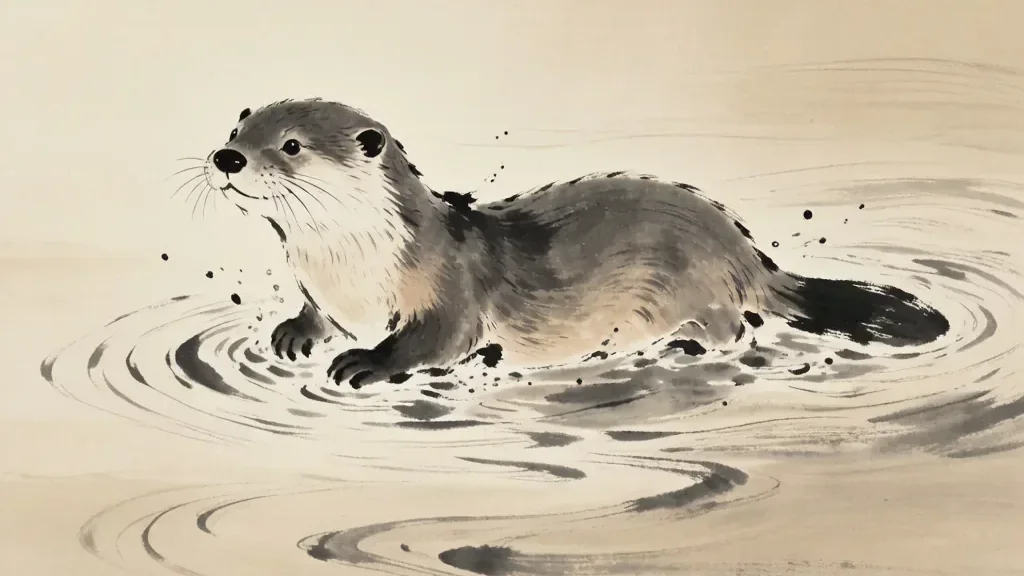
The Otter: The Playful River Dancer
The otter (水獭, shuǐtǎ) glides through Chinese culture as silently as it glides through the rivers of the Yangtze basin — a creature more often sensed than seen, its existence marked by fish bones left on riverbanks and by the fishermen who once trained it as a working partner. In classical Chinese texts, the otter is a figure of methodical competence: the Book of Rites notes that otters arrange their catch on the riverbank before eating, a behavior that the Chinese interpreted as a form of ritual offering. The otter's ability to catch fish with uncanny efficiency made it a symbol of prosperity and resourcefulness, but its nocturnal habits and amphibious nature also gave it an aura of mystery. Like the otter itself, the otter's place in Chinese culture is neither at the center nor at the margin but in the in-between spaces where land meets water and wildness meets domestication.
The Owl: The Watchful Bird of the Dark
Of all the birds in the Chinese bestiary, none has a worse reputation than the owl (猫头鹰, māotóuyīng). Its nocturnal habits, its silent flight, its unsettling call, and its ability to rotate its head nearly 360 degrees made it a creature of deep suspicion in traditional Chinese culture. The owl was the harbinger of death, the messenger of disaster, the bird that announced the end of a dynasty or the death of a child. Unlike the fox, whose malevolence was ambiguous and sometimes even sympathetic, the owl was simply evil — a bird whose very existence seemed to threaten the human order. Yet this uniformly negative assessment is itself a cultural artifact worth examining: why did the Chinese fear the owl so intensely, and what does this fear reveal about Chinese attitudes toward darkness, death, and the boundaries of the human world?
The Ox: The Patient Strength of the Field
In traditional Chinese farming villages, the ox (牛, niú) was not merely livestock but a member of the family, a silent partner in the eternal struggle to coax food from the earth. For millennia, Chinese civilization rested on the broad back of the water buffalo and the yellow ox, animals whose patient strength made wet-rice agriculture possible across the terraced paddies of the south and the dry fields of the north. The ox in Chinese culture symbolizes diligence, endurance, and selfless service — virtues so central to the Confucian ethical system that the animal became a living metaphor for the ideal subject, the devoted official, and the filial child. Even in modern, industrial China, the ox retains its moral prestige as a reminder of the agricultural foundations on which the world's oldest continuous civilization was built.
The Panda: China's Bamboo Ambassador
The giant panda (熊猫, xióngmāo) is China's most famous animal, a black-and-white diplomat whose face appears on everything from coins to corporate logos. Yet for most of Chinese history, the panda was a little-known creature of the misty bamboo forests of Sichuan, described in ancient texts as a "white bear" or "iron-eating beast" and rarely depicted in art. The modern panda mania is a twentieth-century phenomenon, driven by Western explorers, conservation campaigns, and Chinese soft-power strategy. The panda's symbolic meaning has shifted dramatically — from obscure forest dweller to global icon of endangered species preservation, from diplomatic gift to national mascot. Understanding the panda's place in Chinese culture means tracing how an animal of almost no traditional significance became the most recognizable symbol of China in the world.
The Parrot: The Talker of the Canopy
The parrot (鹦鹉, yīngwǔ) was the exotic wonder of the Chinese imperial court — a bird that could speak, that came from distant tropical lands, and that displayed colors more brilliant than any native Chinese bird. The parrot's ability to mimic human speech fascinated Chinese philosophers and poets, who debated whether the bird actually understood what it said or was merely repeating sounds without comprehension. This question — does the parrot speak, or does it only make noise? — became a philosophical puzzle that reached beyond ornithology into the nature of language, intelligence, and the human soul. The parrot in Chinese culture is a creature of surfaces: beautiful to look at, entertaining to listen to, but ultimately hollow — a warning about the danger of valuing appearance over substance.
The Peacock: Pride and Beauty in Every Feather
The peacock (孔雀, kǒngquè) entered Chinese culture as an exotic import from Southeast Asia, a living jewel whose feathers were among the most valuable trade goods exchanged along the southern Silk Road. Unlike the pheasant, which was native to China and embedded in its earliest rituals, the peacock was always a foreigner — a bird of Indian and Southeast Asian origin that the Chinese coveted for its astonishing plumage but never quite naturalized into the native symbolic system. The peacock's train of iridescent eyes, which the Chinese called "hundred-eyed feathers," made it a symbol of beauty, vanity, and the seduction of the exotic. In Buddhist art, the peacock was elevated to a symbol of compassion and watchfulness; in secular Chinese culture, it remained a bird of pure spectacle, valued for its appearance rather than its meaning.
The Pheasant: The Colorful Lord of the Mountains
With its iridescent plumage and explosive flight, the pheasant (雉, zhì) has been a creature of dazzling beauty and practical importance in China for thousands of years. The golden pheasant of central China and the ring-necked pheasant that now ranges across the temperate world both originated in China, and their feathers once adorned the hats of emperors, the arrows of hunters, and the altars of ancestral temples. In Chinese culture, the pheasant occupies a unique position between the wild and the domestic, the natural and the cultural. Its feathers are among the most prized materials in Chinese decorative arts, and the bird itself appears in poetry as a symbol of rustic simplicity and in mythology as a messenger between heaven and earth. The pheasant's Chinese name — zhì — also means "order" or "regulation," a homophonic link that gave the bird an unexpected political significance in ancient China.
The Rabbit: The Gentle Moon Companion
The rabbit (兔子, tùzi) in Chinese culture is a creature of the moon — literally. The most famous rabbit in all of Chinese mythology is the Jade Rabbit (Yù Tù), who lives on the moon and pounds the elixir of immortality with a mortar and pestle. This lunar rabbit is the companion of Chang'e, the Moon Goddess, and its image can be seen in the dark markings of the full moon if one looks carefully enough. The rabbit's association with the moon, with longevity, and with fertility made it one of the most auspicious animals in Chinese culture. But the rabbit's symbolism extends beyond the celestial: it is also a creature of earthly abundance, valued for its soft fur, its gentle nature, and its remarkable reproductive capacity. The rabbit in Chinese culture is a bridge between heaven and earth, connecting the lunar realm of immortality with the terrestrial world of family and plenty.
The Shrimp: The Joyful Dancer of the River
In Chinese culinary culture, the shrimp (虾, xiā) occupies a position of extraordinary importance — it is the most versatile of all seafoods, equally at home in a delicate steaming basket or a fiery wok, equally acceptable in the imperial palace or the street stall. The shrimp's curved body, its translucent shell, and its quick cooking time made it a symbol of agility and adaptability in Chinese culture, and its pink color when cooked — the color of joy and celebration — ensured its place at every festive table. No other aquatic creature appears in as many Chinese dishes as the shrimp, and no other carries such consistently positive symbolic associations: the shrimp is auspicious, delicious, and democratic, a food that bridges the gap between high and low, rich and poor.
The Snake: Wisdom and Danger in Equal Measure
The snake (蛇, shé) slithers through Chinese mythology bearing a dual legacy of terror and transcendence. On one hand, the snake is the most feared creature in the Chinese countryside, associated with venom, deception, and the dark forces of the underworld. On the other hand, the snake is intimately linked to the dragon — the most exalted symbol in Chinese culture — and many myths describe how snakes transform into dragons through centuries of spiritual cultivation. This metamorphic potential gives the snake a unique place in the Chinese symbolic imagination: it is the creature that can shed its skin, transcend its nature, and ascend to the heavens. No other animal in Chinese culture embodies such dramatic transformation from lowly to divine.
The Spider: Fate Woven in Silk
The spider (蜘蛛, zhīzhū) hangs at the center of a Chinese web of meaning that stretches from folk superstition to high philosophy. No other invertebrate has inspired such contradictory assessments in Chinese culture: the spider is simultaneously a bringer of good fortune (because its name sounds like "knowing happiness"), a symbol of maternal devotion (because the mother spider guards her egg sac), a model of patience and precision (because of its web), and a creature of menace (because of its venom and its disturbing appearance). The spider's web — a structure of mathematical perfection built from the spider's own body — fascinated Chinese thinkers, who saw in it a metaphor for the interconnectedness of all things. The spider weaves not just a trap for prey but a model of the universe, a network in which every strand is connected to every other, and a disturbance anywhere reverberates everywhere.
The Stork: The Auspicious White Messenger
The stork (鹳, guàn) is the white bird of Chinese wetlands, a tall, long-legged wader whose unhurried stride and deliberate fishing technique made it a symbol of patient wisdom in Chinese culture. Unlike the crane, which was elevated to a symbol of immortality and nobility, the stork was a more grounded figure — associated with the practical virtues of family loyalty, seasonal regularity, and the provision of food for the young. The stork's habit of returning to the same nesting site year after year was interpreted as a model of constancy and fidelity, and its methodical hunting technique — standing motionless for long periods, then striking with lightning precision — made it a model of the focused mind. In Chinese culture, the stork is the sensible relative of the crane: less glamorous, but more reliable, more connected to the daily rhythms of human life.
The Tiger: The Lord of the Mountain
The tiger (老虎, lǎohǔ) is the undisputed king of the Chinese animal kingdom — not the lion, which was never native to China, and not the dragon, which was a mythological construct. The tiger was the real ruler of the Chinese forest, a predator of such power and majesty that it became the living symbol of military authority, the protector of the home, and the embodiment of yang energy. The tiger's brow — with its distinctive "king" (王) character pattern — was seen as the mark of natural royalty, and the tiger's image appeared everywhere in Chinese culture: on soldiers' shields, on children's hats, on the walls of temples, and in the landscapes of painters. To understand the tiger in Chinese culture is to understand how a people living alongside a dangerous predator transformed their fear into reverence, their dread into defense, and their awe into art.

The Turtle: The Cosmic Shell of Longevity
The turtle (乌龟, wūguī) carries the weight of Chinese civilization on its shell. Long before the invention of paper, Chinese diviners carved questions into turtle plastrons and heated them until cracks appeared, reading the answers in the fissures. These "oracle bones" from the Shang dynasty represent the earliest surviving Chinese writing, making the turtle not merely a symbol of longevity but a medium through which heaven communicated with earth. In Chinese cosmology, the turtle is one of the four celestial animals — alongside the dragon, phoenix, and qilin — and it alone among them is based on a real creature. Its slow, deliberate gait, its astonishing lifespan, and its armored body have made it a multivalent symbol present in every layer of Chinese culture.
The Wolf: Ferocity and the Northern Sky
In the Chinese imagination, the wolf (狼, láng) has always been the outsider — the creature that lurks beyond the wall, the predator that emerges from the steppe when civilization sleeps. Unlike the tiger, which was respected as a king of beasts, or the fox, which was feared as a trickster, the wolf in traditional Chinese culture was almost purely malevolent: greedy, treacherous, and insatiable. Chinese idioms and proverbs consistently associate the wolf with cruelty and rapacity. Yet in recent decades, this ancient reputation has undergone a remarkable transformation. The wolf has been rehabilitated as a symbol of toughness, teamwork, and survival — first by the Mongol and Manchu peoples who admired it, and more recently by Chinese business writers and self-help gurus who see the wolf as a model for success in a competitive world.