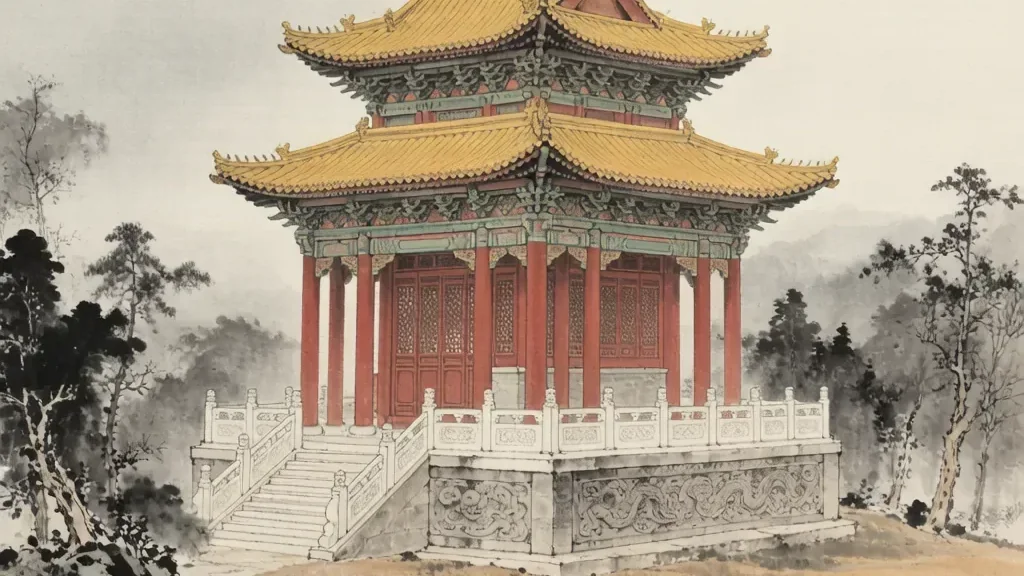
In Chinese religious architecture, the altar mountain (祭坛, jì tán) represents the most direct connection between the human and the divine — an open-air platform where heaven and earth met through the medium of imperial sacrifice. Unlike the enclosed halls of temples and palaces, the altar was exposed to the open sky, designed to place the worshipper in unmediated relationship with the cosmos. The most famous surviving example is the Temple of Heaven complex in Beijing, yet altar mountains were built throughout China for the worship of heaven, earth, the sun, the moon, and the gods of grain, rain, and fertility. To stand on one of these terraces is to read a whole philosophy of the universe written in stone, number, and space.
The Origins of Altar Worship
Chinese altar worship predates written history. Long before the first dynasties, Neolithic communities across the Yellow River basin raised flat earthen mounds for seasonal ceremonies that marked the turning of the agricultural year. These early platforms were simple, yet they already embodied the essential idea of the altar: a cleared, elevated place set apart from ordinary life where the living could address the powers that governed rain, harvest, and survival.
The Zhou dynasty (roughly 1046–256 BCE) gave this practice its classical form. Ritual texts of the period describe a clear hierarchy of altars: a round mound for the worship of Heaven, a square platform for Earth, and rectangular altars for the sun, the moon, and other celestial and natural powers. Crucially, the Zhou system tied the altar to political authority. The Son of Heaven — the emperor — alone performed the great sacrifice to Heaven, while nobles and officials worshipped at altars appropriate to their rank. In this way the altar became both a religious instrument and a statement of cosmic order made visible in the landscape.
Heaven Round, Earth Square
The organizing symbol of every altar mountain is the ancient cosmological pairing of round heaven and square earth (天圆地方, tiān yuán dì fāng). Heaven was imagined as a vast dome, complete and unbounded, so the altar for Heaven took a circular plan. Earth was conceived as stable and measured, so the altar for Earth took a square one. This is not mere decoration; it is a map of the world compressed into geometry.
The pairing runs through the smallest details. The Circular Mound Altar is round in plan and sits within a square walled precinct, so that the worshipper walks from the square frame of the earth into the round heart of heaven. The numbers used in construction reinforce the same idea: odd numbers belong to yang, the active heavenly principle, while even numbers belong to yin, the receptive earthly one. An altar to Heaven is therefore built from odd numbers and multiples of nine, the largest single-digit yang number.
The Temple of Heaven Complex
The Temple of Heaven (天坛, Tiān Tán) in Beijing is the supreme expression of altar architecture and the standard against which all others are measured. Built between 1406 and 1420 during the reign of the Yongle emperor of the Ming dynasty, it occupies a walled park of some 270 hectares in the southern part of the city. The southern wall is square; the northern wall is semicircular — again heaven above, earth below, joined in a single enclosure.
Within the park, the buildings are arranged not for everyday use but for ceremony. Two great axes of structures connect the altars used at different times of year: the Circular Mound Altar in the south, used at the winter solstice, and the Hall of Prayer for Good Harvests in the north, used to pray for the coming year's crops. A raised, paved causeway — the Vermilion Steps Bridge (丹陛桥, Dān Bì Qiáo) — links them, so that the emperor's processions moved along a single sacred line through the seasons.
The Circular Mound Altar
The Circular Mound Altar (圜丘坛, Huánqiū Tán) is a three-tiered white marble platform, each tier said to represent heaven, earth, and humanity in ascending order. The altar is entirely open to the sky, with no roof at all — the emperor worshipped directly beneath heaven, with nothing between him and the dome he addressed.
The number three pervades the design, as does the number nine. There are three tiers, reached by three sets of nine steps on each of the four sides. The top tier is paved with nine concentric rings of stone slabs: the innermost ring has nine stones, the next eighteen, and so outward, each ring gaining nine, until the ninth and outer ring holds eighty-one. Multiplied across the platform, the number nine appears hundreds of times, a deliberate invocation of the highest yang number and of heaven's perfection.
The Hall of Prayer for Good Harvests
Adjacent to the circular mound stands the Hall of Prayer for Good Harvests (祈年殿, Qínián Diàn), a round building crowned with a triple-eaved roof of deep blue-glazed tiles, the color of the sky. Built on a three-tiered marble base, the hall rises about 38 meters and is remarkable for having no interior columns: the entire roof is carried by a ring of massive wooden pillars arranged in concentric circles.
The pillar symbolism is precise. Twenty-eight outer columns are said to represent the twenty-eight lunar mansions used in traditional Chinese astronomy, while four central pillars stand for the four seasons. The structure was designed so that the building itself spoke the calendar — a cosmology rendered in timber and tile. In 1889 the hall was struck by lightning and burned to the ground; it was rebuilt exactly as before and completed in 1896, a deliberate act of faithful restoration rather than innovation.
The Imperial Vault and the Echo Wall
North of the Circular Mound Altar stands the Imperial Vault of Heaven (皇穹宇, huáng qióng yǔ), a smaller circular building that housed the spirit tablets used in the solstice ceremony. It is enclosed by a circular wall faced with polished masonry — the famous Echo Wall (回音壁, huí yīn bì). Because the wall is a near-perfect circle with a smooth, continuous surface, a whisper spoken close to the brick at one point travels around the curve and can be heard clearly at the opposite side, some sixty-five meters away.
The acoustic trickery was not the point of the design, but it has made the wall a beloved feature for visitors. Two other sound curiosities sit within the same courtyard: the Triple Sound Stones, from which a single clap seems to return three distinct echoes, and the Dialogue Stones, which allow two people at set points to converse as if standing side by side. Taken together they show how Ming and Qing builders understood and exploited the behavior of sound within sacred geometry.
Materials and Construction
Altar mountains were built almost entirely from materials that age with dignity and that carry symbolic weight. The great terraces are faced in white marble (汉白玉, hànbáiyù), quarried near Beijing, valued for its purity and its association with the unblemished offering. Roofs were covered in glazed ceramic tile, blue for heaven, yellow reserved for the emperor and earth-related structures elsewhere, and green for lesser ranks. The timber framework of the halls relied on nanmu (楠木, nánmù), a fragrant, insect-resistant hardwood prized for pillars that had to stand for centuries.
Construction followed the traditional Chinese method of interlocking joinery, in which columns, beams, and brackets (斗拱, dǒugǒng) are fitted without nails, allowing the structure to flex during earthquakes. Stone was dressed and laid by hand to tolerances fine enough that the Echo Wall could work at all. The result is a built landscape in which engineering, astronomy, and ritual are impossible to separate.
The Ritual of Sacrifice
The sacrifice to Heaven was the most solemn act of the imperial year. It took place at the winter solstice, before dawn, on the Circular Mound Altar, with the entire complex sealed and guarded so that no commoner might witness it. Only the emperor and a small college of ritual officials were present, for the ceremony was understood as a private audience between the Son of Heaven and Heaven itself.
The offering centered on a freshly killed bullock, presented whole upon the altar along with grain, silk, and jade, while the emperor recited prayers from a tablet and performed the prescribed bows and prostrations. Music and dance accompanied the rite, drawn from a repertoire reserved for the grand sacrifices. The Heaven sacrifice was an exclusively male ritual; the empress conducted her own separate ceremonies at the Altar of the Silkworm Goddess (先蚕坛, Xiāncán Tán), honoring the patron of sericulture. Through these paired rites, the ruler and his consort together sustained the two foundations of the realm: grain and cloth.
The Nine Altars of Beijing
During the Ming and Qing dynasties the capital held a system of nine principal altars, each devoted to a power the state was bound to honor. Together they formed a ritual map of the cosmos centered on the emperor. They were the Altar of Heaven (天坛), the Altar of Earth (地坛), the Altar of the Sun (日坛), the Altar of the Moon (月坛), the Altar of Grain (先农坛, for agriculture), the Altar of Agriculture, the Altar of the Silkworms, the Altar of the Cloud God, and the Altar of the Rain God (also known as the Thunder Altar).
Each was placed according to cosmological direction: the Altar of Heaven to the south, the Altar of Earth to the north, the Sun to the east, and the Moon to the west, mimicking the quarters of the sky. Of the nine, the Altar of Heaven was by far the grandest and the only one reserved for the personal performance of the emperor. The others were served by officials or, in the case of the silkworm altar, by the empress, but all were maintained at public expense as obligations of the state.
Cultural Meaning and Modern Preservation
Beyond their ritual function, altar mountains express a distinctly Chinese vision of the good order of things. The emperor's sacrifice was not a request made to a distant god so much as the renewal of harmony between heaven, earth, and humanity — a harmony on which the harvest, and thus the peace of the realm, depended. The altar is therefore a political object as much as a religious one: to perform the rite correctly was to confirm that the ruler held the Mandate of Heaven.
In modern times the altars have been lifted from their old political role and given new meanings. The Temple of Heaven was inscribed as a UNESCO World Heritage Site in 1998, praised as "a masterpiece of architecture and landscape design." Its parks are now beloved public spaces where Beijingers practise morning tai chi, fly kites, and walk among trees planted centuries ago. The altars no longer receive imperial sacrifice, but they still teach, in their silent geometry, a way of seeing the world as a single ordered whole — round above, square below, and human life held in the middle.
📝 Chinese Vocabulary
🎉 Fun Facts
❓ Frequently Asked Questions
Why was the Heaven altar round?
Because heaven was conceived as round, following the ancient Chinese principle that "heaven is round, earth is square." The Altar of Earth, by contrast, was built square.
Could commoners see the Heaven sacrifice?
No. The sacrifice was conducted before dawn with the temple complex sealed and guarded. Only the emperor and the ritual officials were present.
Did women take part in the sacrifice?
No. The Heaven sacrifice was an exclusively male ritual. The empress had her own separate altar, the Altar of the Silkworm Goddess, for the worship of sericulture.
What is the "Echo Wall"?
It is the circular wall around the Imperial Vault of Heaven, famous for its acoustics: a whisper at one point can be heard clearly on the opposite side of the curve.
How many principal altars were there in Beijing?
Nine: dedicated to Heaven, Earth, Sun, Moon, Grain, Agriculture, Silkworms, the Cloud God, and the Rain God.
Why are the numbers three and nine so important on the altar?
Three and nine are yang (heavenly) numbers. The Circular Mound has three tiers and nine steps per side, and its top pavement is nine concentric rings of stone — a numerical invocation of heaven's perfection.