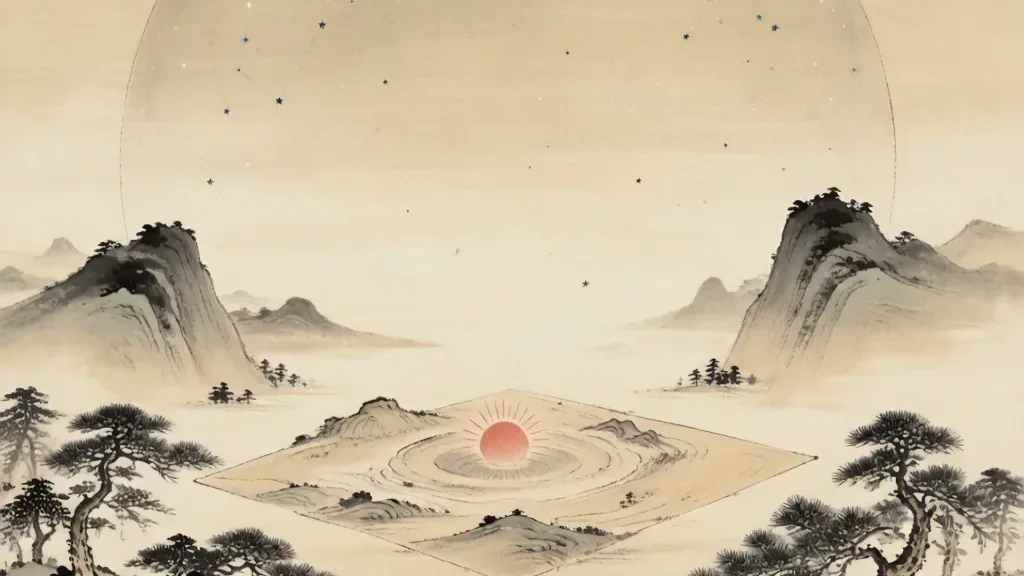
The earliest Chinese model of the universe was not a sphere or an infinite void but a canopy — a hemispherical dome covering a flat, square earth, like an umbrella suspended over a table. This was the Gaitian theory (盖天说, gài tiān shuō), the "Canopy Heaven" cosmology, which emerged during the Zhou dynasty and remained influential for over a thousand years. While later astronomers would reject its literal claims, the Gaitian theory provided the conceptual foundation on which all subsequent Chinese cosmological speculation was built, establishing the categories of thought — heaven above, earth below, and a curved sky covering a flat land — that shaped Chinese astronomy from its origins.
The Canopy and the Carriage
The classic Gaitian model, as described in the Zhoubi Suanjing (周髀算经, "The Gnomon of the Zhou"), one of the oldest Chinese mathematical texts, pictured heaven as a circular dome and earth as a square surface beneath it. The dome was not attached to the earth but rotated around a central vertical axis — the same axis that appeared in the pole star. The sun, moon, and stars were carried across the inner surface of this dome, appearing and disappearing as they passed in and out of view from the observer's position on the flat earth.
The analogy that gave the theory its name was drawn from everyday experience. A canopy over a carriage seat is round, while the carriage chassis is square. The round heaven and square earth of the Gaitian model mirrored this familiar arrangement, making the theory intuitively plausible. The "square earth" was not understood literally as a perfect square; it was a way of saying that the earth had a fixed center and four cardinal directions, in contrast to the continuous curvature of the sky.
The Zhoubi Suanjing and the Gnomon
The Zhoubi Suanjing, compiled between the fourth and first centuries BCE, is the primary textual source for the Gaitian theory. The book is named after the gnomon (周髀, zhōu bì) — a vertical pole used to measure the sun's shadow — and it uses gnomon observations to argue for the Gaitian model. The text demonstrates that the length of the noonday shadow varies with latitude and season, and that this variation can be explained by the sun moving along a curved path over a flat earth.
The mathematical methods in the Zhoubi Suanjing are remarkably sophisticated. The text uses the Pythagorean theorem — known in China as the "Gougu theorem" (勾股定理) — to calculate distances and heights, and it develops a detailed model of the sun's annual motion that produced reasonably accurate predictions of solstice and equinox dates. The Gaitian theory, for all its conceptual simplicity, was backed by real mathematical power.
The Sun's Journey Under the Canopy
In the Gaitian model, the sun's annual motion was explained by its movement between seven concentric circular paths, known as the "Seven Heng" (七衡, qī héng). At the summer solstice, the sun traveled along the innermost path, closest to the pole, producing long days and short shadows. At the winter solstice, it traveled along the outermost path, farthest from the pole, producing short days and long shadows. During the equinoxes, it traveled along the middle path, balancing day and night.
The distances between these paths were calculated using gnomon measurements, giving the theory quantitative predictive power. A Gaitian astronomer could calculate the sun's position at any date by determining where the sun lay between the seven rings. This system was crude by modern standards, but it was the first systematic attempt in Chinese history to model the sun's annual motion, and it established the template for the solar term system that followed.
The Challenge from Huntian
The Gaitian theory began to lose ground during the Han dynasty, as the Huntian (celestial sphere) theory offered a more coherent explanation of celestial phenomena. The Huntian model could explain why stars rose and set at different times of the year, why the moon went through phases, and why solar and lunar eclipses occurred — all of which were difficult for the Gaitian model. By the end of the Han period, the Huntian theory had become the dominant cosmology, and the Gaitian theory was increasingly seen as a primitive precursor.
Yet the Gaitian theory never entirely disappeared. Its simplicity made it attractive for educational purposes, and its mathematical framework remained useful for certain calculations. The Zhoubi Suanjing continued to be studied by Chinese mathematicians for its geometric methods, long after its cosmology had been superseded. The Gaitian theory also lived on in Chinese popular culture, where the image of a round heaven covering a square earth became a standard metaphor for the cosmic order.
The Legacy of the Canopy
The Gaitian theory's greatest contribution to Chinese astronomy was not its model of the cosmos but its method. By insisting that cosmological claims must be grounded in measurement and calculation, the Gaitian school established the empirical standard that all later Chinese astronomers would follow. The Zhoubi Suanjing treated astronomy as a branch of applied mathematics — a discipline in which theories were tested against observations and refined through calculation. This commitment to quantitative astronomy was the Gaitian theory's most enduring legacy.
The round heaven, square earth motif also left a permanent mark on Chinese material culture. The altar of heaven in Beijing — the Circular Mound at the Temple of Heaven — is round, while the earth altar is square. The round shape of sacrificial vessels, the square base of imperial tombs, and the circular domes of observatory roofs all echo the Gaitian cosmology. The canopy of heaven was not just a theory; it was a shape built into the fabric of Chinese civilization.
The Canopy in Han-Era Debate
During the Han dynasty the Gaitian model faced its strongest challenge from the Huntian school, which argued for a spherical sky. Defenders of the canopy responded that a flat earth with a rotating dome explained the daily circuit of the sun and moon well enough for practical calendar-making, and that its mathematics were simpler to teach. The debate was not merely academic: each side claimed its model better served the state's need to predict solstices and eclipses. Although the Huntian view gradually won among working astronomers, the Gaitian argument persisted in classrooms and commentaries for centuries, a reminder that cosmological change in China was slow, evidence-driven, and debated in public writings rather than resolved by a single authority.
A Model Built from Everyday Things
The genius of the Gaitian theory lay in its metaphors. A canopy over a carriage seat is round; the chassis beneath is square. Heaven covers the earth exactly as that canopy covers the seat, making the universe immediately imaginable to anyone who had ridden in a cart. The sun, moon, and stars were carried across the inner dome like passengers, appearing and disappearing at the rim. This everyday imagery let farmers, officials, and rulers share a single picture of the cosmos without specialist training. By rooting grand cosmology in familiar objects, the Gaitian school made astronomy feel like common knowledge rather than priestly secrets, which helped the model survive in folk belief long after its scientific shortcomings were known.
Echoes of the Canopy in Modern China
Though no modern astronomer holds that the earth is flat, the Gaitian image has never fully disappeared. The phrase 'round heaven, square earth' still surfaces in Chinese to evoke traditional order, and the round-altar-over-square-compound layout of the Beijing Temple of Heaven is a built echo of the canopy model. Craft objects, garden design, and popular illustrations of 'ancient Chinese cosmology' routinely reproduce the dome-over-square diagram. The Gaitian theory thus lives on as cultural memory: a reminder that an early scientific idea can outlast its own falsification by becoming a symbol of civilization, identity, and the enduring human wish to picture the sky as a sheltering roof above the world.
❓ Frequently Asked Questions
📝 Chinese Vocabulary
盖天说 — : The Canopy Heaven theory; China's oldest cosmology.
周髀算经 — : The Gnomon of the Zhou; the foundational text of the Gaitian theory.
七衡 — : Seven rings; the concentric solar paths in the Gaitian model.
勾股定理 — : The Gougu theorem (Pythagorean theorem), used in Gaitian calculations.
天圆地方 — : Round heaven, square earth; the classic formulation of the Gaitian cosmology.
盖天 — : Canopy Heaven; the abbreviated name of the Gaitian cosmological theory.
北极星 — : Pole Star; the fixed point around which the Gaitian dome was thought to rotate.
晷影 — : Gnomon shadow; the measured length of the pole's shadow used to track the sun's season.
🎉 Fun Facts
- The phrase "round heaven, square earth" (天圆地方) is still used in Chinese to describe the traditional cosmic order.
- The Zhoubi Suanjing contains the earliest known proof of the Pythagorean theorem in any Chinese text.
- The Temple of Heaven in Beijing was designed according to Gaitian principles: round altar, square compound, a physical representation of the canopy model.
- The Gaitian canopy idea spread to early Korea and Japan, where cosmological texts borrowed the image of a round heaven over a square earth.
- In early correlative cosmology the square earth's 'nine provinces' were thought to mirror a ninefold structure in the heavens above.
- The seven-ring solar-path diagram of the Gaitian school is among the earliest known graphical models of the sun's seasonal motion in East Asia.