Astronomy & Calendar
50 articles — Explore the classical Chinese understanding of the heavens: the Twenty-Eight Lunar Mansions, the Big Dipper, the lunisolar calendar, the sexagenary cycle, ancient cosmic models from canopy to sphere, the armillary sphere of Zhang Heng, the practice of Guanxiang Shoushi, millennia of eclipse and comet records, and the observatories where it all happened.
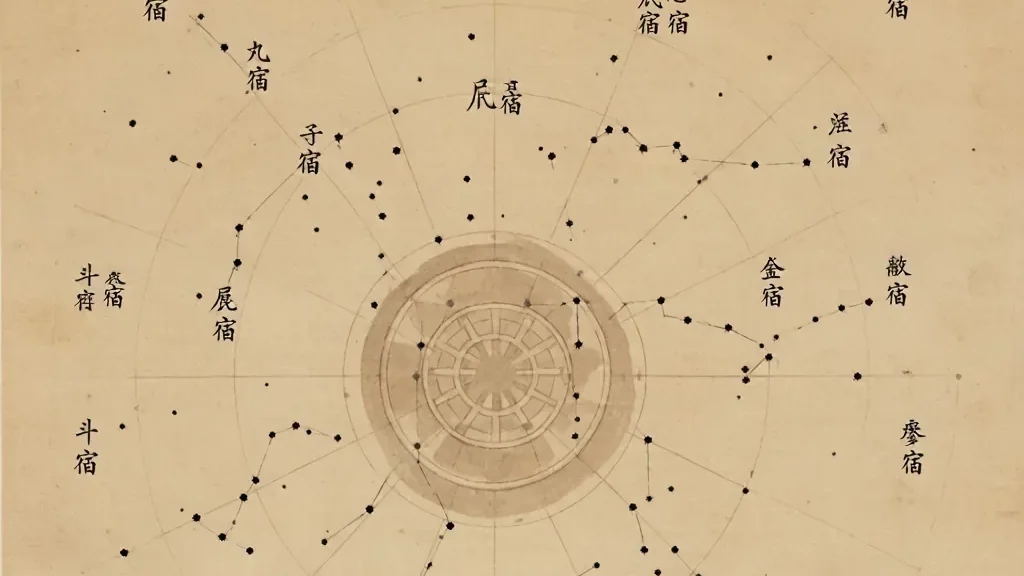
The Twenty-Eight Lunar Mansions (二十八宿)
Long before the zodiac constellations of the West were codified, Chinese astronomers had already divided the sky into a wholly different grid. Instead of focusing on the sun's annual circuit through the ecliptic, they built their primary star map around the moon's daily journey.

The Big Dipper (北斗七星)
On any clear night in the northern hemisphere, seven bright stars form a shape that most modern eyes recognize as a ladle or a plough. In English it is the Big Dipper or the Plough; in Chinese it is the bei dou (北斗, běi dǒu) — the "Northern Ladle" — and for the astronomers, emperors, and priests of ancient China, no constellation carried deeper significance.
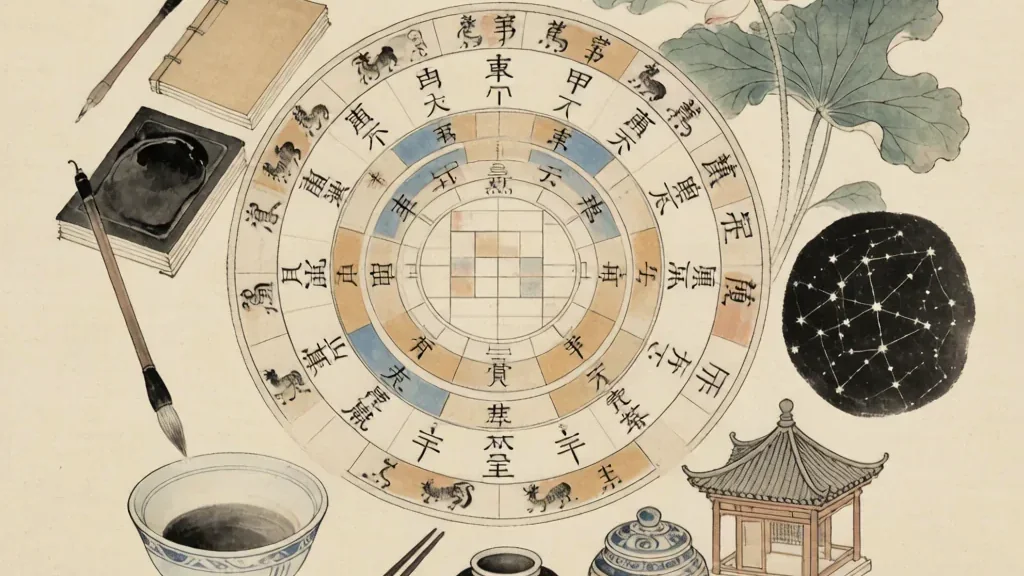
The Chinese Calendar and Sexagenary Cycle (农历与干支)
Of all the inventions Chinese civilization gave the world, none touches everyday life more intimately than its calendar. The nong li (农历, nóng lì) — the "peasant's calendar" — is a lunisolar timekeeping system that coordinates the cycles of the moon, the sun, and the stars into a single, elegant framework.
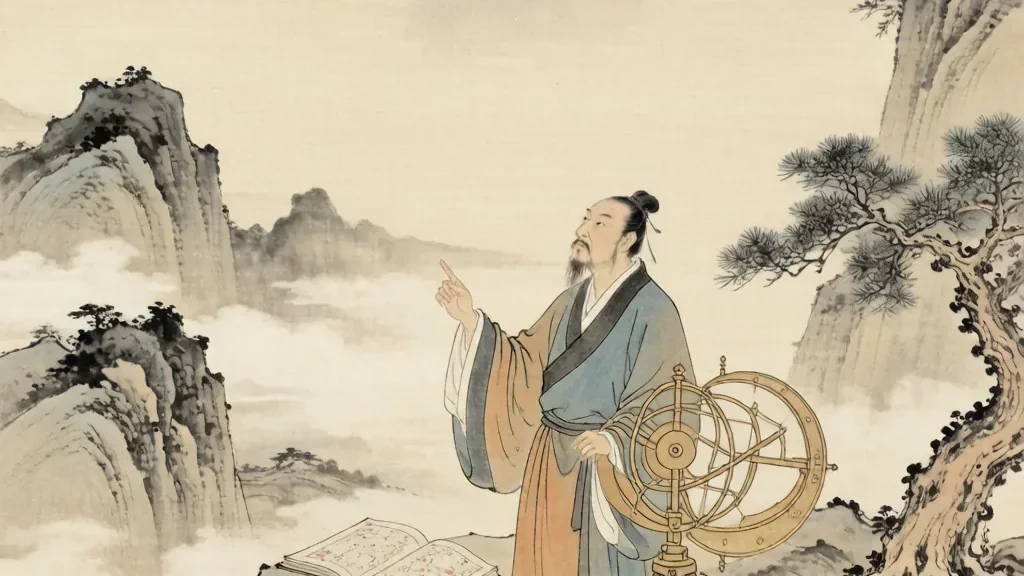
Guanxiang Shoushi: Astronomy and Timekeeping (观象授时)
In traditional China, astronomy was never a purely academic pursuit. It was a branch of government.
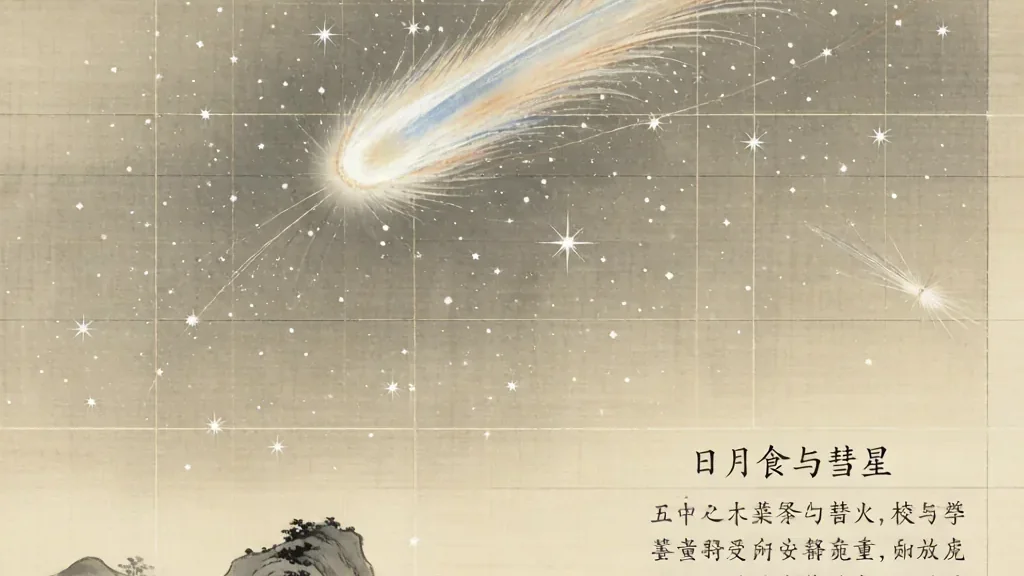
Ancient Records of Eclipses and Comets (日月食与彗星)
When a modern astronomer wants to study the behavior of a comet over two thousand years, or to verify a hypothesis about the gradual slowing of the Earth's rotation, the best place to look is not a European observatory. It is the dynastic histories of China.
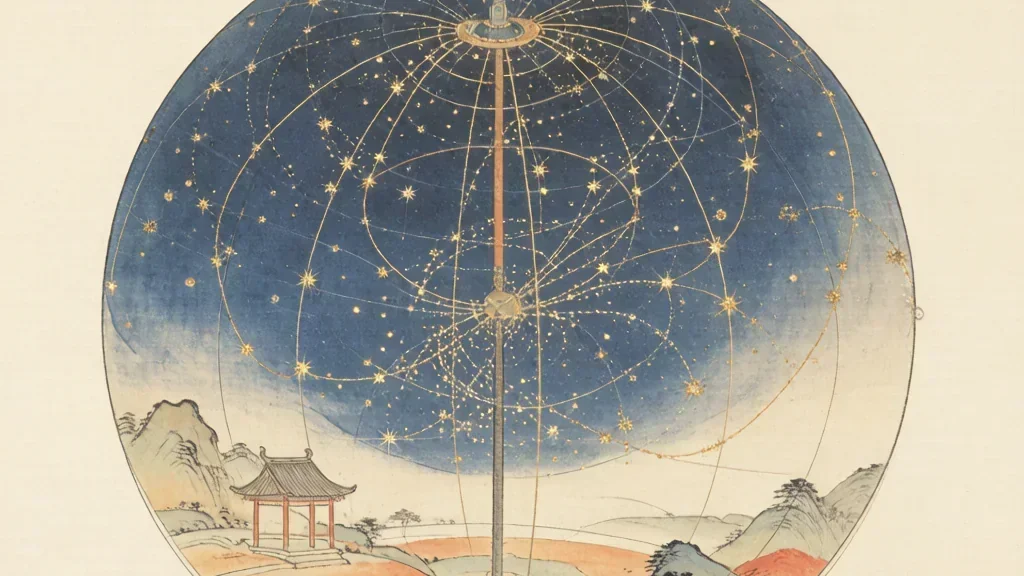
Gaitian and Huntian: Ancient Cosmic Models (盖天说与浑天说)
Before the telescope, before the Copernican revolution, and long before the modern understanding of gravity and orbits, Chinese thinkers debated the fundamental shape of the universe. Was the sky a domed canopy covering a flat, square Earth?
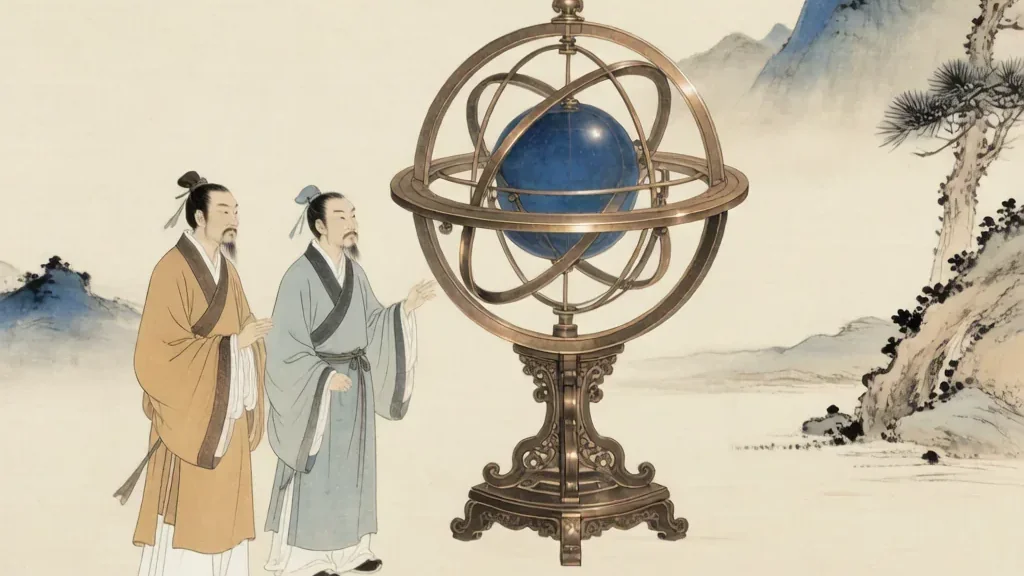
The Armillary Sphere and Zhang Heng (浑天仪与张衡)
More than eighteen hundred years before the first mechanical clocks of medieval Europe, a Han dynasty scholar sat in the Imperial Observatory and watched a bronze globe turn by itself, ringed by slowly rotating metal circles, keeping perfect pace with the stars overhead. This was the hun tian yi (浑天仪, hún tiān yí) — the "armillary sphere" — and its maker, Zhang Heng, is one of the most remarkable scientific minds the ancient world produced.

Ancient Observatories (古天文台)
Long before the first European observatory was built with a telescope, Chinese emperors maintained permanent platforms from which generations of astronomers watched the stars. These observatories — tianwen tai (天文台, tiān wén tái, "terrace of heavenly patterns") — were among the oldest and most elaborate astronomical facilities in the world.
The Celestial Globe: Turning the Sky Indoors
When Han dynasty astronomers wanted to study the night sky, they had three options: climb an observation platform and look up, consult a star chart on silk or bamboo, or gather around a bronze sphere the size of a wine barrel and watch the constellations rotate in miniature. The celestial globe (浑象, hún xiàng) offered something that neither direct observation nor flat maps could provide — a three-dimensional model of the heavens that could be turned, studied, and understood as a complete system. Invented in China by the first century CE, the celestial globe became a standard instrument in every major observatory, serving simultaneously as a teaching tool, a calendrical aid, and a symbol of the astronomer's mastery over the cosmic order.
The Armillary Sphere: Charting Heaven in Bronze
Before the telescope, the most powerful instrument for measuring the heavens was a cage of bronze rings: the armillary sphere (浑仪, hún yí). Chinese astronomers built these nested frameworks of circles for more than two thousand years, refining them from simple observational tools into complex mechanical orreries driven by water power. The armillary sphere was the central instrument of every Chinese observatory, the device that fixed the positions of stars, tracked the motions of planets, and measured the passage of time. To understand Chinese astronomy is to understand this instrument of rings, for it shaped everything Chinese astronomers saw and how they saw it.
The Chant of the Sky: Memorizing China's Star Officials
Imagine being a Tang dynasty student of astronomy, tasked with memorizing the names and positions of over 1,400 stars organized into 283 constellations, and you are given a poem — a single wall of rhyming verse — to hold it all in your mind. That is precisely what the Butian Song (步天歌, "Pacing the Heavens Song") provided. Composed in the seventh century CE, this didactic poem became the standard mnemonic system for Chinese astronomy, allowing generations of scholars to navigate the celestial bureaucracy of the night sky as easily as a child might recite the multiplication table.
Water and Time: The Clepsydra Through the Dynasties
Before the invention of the mechanical clock, before the pendulum and the spring, time in China was measured by the flow of water — a steady drip from one vessel to another that marked the passage of hours, the duration of court sessions, and the timing of astronomical observations. The clepsydra (漏刻, lòu kè), or water clock, was the most important timekeeping instrument in Chinese history, used for over three thousand years from the Shang dynasty to the Qing. It was not a single invention but a family of technologies, evolving from simple outflow vessels to multi-chamber compensated systems that achieved remarkable accuracy for their time.
Brooms Against the Sky: Chinese Comet Observations
When a comet appeared over the Chinese empire, court astronomers reached for their brush and ink, because they knew that every such event had to be recorded — the dynasty's legitimacy depended on it. From the Han dynasty through the Qing, Chinese scribes produced the longest-running, most detailed set of comet observations in human history, spanning more than two thousand years of continuous record-keeping. These "broom stars" (彗星, huì xīng) or "long-tailed stars" (长星, cháng xīng) were meticulously described: their dates of appearance, their positions among the mansions, their tail lengths and colors, and the astrological judgments that followed them.
Three Cosmological Visions: Dome, Sphere, and Infinite Void
During the Han dynasty, Chinese cosmologists engaged in a debate that would shape East Asian astronomy for the next two millennia. Three competing schools — the Gai Tian (盖天, umbrella heaven), the Hun Tian (浑天, celestial sphere), and the Xuan Ye (宣夜, infinite void) — each offered a fundamental account of the structure of the universe. Was the sky a dome rotating above a flat earth? A sphere enveloping the earth like an eggshell around a yolk? Or an infinite empty space through which luminous bodies drifted freely? The answers to these questions defined not only how Chinese astronomers measured the stars but how they understood their place in the cosmos.
The Dayan Calendar: A Tang Dynasty Mathematical Symphony
In 729 CE, the Tang court issued a new calendar that would earn the praise of astronomers for centuries: the Dayan calendar (大衍历, dà yǎn lì), or "Great Expansion Calendar," the creation of the Buddhist monk and mathematician Yi Xing (一行). This calendar was not merely a set of tables predicting solstices and equinoxes; it was a mathematical symphony, the first Chinese calendar to use a second-order interpolation formula for calculating solar motion, and the first to treat the moon's orbit as an ellipse rather than a circle. The Dayan calendar represented a level of mathematical sophistication that Europe would not match for another eight hundred years.
The Observatory of Dengfeng: A Shadow in Stone
On a hill in Henan province, a thirty-foot stone pillar has been measuring the sun with unbroken continuity for more than seven hundred years. The Dengfeng Observatory (登封观星台, dēng fēng guān xīng tái), built under the direction of Guo Shoujing in 1276 CE, is the oldest surviving astronomical observatory in East Asia, and its centerpiece — a colossal gnomon shadow-measuring platform — remains the largest pre-modern astronomical instrument in existence. To stand before it is to see the sky through the eyes of a Yuan dynasty astronomer, who knew that the shadow of a pole could reveal the secrets of the solar year.
The Five Planets: Wandering Emissaries of Heaven
Long before telescopes revealed that Jupiter has moons or that Saturn wears rings, Chinese astronomers had identified five "wandering stars" (行星, xíng xīng) that moved against the fixed backdrop of the celestial sphere. These five planets — Jupiter, Venus, Mars, Saturn, and Mercury — were known to the Chinese as the "Five Emissaries of Heaven" (五纬, wǔ wěi), and each was associated with one of the five elements, one of the five directions, and one of the five celestial emperors. Their movements were recorded with obsessive precision over nearly two millennia, creating a body of planetary data unmatched in the pre-modern world.
The Four Divine Beasts: Guardians of the Heavenly Directions
When a Han dynasty astronomer surveyed the night sky, four colossal spirit animals framed the four cardinal directions: the Azure Dragon coiled in the east, the Vermilion Bird blazing in the south, the White Tiger crouching in the west, and the Black Tortoise coiling in the north. These Four Divine Beasts (四象, sì xiàng) were far more than decorative constellations — they were the guardians of cosmic order, the organizers of astrological time, and the symbolic foundation of Chinese thought about space, direction, and destiny. No other culture created a celestial system that blended zoology, geography, astronomy, and philosophy into such a coherent and enduring whole.
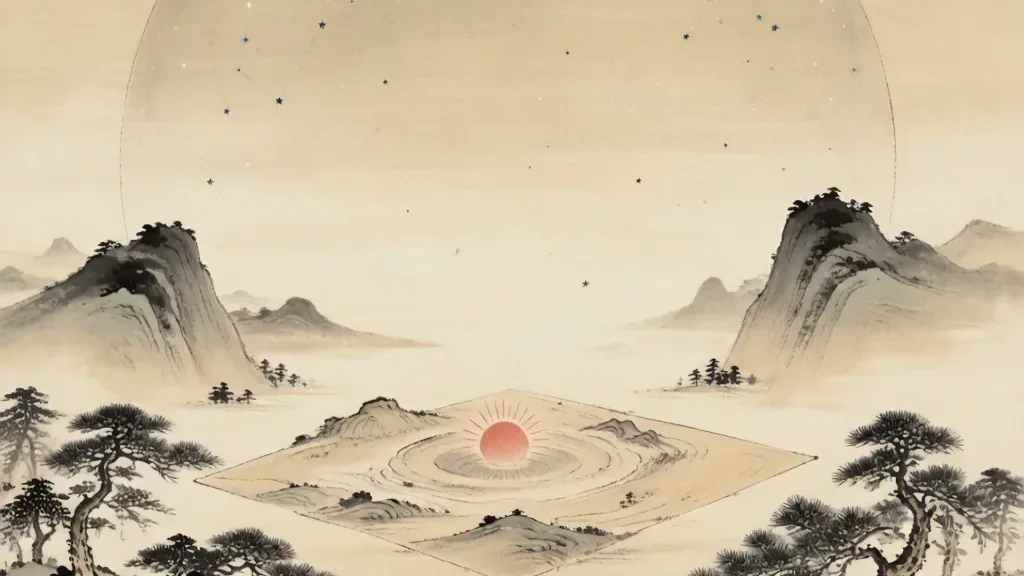
The Canopy of Heaven: China's Oldest Cosmology
The earliest Chinese model of the universe was not a sphere or an infinite void but a canopy — a hemispherical dome covering a flat, square earth, like an umbrella suspended over a table. This was the Gaitian theory (盖天说, gài tiān shuō), the "Canopy Heaven" cosmology, which emerged during the Zhou dynasty and remained influential for over a thousand years. While later astronomers would reject its literal claims, the Gaitian theory provided the conceptual foundation on which all subsequent Chinese cosmological speculation was built, establishing the categories of thought — heaven above, earth below, and a curved sky covering a flat land — that shaped Chinese astronomy from its origins.
The Sixty-Year Cycle: Heavenly Stems and Earthly Branches
Ancient Chinese astronomers measured time not with numbered years but with a repeating cycle of sixty unique names, each a marriage of one heavenly stem and one earthly branch. This system, known as the Ganzhi (干支, gān zhī) or Stem-Branch cycle, is the oldest continuous chronological system on Earth, running without interruption from at least the Shang dynasty to the present day. It is impossible to understand Chinese astrology, calendar-making, or historical chronology without first understanding how these sixty names weave together like strands of silk.
The Gnomon: Measure of the Sun
A stick in the ground, when pointed at the sun, becomes one of the most powerful instruments ever devised. The gnomon (表, biǎo or 圭, guī) — a vertical pole that casts a measurable shadow — was the foundational tool of Chinese astronomy, used for over three thousand years to determine the seasons, measure the year, and establish the cosmic order. From the simple eight-foot pole of the Zhou dynasty to the towering twelve-meter monument at Dengfeng, the gnomon was the instrument through which Chinese astronomers listened to the sun's slow music.
Guest Stars: China's Records of Supernovae
On a summer night in 1054 CE, Chinese astronomers at the Song dynasty court observed a new star blazing in the constellation of Taurus, near the mansion of Net (毕宿, bì xiù). The "guest star" (客星, kè xīng) was so bright that it could be seen in daylight for twenty-three days, and it remained visible to the naked eye for nearly two years before fading from view. Nine centuries later, astronomers using radio telescopes identified the remnant of this spectacular event: the Crab Nebula, the expanding cloud of debris from a supernova that the Chinese had recorded with uncanny precision. The official Chinese records of guest stars are the most extensive and accurate collection of supernova observations in pre-telescopic history, and they continue to provide invaluable data for modern astrophysics.
Guo Shoujing: The Astronomer Who Remeasured the Sky
In 1276, the Mongol emperor Kublai Khan ordered the creation of a new calendar for his young Yuan dynasty, and the man he trusted with this celestial mandate was a twenty-five-year-old engineer and astronomer named Guo Shoujing (郭守敬, 1231–1316). Over the next four years, Guo built the largest astronomical observatory in the medieval world, constructed instruments of unprecedented precision, and produced a calendar that would remain in use for more than 360 years — a record of longevity unmatched by any other calendrical system in Chinese history. His measurement of the solar year, accurate to within twenty-six seconds, would not be surpassed in Europe until the sixteenth century.
The Celestial Sphere: The Huntian Theory of the Heavens
If you had asked a Tang dynasty astronomer what shape the universe was, the answer would almost certainly have been "a sphere." The Huntian theory (浑天说, hún tiān shuō), which described the cosmos as a spherical shell surrounding a flat earth, was the dominant cosmological model in China for over fifteen centuries — from the Han dynasty through the arrival of European astronomy in the seventeenth century. The Huntian model was not merely a philosophical stance; it was an engineering program that produced the armillary sphere, the celestial globe, and the most accurate star maps of the pre-modern world.
The Spirit Platform: Observatory of the Zhou Court
Before the first dynasty ruled China, before the bronze vessels of the Shang and the bronze mirrors of the Zhou, there were platforms — raised mounds of earth and stone where shamans and chiefs climbed to read the night sky. The most important of these was the Spirit Platform (灵台, líng tái), an observatory built in the Zhou dynasty capital near modern-day Xi'an, whose remains still stand after three millennia. The Lingtai was not merely a scientific instrument; it was a sacred space where the king conversed with heaven, where the calendar was calibrated against the stars, and where the legitimacy of the Zhou dynasty was renewed each time a successful eclipse prediction was fulfilled.
The Twenty-Eight Mansions: China's Lunar Zodiac
If you followed the moon night after night through a Chinese sky, you would watch it pass through twenty-eight distinct lodgings, each one a celestial mansion bearing the name of a creature, a building, or a mythical being. The Twenty-Eight Mansions (二十八宿, èr shí bā xiù) form the backbone of traditional Chinese astrometry, dividing the visible celestial sphere into sectors through which the moon tracks each lunar month. This system is older than the zodiac, more detailed than the four directions, and so deeply embedded in Chinese culture that it appears in everything from Tang dynasty poetry to Ming dynasty star charts.
Luoxia Hong: The Astronomer Who Fixed the Year at 365.25
By the second century BCE, the Han dynasty had a problem with time. The calendar in official use, inherited from the Qin dynasty, had drifted so far from the seasons that the new moon no longer fell where it was supposed to, and the solstices arrived days late by the imperial count. The discrepancy embarrassed the court — if the emperor could not even keep the calendar correct, what did that say about his mandate? The man called upon to fix this crisis was Luoxia Hong (落下闳), a reclusive astronomer from the mountains of Sichuan who would change Chinese timekeeping forever by establishing the length of the tropical year at 365.25 days — a value so accurate that it remained standard for over a millennium.
Stars That Fall: Chinese Records of Meteors
On the night of March 16, 687 BCE, a Chinese court astronomer in the service of the Duke of Lu looked up and saw something extraordinary: "The stars fell like rain" — the earliest known description of a meteor shower in any human record. This single line in the Spring and Autumn Annals (春秋, Chūnqiū) — the chronicle of the state of Lu that Confucius is said to have edited — inaugurated a tradition of meteor observation that would continue in China for over two and a half millennia. From the Zhou dynasty through the Qing, Chinese astronomers recorded the appearance of shooting stars, meteor showers, and fireballs with a consistency unmatched by any other civilization, leaving a legacy that modern meteor scientists still rely upon.
The Old Man Star of the South: Naming the Stars of Longevity
At the southern edge of the Chinese sky, just above the horizon, a bright star appears on winter evenings that holds a special place in Chinese tradition — the Old Man Star of the South (南极老人星, nán jí lǎo rén xīng), known to the modern world as Canopus, the second-brightest star in the night sky. In Chinese folklore, this star was the Celestial Old Man (寿星, shòu xīng), a god of longevity whose appearance promised long life and whose invisibility foretold disorder. The Old Man Star was a matter of such importance that the imperial court maintained special observatories at the southern border of the empire, simply to watch for its seasonal return.
The Farming Calendar: How the Moon Told the Seasons
For four thousand years, Chinese farmers have planted, weeded, and harvested according to a calendar that observes both the moon and the sun — a lunisolar system so precise that a single missed day could mean a failed crop and an empty granary. The Farming Calendar (农历, nóng lì), as it is called in Chinese, is not merely a system of dates but a compendium of agricultural wisdom encoded in astronomical observation. It tells the farmer not only what month it is but when the spring rains will come, when the grain should be sown, and when the frosts will return. It is a calendar written by the sky for the earth.
Conjunctions: When Planets Meet in Judgment
On a spring night in 1524, the imperial astronomers in Beijing reported a sight that sent the Ming court into crisis: all five visible planets — Mercury, Venus, Mars, Jupiter, and Saturn — had gathered within a span of thirteen degrees of the sky, clustered so tightly that they seemed to declare a single message from heaven. Such a planetary conjunction (五星合聚, wǔ xīng hé jù) was the rarest and most feared of celestial omens in Chinese tradition, a sign that the cosmic order was undergoing a fundamental shift. The emperor, the court, and the entire bureaucratic apparatus of Ming China scrambled to interpret the meaning of this celestial gathering — and to prepare for whatever it might bring.
The Pole Star and the Turning of the Heavenly Axle
The axis of the Earth does not point to a single, eternal star. Over the course of 26,000 years, it traces a slow circle through the sky, and the star that sits closest to this celestial pole — the "pole star" — changes from century to century. Chinese astronomers were among the first to notice this drift and to theorize about its cause. Their observations of the shifting pole star, recorded across two millennia, reveal a tradition that was not content merely to map the stars but sought to understand the deepest mechanisms of the turning sky. The pole star was not one star but a succession of stars, each taking its turn as the center of the Chinese cosmos.
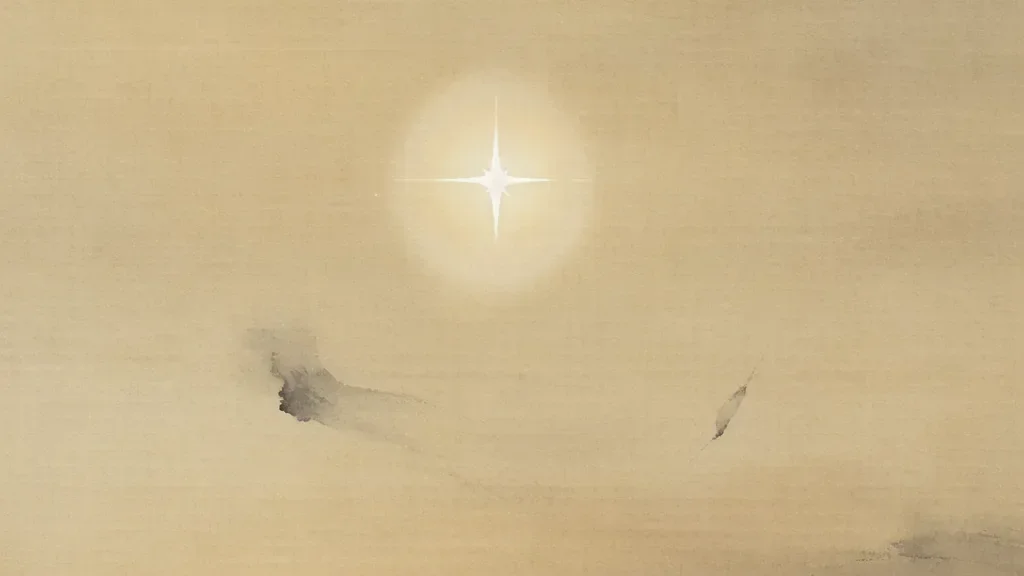
The North Star: The Still Center of the Chinese Cosmos
The fixed point in the northern sky that we call the North Star was not always Polaris. When the first Chinese astronomers began mapping the heavens, the pole lay somewhere near the star Thuban in the constellation Draco, and the star that served as the celestial pivot was Kochab (Beta Ursae Minoris), a modest second-magnitude star in the Little Dipper. Yet despite this slow drift — caused by the 26,000-year cycle of the precession of the equinoxes — the Chinese concept of a central celestial point that never moved remained one of the most stable and powerful ideas in their cosmology. The North Star was not merely a navigational convenience; it was the axis of the entire cosmos, the still point around which the universe revolved.

Precession: The Slow Wobble China Could Not Ignore
By the fourth century CE, Chinese astronomers had been measuring the winter solstice for over a thousand years, and something was wrong. The point in the sky where the sun rose on the solstice had drifted noticeably since the Han dynasty — the position recorded by the Zhou kings no longer matched the reality their instruments showed. The astronomer Yu Xi (虞喜, fl. 307–338 CE) was the first in China to articulate the cause: the entire celestial sphere was slowly wobbling, causing all the stars to shift their positions over centuries. He called this phenomenon "the retreat of the stars" (天左旋, tiān zuǒ xuán), and his discovery of precession — made independently of the Greek astronomer Hipparchus — revealed a deep and previously unsuspected rhythm in the motion of the heavens.
The Purple Forbidden Enclosure: The Emperor's Palace in Heaven
For the Chinese emperor, the celestial realm was a mirror of the earthly court, and nowhere was this reflection clearer than in the Purple Forbidden Enclosure (紫微垣, zǐ wēi yuán), the central palace of heaven where the Celestial Emperor presided over his starry ministers. Lying near the north celestial pole, this circumpolar region never sets below the horizon — a fitting eternal throne for a ruler whose mandate was meant to be everlasting. The Purple Enclosure is the first of the Three Enclosures, and for Chinese astrologers it was the most significant, for it governed the fate of the emperor, the imperial family, and the very legitimacy of the ruling dynasty.
Altair and Vega: The Lovers of the Milky Way
Every summer, on the seventh night of the seventh lunar month, Chinese families gather under the stars to celebrate the meeting of two lovers: the weaver girl Zhi Nü (织女, Vega) and the cowherd Niu Lang (牛郎, Altair). Across a river of stars — the Milky Way — these two figures gaze eternally at each other, permitted to unite only on this single night each year when magpies form a bridge across the celestial river. The Qixi Festival (七夕), or Double Seventh Festival, is one of the oldest and most beloved romantic traditions in Chinese culture, and it is rooted not in literature but in the actual positions of two of the brightest stars in the summer sky.
Shen and Shang: The Rival Stars
In the Chinese constellation system, two star groups — Shen (参, the "Three Stars" of Orion) and Shang (商, the star Antares in Scorpius) — occupy opposite sides of the sky, such that when one rises, the other sets. This astronomical opposition became the basis for one of the most enduring metaphors in Chinese literature: the idea of two people who are destined never to meet, who are "like Shen and Shang" (参商, shēn shāng), forever separated by the turning of the heavens. The phrase appears in the Classic of Poetry, in the poetry of Du Fu and Bai Juyi, and in the modern Chinese idiom that describes estranged friends, separated lovers, or rivals who never cross paths.
The Season-Granting Calendar: Guo Shoujing's Masterpiece
In 1281, the Mongol Yuan dynasty — less than a decade after Kublai Khan completed his conquest of China — adopted a new calendar that would prove to be the most accurate the world had yet seen. The Shoushi calendar (授时历, shòu shí lì), or "Season-Granting Calendar," was the work of Guo Shoujing (郭守敬), a mathematician and engineer whose achievements in observational astronomy, instrument design, and calendar calculation place him among the greatest scientists of the medieval world. The Shoushi calendar measured the tropical year at 365.2425 days — a value so precise that the Gregorian calendar, when it was introduced in 1582, used the same figure. Guo Shoujing had beaten the West by exactly three centuries.
The Heavenly Wolf: Sirius as Omen and Guide
In the Chinese imagination, the brightest star in the night sky was not a peaceful beacon but a wolf — a celestial predator whose appearance was linked to war, raiders, and the breakdown of order. Sirius (天狼星, tiān láng xīng), the star we call the Dog Star, was known in ancient China as the Heavenly Wolf, and its position in the sky carried ominous meaning for every dynasty that watched it. Yet the wolf star was also a guide, a seasonal marker, and later, through contact with Western astronomy, a gateway to understanding the true nature of the cosmos.
The Sky Behind Seasons: How Astronomy Guides Chinese Festivals
Every year around April 5, families across China and East Asia sweep the graves of their ancestors, burn incense, and leave offerings of food and wine. The occasion is Qingming Festival (清明节), and its date is not chosen by convenience. It falls on the first day of Qingming, one of the twenty-four solar terms (节气, jié qì) that divide the Chinese solar year — a system of astronomical timekeeping so ancient and so precise that farmers, astrologers, and festival planners have relied on it for over two thousand years. The solar terms are the hidden skeleton of the Chinese calendar, the astronomical heartbeat beneath the cultural rituals that define East Asian civilization.
Mapping the Milky River: China's Surviving Star Charts
On a winter night around the year 700 CE, a Tang dynasty astronomer named unknown to us — a scholar whose name was never recorded — sketched the stars above Dunhuang on a sheet of paper, carefully marking their positions, sizes, and colors in black and red ink. Over a thousand years later, that sketch was discovered by the British archaeologist Aurel Stein in a sealed cave at the Mogao Grottoes, and it is now recognized as the oldest complete star atlas in the world. The Dunhuang Star Map (敦煌星图, Dūnhuáng xīng tú) is the crown jewel of a Chinese tradition of celestial cartography that produced the most accurate and comprehensive star charts of the pre-modern world.

The Star Officials: Staffing the Heavenly Bureaucracy
A Chinese star map from the Tang dynasty looks, at first glance, less like an astronomical chart than like an organizational flow chart of the imperial government. There, among the stars, are the "Grand Chancellor" (太宰, tài zǎi), the "Minister of Public Works" (司空, sī kōng), the "Chief of the Imperial Bodyguard" (宿卫, sù wèi), and the "Director of the Imperial Granaries" (司农, sī nóng). The Chinese imagined the sky as a vast bureaucracy staffed by star officials, each with a rank, a function, and a designated territory. This bureaucratic vision of the cosmos — the "Heavenly Offices" (天官, tiān guān) — is the most distinctive feature of Chinese astronomy, a system in which the order of the stars reflected and legitimated the order of the state.
Su Song's Astronomical Clock: The Tower of Time
In 1094, the Song dynasty court gathered before a towering bronze-and-iron machine that rose twelve meters above the palace grounds — a mechanical behemoth that not only told the hour but tracked the motions of every major celestial body visible from Kaifeng. Designed by the polymath official Su Song (苏颂), this astronomical clock tower integrated an armillary sphere, a celestial globe, and a set of time-announcing puppets into a single, water-driven mechanism that remains one of the supreme achievements of pre-industrial engineering. The tower did not simply measure time; it replicated the cosmos in miniature, translating the slow drift of the heavens into the steady drip of water and the rhythmic clatter of wooden gears.
Dark Marks on the Sun: China's Ancient Sunspot Observations
On the tenth day of the third month of the first year of the Heping reign of the Han emperor Cheng — a date that corresponds to May 10, 28 BCE — Chinese court astronomers recorded a dark mark on the sun: "The sun had a black spot, the size of a crow." This simple notation in the imperial annals is the earliest dated observation of a sunspot in any civilization, predating the first European sighting by over fifteen centuries. The Chinese astronomers who made this observation did not understand what they were seeing — they had no concept of solar magnetism or nuclear fusion — but they recognized that the spot was meaningful, a portent written on the face of the world's brightest object.
Tai Sui: The Heavenly Grand Duke Who Offends
In Chinese astrology, the most dangerous direction is the one directly opposite the planet Jupiter — a zone ruled by a terrifying deity known as Tai Sui (太岁, "the Grand Duke of Heaven"). To build a house, dig a well, or even travel in the direction of Tai Sui was to invite disaster. This invisible but inescapable power — sometimes identified with Jupiter itself, sometimes with an imaginary anti-Jupiter — has governed Chinese geomancy and superstition for over two thousand years. Understanding Tai Sui is essential to understanding how Chinese astrology translated the movements of the planets into the everyday decisions of ordinary people.
The Taichu Calendar: The Han Reform That Endured
In 104 BCE, the Han emperor Wudi summoned the greatest astronomers of his realm to the capital at Chang'an with a simple but terrifying instruction: fix the calendar or answer to heaven. The existing calendar, inherited from the defeated Qin dynasty, had accumulated errors so severe that the first day of spring sometimes arrived while winter still gripped the land, and the winter solstice had drifted three days from its proper date. The result of this imperial command was the Taichu calendar (太初历, tài chū lì), the "Grand Inception" calendar, a reform so comprehensive that it established the framework for Chinese calendrical astronomy for the next two thousand years — the first calendar in Chinese history to be based on systematic observation rather than political convenience.

The Three Enclosures: Charting the Heavenly Capital
A Chinese astronomer of the Han dynasty looked at the northern sky and saw not scattered stars but a walled capital city, complete with imperial palace, administrative ministries, and market wards. This vision of heaven as a celestial bureaucracy was organized through the Three Enclosures (三垣, sān yuán): the Purple Forbidden Enclosure at the center, the Supreme Palace Enclosure to its east, and the Heavenly Market Enclosure to its south. Together, these three walled regions covered the circumpolar and equatorial zones of the sky, creating an administrative map of heaven that governed how Chinese astronomers classified stars, interpreted omens, and understood the cosmos for more than two thousand years.
The Radiant Night: China's Infinite Universe Theory
In the first century CE, when most of the world's philosophers still believed the heavens were a solid dome or a series of crystal spheres, a school of Chinese astronomers proposed something startling: the universe was infinite, empty, and filled with stars that floated freely in boundless space, their light traveling across unimaginable distances. This was the Xuanye theory (宣夜说, xuān yè shuō), the "Radiant Night" or "Expansive Night" cosmology, and it remains one of the most remarkable scientific insights of the ancient world — a vision of the cosmos that would not be fully accepted in the West until the seventeenth century.
The Yellow Path: The Sun's Road Across the Sky
While the daily rotation of the stars was a predictable wheel, the sun traced a different course each day, climbing higher in summer and dropping lower in winter. Chinese astronomers called this annual track the "Yellow Path" (黄道, huáng dào) — the road the sun traveled through the twenty-eight mansions on its yearly journey. The Yellow Path was not merely an astronomical concept but a metaphysical one: it was the axis of Chinese calendrical science, the reference line for all planetary motion, and a symbol of the imperial order that linked the emperor's virtue to the sun's regularity.
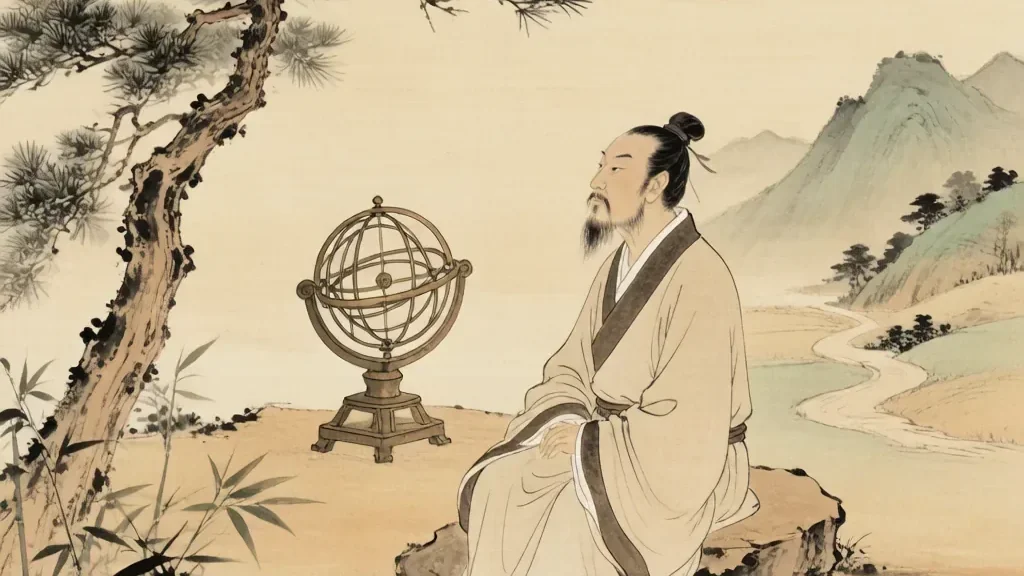
Zhang Heng: The Polymath Who Explored the Cosmos
The Han dynasty scholar Zhang Heng (张衡, 78–139 CE) is remembered as the inventor of the world's first seismoscope, but his contributions to astronomy were equally groundbreaking. He built the first water-powered armillary sphere, mapped over 2,500 stars, calculated the value of pi to 3.1466, and proposed a cosmological model in which the universe was like an egg with the earth as its yolk. Zhang Heng was the archetypal Chinese polymath — astronomer, mathematician, inventor, poet, and cartographer — and his work established the standards of precision and mechanical ingenuity that would define Chinese astronomy for the next millennium.