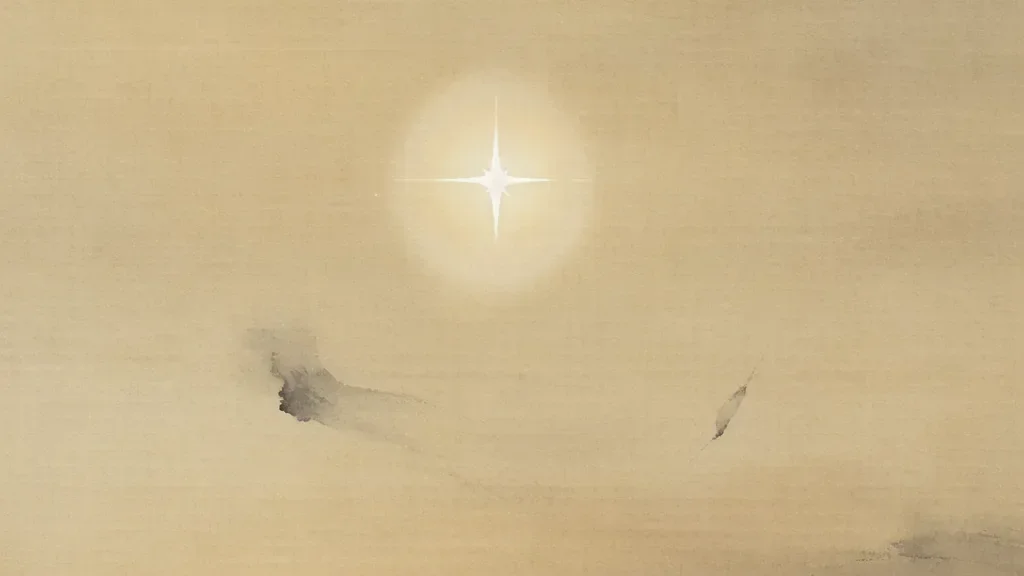
The fixed point in the northern sky that we call the North Star was not always Polaris. When the first Chinese astronomers began mapping the heavens, the pole lay somewhere near the star Thuban in the constellation Draco, and the star that served as the celestial pivot was Kochab (Beta Ursae Minoris), a modest second-magnitude star in the Little Dipper. Yet despite this slow drift — caused by the 26,000-year cycle of the precession of the equinoxes — the Chinese concept of a central celestial point that never moved remained one of the most stable and powerful ideas in their cosmology. The North Star was not merely a navigational convenience; it was the axis of the entire cosmos, the still point around which the universe revolved.
The Pole Star in Chinese Cosmology
In the Chinese cosmological system, the North Star occupied a unique position. It was the abode of the Supreme Emperor (天帝, tiān dì), the highest deity in the celestial bureaucracy. The star itself was not the emperor's physical palace but the point around which the heavenly palace revolved — the central pillar of the cosmic tent. Around this fixed point, the other stars circled in orderly procession, their motions governed by their proximity to the central stillness. The closer a star was to the pole, the smaller its circle of motion and the higher its status in the celestial hierarchy.
This vision of the cosmos was deeply political. The emperor on earth, like the pole star in heaven, was supposed to remain still at the center while his ministers and subjects carried out the work of governance. The Analects of Confucius (论语) capture this ideal: "The one who rules by virtue is like the pole star, which remains in its place while all the other stars revolve around it." A good ruler did not need to chase after influence; like the pole, he exerted power simply by being where he was.
The Polar Constellations: The Purple Palace
The region around the North Star was the most important area of the Chinese sky — the Purple Palace Enclosure (紫微垣, zǐ wēi yuán), the celestial equivalent of the imperial palace. This enclosure contained not only the pole star itself but a series of subsidiary stars representing the emperor's court: the Crown Prince, the Empress, the Heir Apparent, the Grand Ministers, the Guards, and the Eunuchs. The structures of the earthly palace were reflected in the sky: walls, gates, audience halls, and treasuries.
The Purple Palace was not visible in its entirety from all latitudes. At lower latitudes, near the southern edge of Chinese territory, part of the enclosure dipped below the horizon. Astronomers from these regions reported fainter stars and an incomplete palace, a fact that was interpreted as evidence of their marginal position in the empire. The full glory of the Purple Palace was reserved for the capital cities of the north, where the pole stood high in the sky.
The Shifting Pole Through Chinese History
The precession of the equinoxes — the slow wobble of Earth's rotational axis — caused the identity of the pole star to change over the centuries. The first Chinese astronomers, around 2000 BCE, would have seen the star Thuban (右枢, yòu shū) as the pole star. By the Zhou dynasty, the pole had moved to Kochab (北极星, Běi jí xīng — though the name was applied to different stars at different times). Modern Polaris (勾陈一, Gōu Chén yī) became the pole star around 500 CE and has been used as such ever since.
Chinese astronomers noticed this drift. The great astronomer Zhang Heng, writing in the second century CE, commented that the pole star position recorded in ancient texts did not match his own observations, and he speculated that the heavens might be slowly shifting. This awareness of precession — though not formulated as clearly as the Greek astronomer Hipparchus had done — demonstrates the long time-scales over which Chinese astronomy operated. A tradition that preserved records for centuries could detect changes that were imperceptible within a single human lifetime.
The Pole Star in Navigation and Calendrics
For practical purposes, the pole star was the most important navigational reference in the Chinese toolkit. Its fixed position due north made it the primary reference for finding the cardinal directions. Chinese surveyors used the pole star to align city walls, tombs, and ritual structures. The orientation of the Great Wall's northern sections was checked against the pole star. The Forbidden City in Beijing was aligned on a north-south axis that pointed toward Polaris.
In calendrical astronomy, the pole star served as a reference for determining the equinoxes. By observing which stars rose or set at the same time as the pole star crossed the meridian, astronomers could calculate the position of the sun along the ecliptic and thus determine the date with precision. The pole star was also the anchor for the equatorial coordinate system used in Chinese astronomy — the system of xiu (lunar mansions) that divided the sky along parallels of right ascension.
The Celestial Axis in Daoism and Art
The concept of the central, unmoving point extended beyond astronomy into Daoist philosophy and Chinese art. The Daoist adept sought to find the "pole star within" — the still point of consciousness from which all thoughts and emotions could be observed without attachment. Daoist meditation texts described the flow of qi (vital energy) as circling around a central axis, just as the stars circled the pole. This meditative model influenced the design of Chinese gardens, where the central pavilion or rock served as the symbolic pole star around which the landscape was arranged.
In Chinese landscape painting, the composition often revolved around an axial element — a central mountain, tree, or figure — while the surrounding features radiated outward in balanced asymmetry. The aesthetic principle of returning to the center, of finding stillness within movement, traced its lineage back to the pole star and the cosmic order it represented.
The Pole Star in Folk Astronomy
Beyond the court, ordinary people knew the pole star as a steady friend in the night. Travelers used it to keep their bearings on dark roads, and villagers spoke of it as the nail the sky turns upon. Folk sayings urged the honest person to be 'like the pole star', constant and reliable, showing how the astronomical idea entered everyday speech. Although most people could not name the mansions or read an almanac, they could find the pole and the Dipper, so the still point of the sky became a shared reference that joined humble experience to the grand cosmology of the astronomers.
The Northern Dipper Through the Year
Because the Dipper circles the pole, its orientation marks the progress of the seasons as reliably as a clock hand. When its handle points east, spring is near; south, it is summer; west, autumn; north, winter. Chinese farmers and poets alike read the year from this slow turning, and the handle's direction was used to time tasks from sowing to harvest. This practical calendar needed no writing and no instrument, only a clear night and a glance upward, which is why the Dipper's annual sweep became one of the most widely known pieces of sky knowledge in the countryside.
The Pole in the Modern Chinese Sky
Today the pole star still draws crowds to planetariums and dark-sky sites across China. Light pollution in big cities has dimmed the circumpolar stars for many residents, but programs that bus visitors to rural observatories keep the tradition alive. Educators use the pole and the Dipper to teach the basics of the celestial sphere, and the Forbidden City's alignment with Polaris is now a popular point of tour commentary. The star that once anchored an empire thus continues to connect modern Chinese audiences to the astronomical heritage of their ancestors.
❓ Frequently Asked Questions
📝 Chinese Vocabulary
北极星 — : North Pole Star; the general term for the pole star.
紫微垣 — : The Purple Palace Enclosure; the region around the pole star.
天帝 — : The Supreme Emperor; the celestial ruler whose abode is the pole.
北斗七星 — : The Northern Dipper; the seven stars that circle the pole.
勾陈 — : Curved Array; the asterism containing the modern pole star Polaris.
北极 — : The North Pole, the region of sky around the celestial pivot where the emperor's stars dwell.
帝座 — : The Emperor's Seat, the star representing the throne near the pole.
华盖 — : The Canopy, a circumpolar asterism imagined as the imperial umbrella over the pole.
🎉 Fun Facts
- Polaris is actually a triple star system, though the two companion stars are too faint to be seen without a telescope.
- The pole star will not always be Polaris. In about 13,000 years, the pole will have moved close to the bright star Vega in the constellation Lyra.
- Confucius compared the ideal ruler to the pole star — "standing in place while all others revolve around him" — a metaphor that shaped Chinese political thought for centuries.
- The central star of the Big Dipper, Mizar, sits next to a faint companion, Alcor, once used as a test of keen eyesight in imperial times.
- Porters and night travelers used the Dipper's pointer stars to find true north within a couple of degrees.
- The pole star region contains dozens of named 'officials', so the northern sky itself was drawn as a complete government.