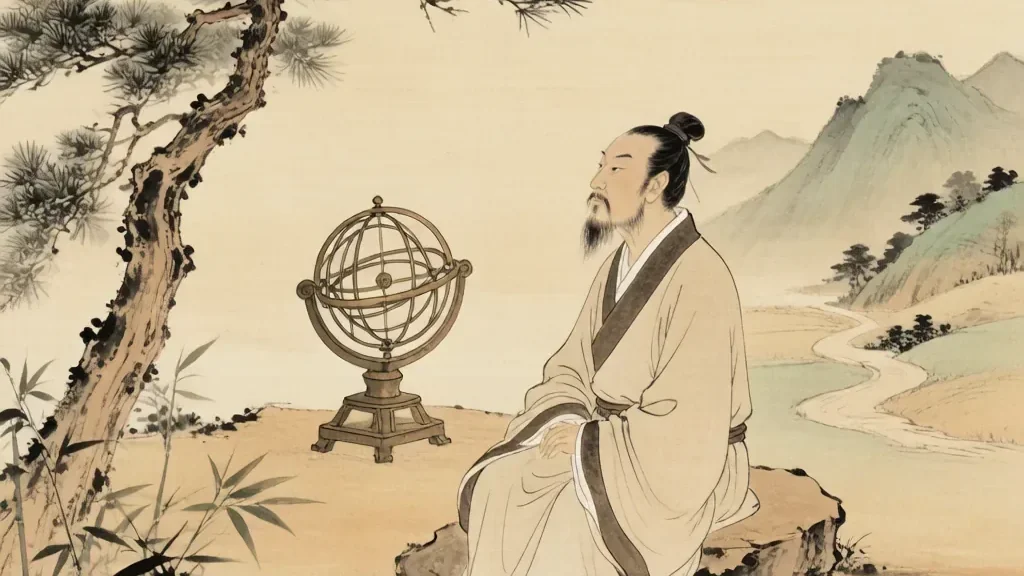
The Han dynasty scholar Zhang Heng (张衡, 78–139 CE) is remembered as the inventor of the world's first seismoscope, but his contributions to astronomy were equally groundbreaking. He built the first water-powered armillary sphere, mapped over 2,500 stars, calculated the value of pi to 3.1466, and proposed a cosmological model in which the universe was like an egg with the earth as its yolk. Zhang Heng was the archetypal Chinese polymath — astronomer, mathematician, inventor, poet, and cartographer — and his work established the standards of precision and mechanical ingenuity that would define Chinese astronomy for the next millennium.
Zhang Heng's Celestial Globe and Armillary Sphere
In 117 CE, Zhang Heng constructed a "celestial globe" (浑天仪, hún tiān yí) that was a landmark of mechanical engineering. The globe was a bronze sphere, about five meters in circumference, with the constellations mapped onto its surface in exact positions. It was driven by a water wheel that used a constant-flow clepsydra (water clock) to rotate the sphere at the same speed as the actual sky — one revolution per day. Observers sitting inside a chamber could watch the model stars rise and set in perfect synchrony with the real heavens. This was the world's first known mechanically powered astronomical model.
The water-driven armillary sphere was not merely a display piece; it was a scientific instrument. Zhang used it to test and refine his theories of celestial motion, adjusting the positions of stars and the angles of planetary orbits until the model matched careful observations. His writings describe the sphere's construction in detail, including gear ratios, water-flow regulators, and temperature-compensation mechanisms. Though the original sphere was destroyed centuries ago, later Chinese astronomers — including the Song dynasty's Su Song — explicitly acknowledged Zhang Heng's design as the foundation of their own mechanical models.
Star Catalog and Astronomical Writings
Zhang Heng compiled a star catalog that listed 124 constellations and 2,500 individual stars, a significant increase over earlier Chinese catalogs. His criteria for inclusion were systematic: a star was included if it was visible to the naked eye and appeared in at least one of the standard star groups recognized by the Han court. The catalog, preserved in fragments through later quotations, shows that Zhang classified stars by brightness into six magnitudes — the same system later adopted by Western astronomers in the Hellenistic period. His magnitude estimates were remarkably consistent; modern recalculations of his catalog entries show an error rate of less than half a magnitude for most stars.
His most important astronomical text was the Spiritual Constitution of the Universe (灵宪, Líng Xiàn), a comprehensive treatise on cosmology, astronomy, and astrology. In it, Zhang set forth his "egg model" of the cosmos (浑天说, hún tiān shuō), which held that the heavens were spherical and enveloped the flat earth like an eggshell around its yolk. This model, though incorrect by modern standards, was far more sophisticated than the competing "heavenly dome" theory of the Gai Tian school. Zhang also correctly explained that the moon shines by reflected sunlight, and he described lunar eclipses as the earth's shadow falling on the moon — a theory that would not appear in European astronomy until Aristotle, but which Zhang developed independently.
The Seismoscope: A Technological Marvel
In 132 CE, Zhang Heng presented the Han court with a device unlike any ever built: a seismoscope that could detect earthquakes hundreds of kilometers away. The instrument was a bronze vessel about two meters in diameter, shaped like a wine jar, with eight dragon heads around its rim, each holding a bronze ball in its mouth. Eight toads sat below, mouths open to catch the balls. When an earthquake struck, a pendulum inside the vessel would swing toward the direction of the tremor, triggering one of the dragons to release its ball into the toad's mouth with a loud clang. The direction of the fallen ball indicated the direction of the earthquake's epicenter.
The seismoscope's first recorded success came in 138 CE, when it detected an earthquake that court officials in Luoyang had not felt. Days later, a messenger arrived from the Longxi region (modern Gansu province), over 400 kilometers away, reporting that an earthquake had indeed occurred there. The device thus demonstrated both its sensitivity and its directional accuracy. Modern engineers have built replicas of Zhang's seismoscope and confirmed that a pendulum-based mechanism of this design can indeed detect distant tremors, though the exact internal mechanism — whether inverted pendulum or some other configuration — remains debated among historians of technology.
Literary and Artistic Achievements
Zhang Heng was also one of the great literary figures of the Han dynasty. His Fu on the Two Capitals (两京赋, Liǎng Jīng Fù) is a masterpiece of rhapsodic poetry that describes the imperial capitals of Changan and Luoyang in encyclopedic detail. His Fu on Contemplating the Mysteries (思玄赋, Sī Xuán Fù) combines astronomical imagery with metaphysical reflection, describing a celestial journey through the stars and constellations. The poem, shimmering with astronomical terminology, demonstrates that Zhang was not merely a technician but a thinker who felt the beauty and mystery of the cosmos as keenly as any poet.
In his later years, Zhang turned to cartography and mathematics. He developed a grid system for mapping the Han empire, an early form of rectangular coordinate mapping that anticipated modern cartographic practices. His calculation of pi — the ratio of a circle's circumference to its diameter — as the square root of ten (approximately 3.1466) was one of the most accurate values achieved anywhere in the world at that time. He also proposed a value for the volume of a sphere, though the exact formula has been lost.
Legacy and Modern Recognition
Zhang Heng was posthumously recognized in China as one of the greatest scientific minds of antiquity. During the Ming dynasty, his works were reprinted and studied by Jesuit astronomers who were amazed at the sophistication of Han dynasty science. In the twentieth century, UNESCO recognized Zhang Heng as a "world cultural celebrity," and a lunar crater was named in his honor. Chinese schools teach his story as an exemplar of scientific and creative achievement — a reminder that the pursuit of knowledge about the heavens and the earth were not separate endeavors in ancient China, but two sides of a single, inquiring mind.
The Moon and the Shadow
Zhang Heng gave China its first clear physical theory of the moon. In his treatise Ling Xian he explained that the moon shines only by borrowed sunlight and that a lunar eclipse occurs when the earth's shadow falls upon it. He also recognized that the moon's phases come from our viewing angle of its sunlit half. This was a major conceptual advance, replacing vague yin-yang accounts with a geometry of light and shadow. Although the Greek Aristotle had voiced a similar idea, Zhang reached it independently within the Chinese cosmos. His explanation let astronomers predict eclipses by the relative positions of sun, earth, and moon, joining observation to a coherent mechanical picture of the heavens. It marks a clear step from poetry about the moon to physics of the moon.
Cartography and Mathematics
Zhang Heng's genius was not confined to the sky. He computed pi by relating a circle's circumference to its diameter, arriving at the square root of ten, a value accurate to two decimal places for his time. In geography he laid out the Han realm on a grid of squares, so that scale and direction could be read from the map itself, a method later standard in Chinese cartography. He also studied the varying lengths of the solar year and the geometry of the celestial sphere. These pursuits show a mind that treated earth measurement and sky measurement as one discipline. The same quantitative habit that built his armillary sphere also let him plot the empire and approximate the circle's constant.
Influence on Later Science
Zhang Heng set a standard later Chinese scientists measured themselves against. The water-driven armillary he pioneered was rebuilt and enlarged by Su Song seven centuries later, and Ming-era astronomers still cited his writings. His combination of instrument building, theory, and literature became a model of the complete scholar-official. When Jesuit astronomers reached China they were surprised to find a second-century scientist who had already described a spherical cosmos and an eclipse mechanism. Modern China honors him with a lunar crater and school lessons, ensuring his name remains shorthand for native ingenuity. His career proves that systematic science flourished in Han China long before the telescopic age. His example shows that careful measurement, not myth, built China's lasting astronomical reputation, and earned him a place among the greatest scientists of the ancient world.
❓ Frequently Asked Questions
📝 Chinese Vocabulary
张衡 — : Zhang Heng; Han dynasty astronomer, mathematician, and inventor.
浑天仪 — : Armillary sphere; Zhang's water-driven celestial globe.
候风地动仪 — : Seismoscope; Zhang's earthquake-detection device.
灵宪 — : Spiritual Constitution of the Universe; Zhang's cosmological treatise.
浑天说 — : Celestial Sphere Theory; the cosmological model Zhang championed.
漏水转浑天仪 — : Water-Driven Armillary Sphere; Zhang Heng's powered celestial globe.
两京赋 — : Fu on the Two Capitals; Zhang Heng's famed rhapsody describing the Han capitals.
圆周率 — : Ratio of Circumference to Diameter; the mathematical constant Zhang Heng estimated as about 3.1466.
🎉 Fun Facts
- Zhang Heng's seismoscope is depicted on Chinese postage stamps and featured in Chinese middle-school textbooks as a national invention of the highest order.
- He calculated the value of pi as the square root of ten (about 3.1623), though his actual writings give 3.1466 — both values were remarkably close for the second century CE.
- The water-powered armillary sphere was the first known self-rotating astronomical model in any civilization, predating similar European devices by at least 1,300 years.
- A crater on the far side of the moon bears Zhang Heng's name, awarded by the International Astronomical Union in honor of his science.
- Zhang Heng served in the imperial observatory and was reportedly demoted after urging the court to curb wasteful spending.
- His map of the Han empire was drawn on a grid, a scroll roughly three meters square that anticipated modern coordinate cartography.