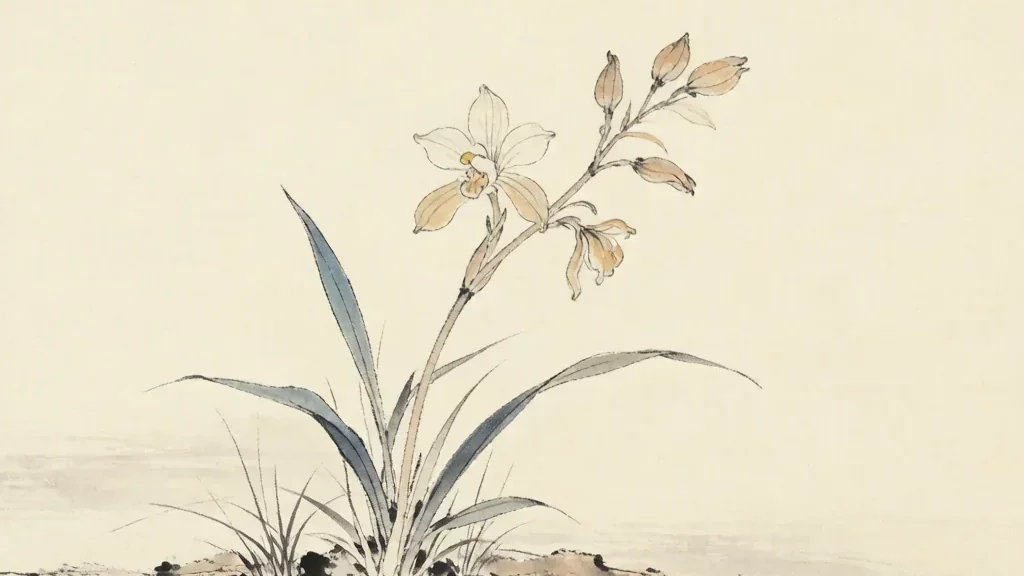
The orchid, called lán (兰) in Chinese, holds a special place among the great plants of Chinese culture, ranking with the plum, bamboo, and chrysanthemum as one of the "four gentlemen" of scholar painting. Unlike the showy blooms prized for color, the classical Chinese orchid is admired for subtle fragrance, restrained form, and the quiet elegance that suits a refined mind. Grown in pots and celebrated in ink, the orchid became a symbol of the noble person who keeps virtue even in obscurity—a flower more felt than seen, more heard (in scent) than shouted (in hue).
What "Lan" Means in Chinese
In Chinese tradition, lán often refers to terrestrial orchids of the genus Cymbidium, with long grass-like leaves and arching stems of modest flowers, rather than the tropical orchids familiar from hothouses. These hardy orchids grow in shaded, rocky, or woodland places and were the ones known to classical gardeners.
The word also broadens to include fragrant herbs in general, and "orchid" symbolism stretches across several kinds. What matters culturally is not botanical precision but the idea of a plant that is fragrant without being loud and beautiful without being ostentatious.
The Orchid Among the Four Gentlemen
The "four gentlemen" (méi lán zhú jú) pair the plum, orchid, bamboo, and chrysanthemum as ideals of character. The orchid stands for refinement, humility, and inner virtue—qualities of the gentleman who does not need an audience. Painters used a few ink strokes to suggest leaves and a sparse bloom, implying more than they drew.
Where the plum defies winter and the bamboo bends but does not break, the orchid contributes the note of gentle, private goodness. Together the four form a small moral alphabet taught through plants, repeated in countless scrolls and poems.
Growth and Cultivation
Classical orchids like Cymbidium are epiphytic or terrestrial, liking loose, well-drained growing medium, indirect light, and fresh air. They are grown in pots with special orchid mix rather than heavy soil, and valued for both leaf and flower.
Chinese growers developed deep knowledge of watering, shading, and timing bloom, often keeping prized plants in study rooms where their scent could be enjoyed while reading. The care of orchids became a leisurely art associated with scholarly life rather than with farmwork.
Fragrance and the Invisible Flower
The orchid's chief glory is its scent: faint, sweet, and clean, released without a bright show of petals. Chinese writers returned again and again to this idea—that true worth makes itself known gently, like a good reputation or a virtuous friend.
Confucius is credited in later tradition with comparing the orchid to the superior person whose goodness is not diminished by lack of recognition. Whether or not the saying is historical, it captured how the flower was understood: excellence that needs no stage.
Orchid in Painting
Orchid painting (lán huà) is a recognized mode of ink art, sometimes practiced by beginners for its simple lines yet capable of great sophistication. The angled leaves and sparse flowers test the artist's control of brush and breath, since minimal forms hide no mistakes.
Famous painters made the orchid a vehicle for personal feeling, especially in times of upheaval, when a bare orchid could stand for integrity under pressure. The plant's restraint matched the mood of artists who wished to speak without shouting.
Orchid in Poetry
Poets invoked the orchid to praise friends, mourn separation, and express loyalty to principle. The Songs of Chu (Chǔ cí), an ancient southern poetry collection, uses orchids and similar fragrant plants as symbols of purity amid a corrupt world, establishing a lasting trope.
Later verse kept the association, often placing the orchid in empty valleys to stress that it smells sweet even where no one passes. This image became a compact lesson in self-possessed virtue, taught through a single flower in a ravine.
The Empty-Valley Orchid
A key motif is the "orchid in an empty valley" (kōng gǔ yōu lán), blooming unseen yet fragrant. It encapsulates the belief that moral worth does not depend on reward or witness. The phrase entered common speech as praise for quiet, unselfish people.
This idea also comforted the unsuccessful scholar, suggesting that being good matters more than being noticed. The orchid thus served both as flattery and as consolation within the same cultural code.
Orchids and Friendship
Because the orchid's scent was likened to a friend's pleasing company, the flower became a token of refined friendship and parting. Gifts of orchid plants or poems about them marked bonds between like-minded people.
In gardens, a few orchids on a windowsill could stand for the presence of good companions even in solitude. The plant's small, private pleasures fit a culture that valued subtle, durable relationships over loud display.
Regional Orchid Cultures
Different regions favored different orchids; spring orchids (Cymbidium goeringii) and others were bred for leaf shape, bloom time, and scent. Enthusiasts held informal gatherings to compare plants, a gentle hobby of connoisseurship.
Some areas became known for particularly fine wild-collected orchids, and local pride attached to the subtlety of a strain. Though modest in scale, this culture was serious to those who practiced it, linking horticulture to taste.
The Orchid's Enduring Lesson
The Chinese orchid endures not because it is grand but because it is exact: a small plant teaching that restraint, fragrance, and quiet integrity outlast noise. Its place among the four gentlemen ensures it a permanent role in how Chinese culture pictures the good life.
To grow or paint an orchid is, in a sense, to rehearse a stance toward the world—modest, clean, and self-sufficient. Few flowers carry so much philosophy in so few petals.
Orchids in the Modern Home
Today the orchid has moved from the scholar's desk into the urban apartment, where potted Cymbidium and other easy kinds brighten balconies and living rooms. The plant's tolerance of indoor light and its clean scent fit modern tastes that value calm over show, and a single flowering pot can soften a plain room.
Gardening clubs and online communities now share tips on watering and coaxing bloom, keeping the old connoisseurship alive in new forms. The orchid thus remains what it always was—a small, fragrant teacher of restraint—now reaching people who may never lift a brush yet still catch its quiet lesson of composure.
❓ Frequently Asked Questions
Q: What does the orchid symbolize in Chinese culture?
A: The orchid (兰花, lánhuā) symbolizes refinement, elegance, and scholarly virtue. It represents humility and beauty — growing quietly in remote mountain valleys rather than competing for attention. It is one of the 'Four Gentlemen' in Chinese art.
Q: Why is the orchid associated with scholars?
A: Confucius compared virtuous men to orchids: '与善人居,如入芝兰之室' ('Being with good people is like entering a room full of orchids'). The orchid's delicate fragrance, even in isolation, parallels the scholar's virtue that persists regardless of recognition or reward.
Q: What is the history of orchid cultivation in China?
A: Chinese orchid cultivation dates back over 2,500 years. The earliest records appear in the Confucian classic 'Book of Songs.' Orchids were collected from the wild and cultivated in gardens during the Tang Dynasty. The Song Dynasty saw the first illustrated manuals on orchid cultivation.
Q: What is the difference between Chinese orchids and Western orchids?
A: Chinese orchids (Cymbidium species) are primarily terrestrial and prized for their subtle, elegant appearance and delicate fragrance. Western orchids (like Phalaenopsis) are often tropical epiphytes with showy, long-lasting flowers. Chinese aesthetics prefer understated, graceful blooms.
Q: Which orchid does "lan" mean?
A: Traditionally it refers to hardy terrestrial Cymbidium orchids with grass-like leaves, not the showy tropical kinds, valued for subtle flower and scent.
Q: Why is the orchid a "gentleman"?
A: It stands for refinement, humility, and inner virtue—goodness that needs no audience—making it one of the four gentleman plants.
Q: What is the empty-valley orchid?
A: A motif of an orchid blooming unseen yet fragrant, used to teach that true worth does not depend on being noticed or rewarded.
Q: How is the orchid used in art?
A: Ink painters render a few leaves and sparse blooms, where minimal forms test brush skill and carry personal or moral feeling.
Q: What does the orchid's scent symbolize?
A: A gentle, clean goodness that makes itself known without show, likened to a virtuous friend or a good reputation.
Q: How were orchids grown historically?
A: In pots with loose, well-drained medium in shaded, airy spots, often kept in scholars' rooms so the scent could be enjoyed while reading.