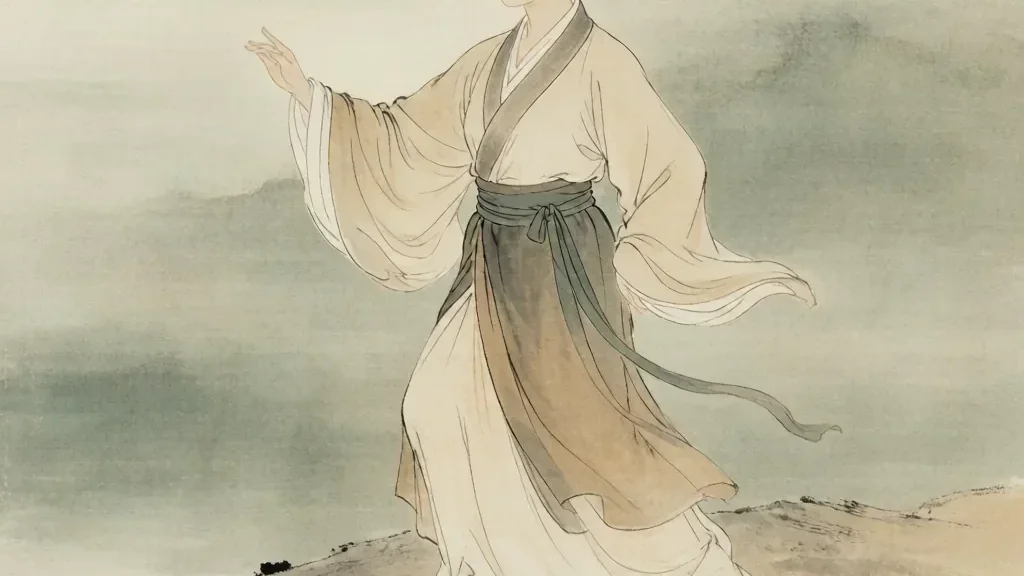
The Eight Brocades (八段锦) is a gentle qigong set of eight linked exercises, a daily 'silk weaving' of breath and motion for health rather than combat.
The History of the Eight Brocades
The Eight Brocades trace their origins to the Song dynasty. The name 'brocade' refers to precious silk — each movement is valuable. The number eight reflects completeness.
Movement One: Two Hands Holding Up the Heavens
Interlacing fingers and stretching overhead opens the Triple Burner meridian and decompresses the spine.
Movement Two: Drawing the Bow
Imitating an archer, this activates the Lung and Large Intestine meridians.
Movement Three: Separating Heaven and Earth
A contrasting push creating a diagonal stretch stimulating the Stomach and Spleen meridians.
Movement Four: The Wise Owl Gazes Backward
A spinal twist counteracting hunch posture.
Movements Five through Eight
The fifth targets the Heart; the sixth is a forward fold for Kidney energy; the seventh returns to martial quality; the eighth is gentle heel bouncing.
The Seated Baduanjin Variant
Beyond the familiar standing sequence, a seated version of the Eight Brocades was compiled by the Ming dynasty physician Gao Lian in his work Zunsheng Eight Jians (遵生八笺). This variation, known as the 'Bed Exercises for Any Time,' adapts each movement to a seated posture, making it accessible to the elderly and those recovering from illness. The seated version preserves the meridian-based logic of the original while reducing the physical load on the legs and knees.
Gao Lian's text describes specific breathing patterns to accompany each seated movement. For instance, 'Punching with Clenched Fists and Glaring Angrily' is paired with a sharp exhalation to clear the Liver meridian, while 'Swaying the Head and Wagging the Tail' uses slow, deep breaths to calm the Heart. This integration of breath work with gentle motion is a hallmark of the baduanjin tradition and underscores its roots in traditional Chinese medicine.
Modern clinical studies in China have validated the seated baduanjin as an effective intervention for patients with chronic obstructive pulmonary disease (COPD). A 2021 randomized controlled trial at the Shanghai University of Traditional Chinese Medicine found that patients who practiced the seated version for twelve weeks showed significant improvements in lung function and quality of life compared to the control group. This research demonstrates that the baduanjin's therapeutic value does not depend on the standing posture alone.
Baduanjin in East Asian Transmission
The Eight Brocades did not remain confined to China. During the Tang dynasty, Buddhist monks traveling the Silk Road carried the practice to Korea, where it evolved into the Paldan-geup (팔단급) system. Korean practitioners adapted the original eight movements to align with the five-element theory of Korean traditional medicine, adding percussive tapping and rhythm-based breathing. The Korean version placed greater emphasis on the kidney and bladder meridians, reflecting the colder climate and different health concerns of the Korean peninsula.
In Japan, the baduanjin arrived through Zen Buddhist channels during the Kamakura period (1185–1333). Japanese monks recorded the exercises as the Hachidan-kin (八段錦), incorporating them into the daily routine of temple life. The Japanese version stripped away much of the Daoist terminology and reframed the movements within a purely meditative context. This secularization helped the Hachidan-kin survive the Meiji-era suppression of traditional Chinese medical practices and remain popular in Japan to this day.
The transmission of baduanjin across East Asia created distinct regional variations, yet the core principles remained constant: gentle stretching, coordinated breathing, and meditative focus. This adaptability is the reason the Eight Brocades have survived for over a millennium, evolving with each culture that embraced them while never losing their essential character as a health cultivation system.
The Science Behind the Silk: Modern Research on Baduanjin
In recent decades, the baduanjin has attracted serious attention from the international scientific community. A landmark 2018 meta-analysis published in the Journal of Sport and Health Science examined twenty-three randomized controlled trials and concluded that baduanjin practice significantly improved balance, flexibility, and mental well-being in older adults. The analysis also found moderate evidence for reduced blood pressure and improved sleep quality among regular practitioners.
Neuroimaging studies have provided even more striking results. Researchers at Beijing University of Chinese Medicine used functional MRI scans to observe changes in brain activity after eight weeks of baduanjin training. They found increased gray matter density in the prefrontal cortex and hippocampus, regions associated with memory and executive function. These findings suggest that baduanjin may help delay cognitive decline, a possibility that has sparked interest in using the practice as a low-cost intervention for aging populations.
The mechanism behind these benefits appears to be the combination of gentle aerobic exercise, mindfulness, and controlled breathing. Unlike high-intensity workouts that activate the sympathetic nervous system, baduanjin stimulates the parasympathetic 'rest and digest' response, reducing cortisol levels and inflammation markers. This unique physiological profile positions the Eight Brocades not merely as a traditional exercise but as a scientifically validated tool for holistic health maintenance.
❓ Frequently Asked Questions
📝 Chinese Vocabulary
八段锦 — : Eight Brocades; classic qigong.
三焦 — : Triple Burner meridian.
督脉 — : Governing Vessel; central meridian.
气功 — : Qigong; energy cultivation.
双手托天理三焦 — : Two Hands Hold Up the Heavens, the first of the Eight Brocades
摇头摆尾去心火 — : Sway the Head and Shake the Tail to Remove Heart Fire, the sixth movement
攒拳怒目增气力 — : Clench the Fist and Glare Fiercely to Increase Strength, the seventh movement
背后七颠百病消 — : Seven Bounces Behind the Back to Cure a Hundred Illnesses, the eighth movement
🎉 Fun Facts
- Each movement is named after silk brocade, Song China's most valuable textile.
- Baduanjin is prescribed in Chinese hospitals for stroke and surgery rehabilitation.
- A 2019 meta-analysis confirmed Baduanjin improves cognitive function in older adults.
- The eight movement names are traditionally taught as a single rhyming poem that students recite aloud to remember the sequence.
- Seated versions of Baduanjin exist so the practice can be done in a chair, making it popular with the elderly and people with limited mobility.
- Baduanjin is regularly prescribed in Chinese community health programs and hospital wellness classes as gentle preventive exercise.