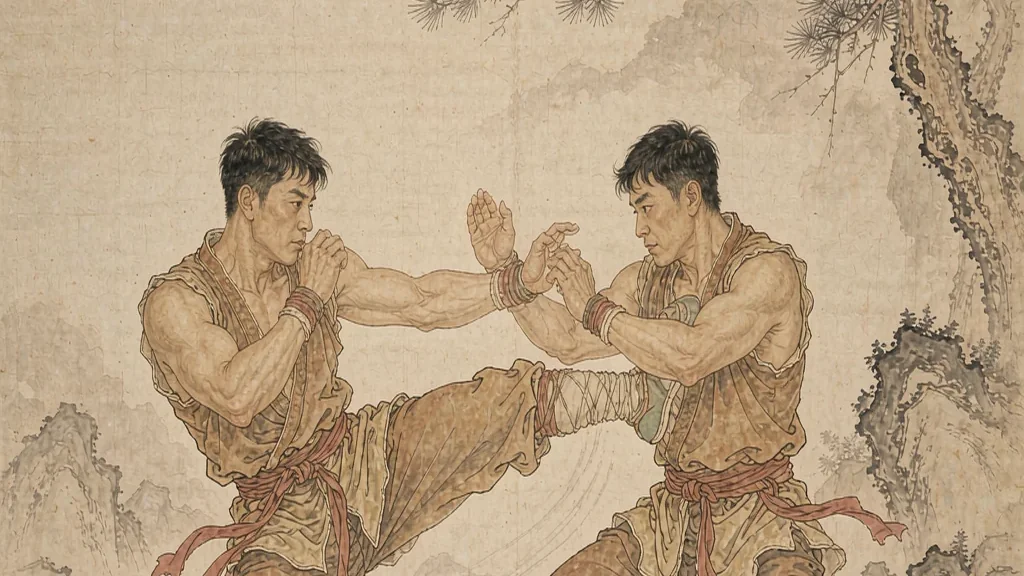
Sanda (散打) is modern Chinese kickboxing — a full-contact sport of strikes, throws, and kicks distilled from traditional wushu.
The Birth of Sanda
Sanda emerged from military and police hand-to-hand combat training, combining traditional Chinese techniques with modern sports science. The China Sports Commission standardized the rules in the 1970s, creating a combat sport that could compete internationally.
Unlike point-sparring systems, Sanda trains for real damage — controlled but full-contact striking with protective gear. Its practical approach has made it one of China's most successful martial exports.
The Ruleset
Sanda allows punches, kicks, and throws — the three pillars of unarmed combat. Fighters wear headgear, chest protector, shin guards, and gloves. Matches are three rounds of two minutes each.
Throws score two points; knockdowns score two points; punches and kicks score one point. The throw element distinguishes Sanda from Western kickboxing and Muay Thai.
The Shuaijiao Connection
Sanda's throwing techniques derive from shuai jiao, traditional Chinese wrestling. Fighters learn to clinch, off-balance, and throw opponents using hip tosses, leg sweeps, and upper-body throws.
This wrestling integration makes Sanda unique among striking sports. A Sanda fighter who cannot throw will lose to one who can, regardless of striking skill.
Training Methods
Sanda training includes heavy bag work, pad drills, sparring, and condition training. The 'move, strike, throw' combination drill trains the three ranges of combat in sequence.
Traditional conditioning exercises — handstands, horse stance, iron body — supplement modern weight training. The best Sanda gyms combine ancient and modern methods.
Sanda vs. Other Combat Sports
Comparisons with Muay Thai are natural — both allow kicks and clinch strikes. Sanda differs in allowing throws and in its mobile footwork, emphasizing angles over forward pressure.
Sanda fighters have performed well in mixed-rules competitions, though the headgear and scoring system create different strategic priorities.
Sanda Today
Sanda is a medal sport in the Asian Games and World Combat Games. Professional leagues in China attract top fighters. Its influence extends into MMA, where Sanda's combination of striking and throwing produces well-rounded fighters.
The challenge for Sanda's future is balancing sport safety with combat realism — a tension shared by all combat sports.
The Birth of Modern Chinese Kickboxing
Sanda (散打), also known as Chinese kickboxing or 'free fighting,' represents the modern synthesis of traditional Chinese martial techniques into a competitive combat sport. The Chinese government initiated the development of sanda in the 1970s as part of an effort to systematize Chinese martial arts for sport competition. The goal was to create a ruleset that would allow practitioners of different traditional styles to compete safely while preserving the essence of Chinese martial technique.
The resulting sport combines punches, kicks, and throws — borrowing the striking techniques from northern Chinese styles and the throwing techniques from shuai jiao (Chinese wrestling). Sanda matches are fought on a raised platform called a 'leitai' (擂台), and fighters score points for clean strikes, takedowns, and throws. The rules prohibit strikes to the back of the head and the groin, and require fighters to wear protective gear including headgear, gloves, and a chest protector.
Sanda quickly gained popularity both in China and internationally. The International Wushu Federation (IWUF) standardized sanda rules for global competition, and the sport was included in the Asian Games and other international multi-sport events. China has produced numerous world champion sanda fighters who have demonstrated the effectiveness of the Chinese approach combining striking and throwing in ways that distinguish sanda from Western kickboxing and Muay Thai.
Sanda vs. Traditional Chinese Martial Arts
The relationship between sanda and traditional Chinese martial arts (known collectively as 'kung fu' or 'wushu') is complex and sometimes contentious. Proponents of sanda argue that the sport represents the real, practical essence of Chinese martial arts, stripped of the flowery forms and performance-oriented techniques that dominate modern wushu. Critics argue that sanda's rules constrain the full range of traditional techniques, particularly excluding the vital-point strikes and chin na joint locks that were essential to traditional combat.
Many traditional kung fu masters have nonetheless embraced sanda as a training method for developing practical fighting skills. Schools that teach traditional forms often incorporate sanda sparring as a way for students to test their techniques against resisting opponents. This integration of traditional forms with modern sparring creates a complete training system that preserves cultural heritage while developing real combat capability. The most respected kung fu schools in China today typically train both forms and sanda.
For the international martial arts community, sanda has become the most accessible entry point into Chinese martial culture. A student who begins with sanda develops a foundation in practical striking and throwing before deciding whether to explore the deeper traditions of the classical styles. Sanda gyms have opened in cities around the world, offering a Chinese alternative to the Muay Thai and Brazilian Jiu-Jitsu that dominate the global combat sports landscape.
❓ Frequently Asked Questions
📝 Chinese Vocabulary
散打 — : Sanda; free fighting/Chinese kickboxing.
摔法 — : Throwing techniques derived from shuai jiao.
拳腿摔 — : Punch, kick, throw — the three Sanda pillars.
擂台 — : Lei tai; the raised fighting platform.
鞭腿 — : whip kick, the fast circular leg Sanda fighters use most often
接腿摔 — : catch-and-throw, scooping an opponent's kick into a takedown
抱架 — : the guard, Sanda's protective hands-and-elbows posture
组合拳 — : combination punching, chaining strikes in quick sequences
🎉 Fun Facts
- Sanda was developed from military hand-to-hand combat training.
- The first Sanda world championships were held in 1991 in Beijing.
- Several Sanda fighters have transitioned successfully to MMA, including Zhang Weili.
- Sanda athletes commonly wear protective gear including headguard, chest guard, and mouthguard in amateur bouts.
- The sport's rules allow kicks, punches, and throws but forbid strikes to the back of the head and the spine.
- China's national Sanda teams train full-time athletes who also cross-train in wrestling and boxing.