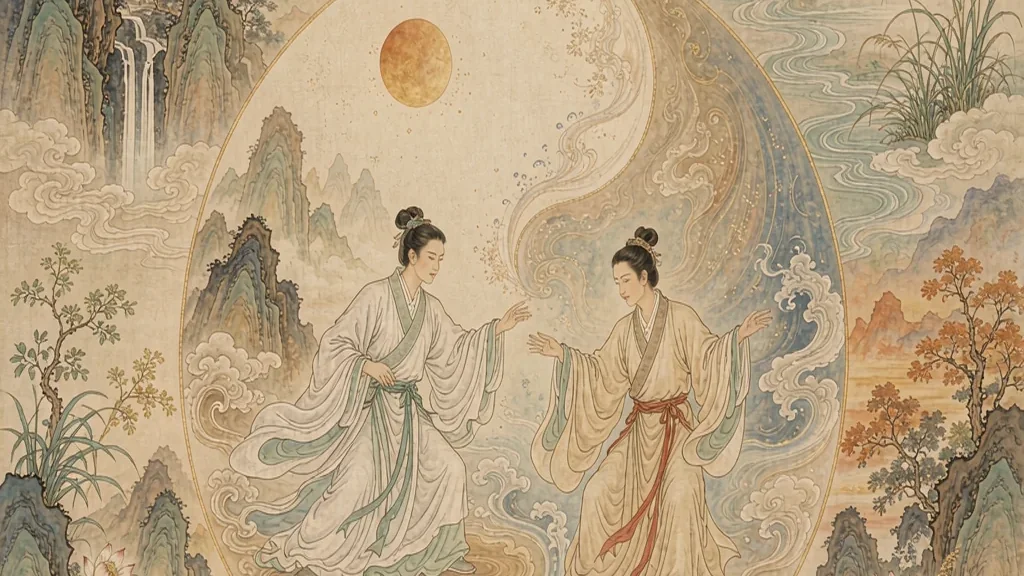
The philosophy of taiji (太极) is the worldview of complementary opposites — yin and yang in perpetual, balanced change that the movement embodies.
The Origins of Taiji Philosophy
Taijiquan's philosophical roots run deeper than its martial applications, drawing directly from the Yijing (I Ching) and Daoist cosmology. The term taiji means 'supreme ultimate,' representing the primordial state of yin and yang before differentiation. This concept became the theoretical foundation for a martial art that treats opposition as an illusion and balance as the highest skill.
The legendary Zhang Sanfeng, a Daoist immortal credited as Taijiquan's progenitor, supposedly synthesized the art after witnessing a crane defeat a snake. While historians debate Zhang's historicity, the story captures Taijiquan's essence: softness overcomes hardness, yielding defeats aggression.
Yin and Yang in Martial Movement
Every Taijiquan form embodies the interplay of yin and yang — empty and full, open and close, rise and sink. This constant alternation trains the practitioner to never be caught in a static state, always ready to transform one quality into its opposite.
The push hands exercise makes this tangible: two partners maintain contact while attempting to uproot each other. Success comes not from strength but from sensing the partner's imbalance.
Wu Wei: Effortless Action in Combat
The Daoist principle of wu wei, or effortless action, finds its most practical expression in Taijiquan. The practitioner learns to respond without premeditation. In combat, this means never meeting force with force.
The Taiji Classics
The theoretical corpus includes the Treatise on Taijiquan, the Mental Elucidation, and the Song of the Thirteen Postures. These texts blend martial instruction with Daoist philosophy.
Health and Longevity
Modern science confirms Taiji improves balance, reduces stress, enhances immune function, and slows cognitive decline. Millions practice in parks at dawn.
Taiji and Internal Alchemy
The Daoist practice of neidan profoundly shaped Taiji. The slow movements guide qi through energy channels, refining jing, qi, and shen.
The Yijing and the Origins of Taiji Philosophy
The philosophical foundations of taiji (太极) are deeply rooted in the Yijing (易经), the Book of Changes, one of the oldest and most important texts in Chinese civilization. The Yijing's central concept is that reality is composed of dynamic relationships between opposing forces — yin and yang — that continuously transform into one another. The taiji symbol (太极图), with its interlocking black and white teardrops, visually represents this understanding: within each extreme lies the seed of its opposite.
The Yijing provides the sixty-four hexagrams that serve as archetypal patterns of change, and the taiji philosopher studies these patterns to understand how situations develop, culminate, and transform. For the martial artist, this translates into a strategic framework that recognizes the inevitable cycles of attack and defense, tension and release, advance and retreat. The taiji practitioner does not fight against these cycles but works with them, using the opponent's momentum as the foundation for counteraction.
The ten wings (十翼) — the commentaries traditionally attributed to Confucius — further developed the philosophical implications of the Yijing, applying its principles to ethics, governance, and personal cultivation. These commentaries established the idea that understanding the patterns of change is the path to wisdom. The taiji martial artist who studies the Yijing is seeking the same wisdom, recognizing that mastery of combat is ultimately mastery of change itself.
Taiji as Applied Daoist Philosophy
The Daoist classic Dao De Jing (道德经) provides the philosophical core of taiji practice. Laozi's teachings on yielding, softness, and non-contention (不争) are expressed directly in the martial principles of taijiquan. 'The soft overcomes the hard,' Laozi wrote, and the taiji practitioner demonstrates this principle daily by redirecting an opponent's force rather than meeting it with resistance.
The concept of wu wei (无为), or 'effortless action,' is particularly relevant to taiji. Wu wei does not mean inaction but action that is perfectly spontaneous, appropriate, and efficient — action without strain, without forcing, without unnecessary expenditure of energy. In taiji practice, this manifests as the ability to respond to an attack without premeditation, the body moving in perfect harmony with the situation. The highest level of taiji skill is wu wei expressed through physical movement.
The Daoist emphasis on simplicity and naturalness also shapes taiji philosophy. The taiji practitioner seeks to strip away unnecessary tension, unnecessary thought, unnecessary movement — returning to a state of natural, unforced being. This process of simplification is understood as a return to the Dao, the source of all things. Each taiji form is a meditation on this return, a physical expression of the philosophy that the most powerful action is the one that requires the least effort.
❓ Frequently Asked Questions
📝 Chinese Vocabulary
太极 — : Supreme ultimate; primordial yin-yang unity.
无为 — : Effortless action; acting without forced intervention.
内丹 — : Internal alchemy; refining energy.
推手 — : Push hands; sensitivity training exercise.
太极 — : the Supreme Ultimate, the source symbol of Yin and Yang
阴阳 — : Yin and Yang, the complementary opposites in Tai Chi thought
松 — : to loosen or relax, the central physical requirement of Tai Chi
用意不用力 — : use intent not force, a core Tai Chi training principle
🎉 Fun Facts
- The taiji concept originated in the Yijing over 3,000 years ago.
- The yin-yang symbol was not associated with Taijiquan until the Song dynasty.
- Many modern Taiji masters hold academic degrees in philosophy.
- The Tai Chi symbol, a circle split into swirling light and dark halves, is one of the most recognized images in the world.
- Tai Chi is sometimes translated as 'Grand Ultimate' or 'Supreme Pole' rather than the literal 'Great Ridgepole.'
- Practicing Tai Chi in nature at sunrise is considered ideal because the calm supports the art's slow, mindful pace.