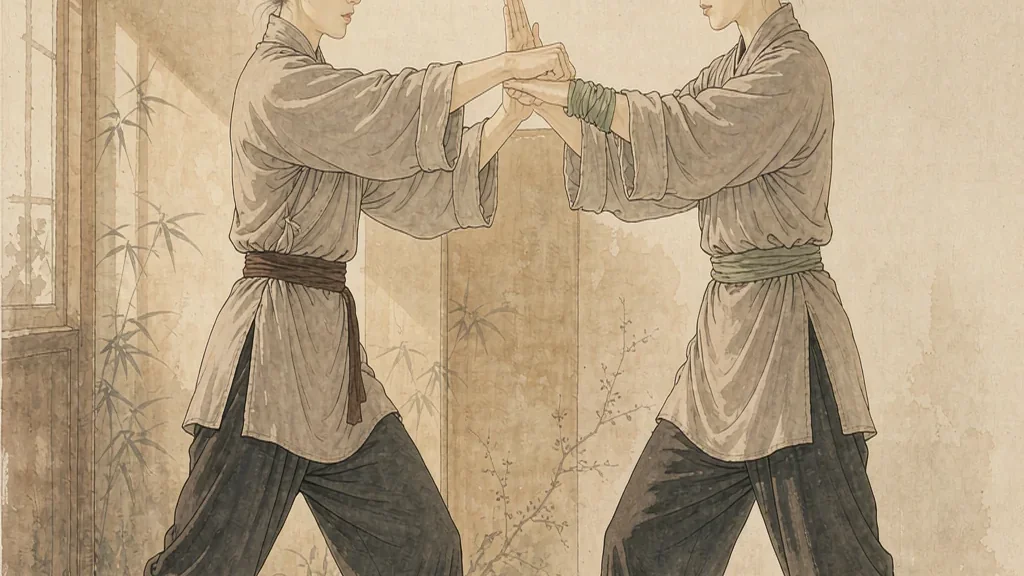
Wing Chun (咏春) is the southern art of the straight line — compact, economical movements and sensitive trapping built for close range.
The Legend of Yim Wing Chun
Wing Chun is named after Yim Wing Chun (严咏春), a young woman who, according to legend, developed the style to defend herself against a forced marriage. Her teacher, the nun Ng Mui, taught her principles that favored technique over strength.
The historical accuracy of the legend is debated, but the story's symbolic importance is clear: Wing Chun was designed to work for the physically weaker against the stronger.
The Central Principles
Wing Chun is built on four core principles: center-line theory (中线理论) — attack and defend along the body's central axis; economy of motion — the shortest path wins; simultaneous attack and defense — never separate the two; and relaxation — tension slows reaction.
The center-line theory is the most distinctive. The Wing Chun fighter controls the space between their center and the opponent's center, attacking that line and defending it simultaneously.
The Forms
Wing Chun has three empty-hand forms: Siu Nim Tao (小念头, Little Idea), Chum Kiu (寻桥, Seeking the Bridge), and Biu Gee (标指, Thrusting Fingers). Each develops specific skills: structure, footwork, and emergency techniques.
The wooden dummy form (木人桩法) is the fourth form, and the butterfly knife and long pole are the weapons forms.
Chi Sao: Sticking Hands
Chi Sao (黐手, Sticking Hands) is Wing Chun's signature training method — partners maintain arm contact while practicing the center-line theory in real time. Chi Sao develops reflexes, sensitivity, and the ability to read the opponent's intention through touch.
The training begins with single-hand chi sao and progresses to double-hand. Advanced chi sao incorporates footwork and striking.
The Close-Range System
Wing Chun specializes in close-range fighting — the range at which most real fights occur. The short, direct punches (chain punches) are the signature technique, delivered in rapid succession along the center line.
The simultaneous block-and-punch is another Wing Chun hallmark: the blocking hand and striking hand move together, covering defense and offense in one motion.
Wing Chun Worldwide
Wing Chun achieved global fame through Bruce Lee, who trained in it before developing Jeet Kune Do. Ip Man, Bruce Lee's teacher, is credited with bringing Wing Chun from Foshan to Hong Kong and the world.
Today, Wing Chun is practiced in over 80 countries. The Ip Man lineage is the most widespread, with many schools teaching both traditional and modernized versions.
The Red Boat Opera Troupe Connection
The historical development of Wing Chun is inextricably linked to the Red Boat Opera Troupe (红船戏班) of the Qing dynasty. During the reign of Emperor Xianfeng (1850–1861), the opera troupes of Guangdong province were forced to perform on boats due to government restrictions on land-based theaters. These floating performance troupes became unlikely centers of martial arts transmission, as the actors needed combat skills for their stage roles and for self-defense against pirates and bandits along the Pearl River Delta.
The most famous of the Red Boat performers was Leung Jan (梁赞), a doctor and martial artist from Foshan who is traditionally credited with systematizing Wing Chun's techniques. Leung Jan studied under the legendary Wong Wah-bo, a member of the Red Boat Troupe who had learned the style from the nun Ng Mui's disciples. Leung Jan's medical practice brought him into contact with fighters from all over southern China, and he refined Wing Chun's techniques through practical application against other styles.
The Red Boat lineage explains several distinctive features of Wing Chun. The close-quarters techniques reflect the confined spaces of a boat cabin, where wide stances and large movements would be impractical. The simultaneous block-and-strike techniques mirror the choreography of stage combat, where actors needed to portray realistic fighting within the limited space of a performance platform. This origin story connects Wing Chun not just to martial tradition but to the rich cultural history of Cantonese opera.
Wing Chun's Scientific Approach to Combat
Wing Chun has often been described as the most 'scientific' of Chinese martial arts, and this characterization is not merely rhetorical. The style's center-line theory is based on a biomechanical understanding of the human body's structure: the center line contains the most vital targets (throat, solar plexus, groin) and is also the most efficient path for delivering force. By controlling the center line, the Wing Chun fighter simultaneously attacks the highest-value targets and defends against the most direct attacks.
The Wing Chun chain punch, often criticized as a simple technique, is actually a sophisticated application of physics. Each punch is delivered with the body behind it, the arm moving in a straight line from the center of the chest. The short travel distance means less telegraphing and faster recovery. The rapid succession of punches creates a 'wall' of strikes that is nearly impossible to counter, as blocking one punch leaves the defender open to the next. The chain punch is not a single technique but a system of continuous pressure.
Modern sports science has validated many of Wing Chun's training methods. The 'wooden dummy' form, for example, develops proprioception and targeting accuracy in ways that are consistent with contemporary motor learning theory. The chi sao training develops what neuroscientists call 'predictive coding' — the brain's ability to anticipate sensory input based on prior experience. These scientific validations have helped Wing Chun maintain its credibility in an era when many traditional martial arts have struggled to demonstrate their effectiveness.
The Ip Man Legacy and Global Expansion
The global spread of Wing Chun is largely the story of one man: Ip Man (叶问, 1893–1972). Born into a wealthy Foshan family, Ip Man studied Wing Chun under Chen Wah Shun and later Leung Bik, the son of Leung Jan. After the Communist victory in 1949, Ip Man fled to Hong Kong, where he began teaching Wing Chun to a small group of students. His teaching was initially reluctant — he considered Wing Chun a family art — but economic necessity compelled him to accept students from outside the traditional lineage.
Among Ip Man's early Hong Kong students was a young Bruce Lee, who would go on to transform global martial arts culture. Lee studied under Ip Man for several years, and the influence of Wing Chun's efficiency philosophy is evident in Lee's Jeet Kune Do. The connection to Bruce Lee gave Wing Chun an exposure that no other Chinese martial art could match, and schools claiming the Ip Man lineage opened in cities around the world.
The post-Ip Man era has seen a proliferation of Wing Chun organizations, not all of which maintain the quality standards of the original lineage. The proliferation is a double-edged sword: it has spread the art to millions of new practitioners, but it has also diluted the technical standards in some schools. The core of authentic Wing Chun — the center-line theory, the chi sao training, the emphasis on efficiency — remains intact in the major lineages, and the art continues to attract serious students who appreciate its practical, no-nonsense approach to combat.
❓ Frequently Asked Questions
📝 Chinese Vocabulary
咏春拳 — : Wing Chun; 'Spring Praise' fist.
黐手 — : Chi sao; sticking hands training.
中线理论 — : Center-line theory; core Wing Chun principle.
小念头 — : Siu Nim Tao; first empty-hand form.
中线 — : the centerline, the central vertical line Wing Chun fights to control
寻桥 — : Seeking the Bridge, the second Wing Chun empty-hand form
标指 — : Thrusting Fingers, the third and most emergency-oriented form
八斩刀 — : Eight Slashing Knives, the Wing Chun butterfly knives
🎉 Fun Facts
- Wing Chun was one of the first Chinese martial arts to be systematically taught to Westerners.
- The chain punch can deliver up to 8 punches per second.
- Ip Man taught Wing Chun in Hong Kong without charging fees, living modestly.
- Wing Chun's butterfly knives are short, broad blades trained only after the empty-hand and dummy forms are mastered.
- The long pole form preserves older battlefield techniques adapted to a civilian boxing system.
- Wing Chun is prized by law enforcement and military units for its simple, direct close-range responses.