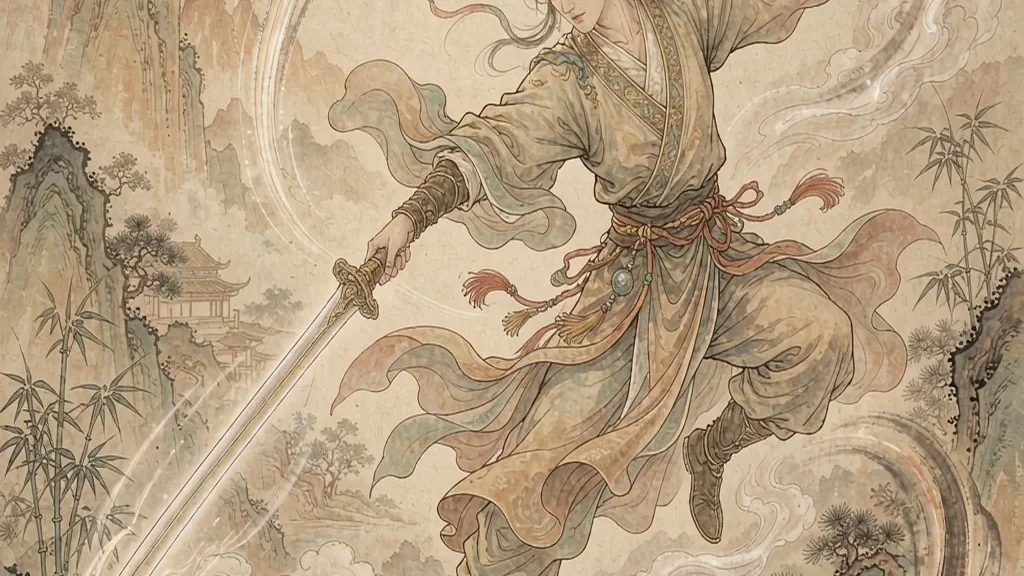
Drunken sword (醉剑) is the saber art performed with reeling, off-balance footwork that hides precise cuts behind a 'drunk' disguise.
The Nine Drunken States
Zui Jiu is organized around nine 'drunken states' — levels of simulated intoxication ranging from slight tipsiness to complete collapse. Each state triggers a different set of techniques.
State One is 'Tipsy Scholar' — graceful, swaying, deceptive. State Nine is 'Dead Drunk' — completely limp, prone, attacking from the ground.
The Wine Vessel
Zui Jiu traditionally includes training with a wine vessel (usually a gourd or jug). The vessel is used for blocking, striking, and as a decoy — the opponent focuses on the jug while the hand attacks.
Advanced practitioners can fight with liquid in the jug, using the sloshing motion to generate unpredictable momentum.
Falling as Weapon
Where conventional martial arts avoid falling, Zui Jiu treats the fall as a primary attack vector. Controlled falls become sweeps, leg entanglements, and ground strikes.
The 'rolling thunder' technique — a diagonal shoulder roll into a leg sweep — exemplifies this philosophy: the fall itself is the technique.
Breath and Intoxication
Zui Jiu training includes specific breathing patterns that simulate the slowed reactions of intoxication while maintaining actual readiness. The mind is sharp; only the body appears drunk.
This disconnection between appearance and reality is the art's deepest teaching: never show your true state to an opponent.
Performance vs. Combat
Like Drunken Boxing, Zui Jiu suffers from its own popularity in performance. Many modern practitioners focus on the spectacular acrobatic aspects at the expense of combat application.
Traditional teachers distinguish between 'performance Zui Jiu' and 'combat Zui Jiu' — the former is beautiful, the latter is brutal.
Zui Jiu Today
Authentic Zui Jiu is rare, taught only in a few traditional schools in northern China. Its high difficulty and injury risk limit its practitioners, but those who master it gain a uniquely versatile fighting system.
Drunken Wine Boxing: The Northern Tradition
Zui Jiu (醉酒), or 'Drunken Wine Boxing,' is a distinctive variant of the broader Drunken Boxing tradition that emphasizes the incorporation of wine-drinking movements into combat techniques. Unlike standard Zuiquan, which focuses primarily on the imitation of drunken staggering and falling, Zui Jiu adds explicit references to wine cups, wine jars, and the gestures of a drinker in a tavern. The result is a martial art that is both comedic and deadly, entertaining and practical.
The forms of Zui Jiu include techniques such as 'Offering the Wine Cup' (敬酒), a deceptive hand gesture that conceals a palm strike; 'Spilling the Wine Jar' (泼酒), a circular arm movement that deflects attacks while setting up a counter; and 'Drunkard Falls Backward' (醉汉倒), a controlled fall that transitions into a kick from the ground. Each movement is named for a drinking-related action, creating a thematic consistency that makes the forms memorable and engaging.
The training methodology for Zui Jiu follows the same progressive approach as standard Drunken Boxing, beginning with fundamental stances and footwork before introducing the 'drunken' layer. The wine-drinking gestures add a level of sophistication to the training, as the practitioner must simultaneously maintain the illusion of intoxication while executing precise combat techniques. The contrast between the appearance of drunkenness and the reality of combat readiness is the essence of the art.
The Cultural Context of Wine in Chinese Martial Arts
Wine (酒) has a complex relationship with Chinese martial culture that extends far beyond the drunken boxing traditions. In classical Chinese literature, wine is often associated with courage and martial spirit — the general who drinks before battle is not becoming cowardly but steeled for combat. The famous poet Li Bai (李白) wrote many of his greatest poems while drunk, and the connection between alcohol intoxication and creative or martial inspiration is deeply embedded in Chinese cultural mythology.
Historical records suggest that some Chinese martial artists did consume small amounts of wine before training or combat. The alcohol was believed to relax the muscles, reduce inhibitions, and promote the flow of qi — effects that could be beneficial for performance. However, this practice was always controversial, and most teachers warned against excessive consumption. The 'drunken' styles are therefore not endorsements of alcohol abuse but artistic expressions of the paradoxical relationship between intoxication and martial skill.
In modern practice, Zui Jiu is primarily a performance art, taught for its cultural and entertainment value rather than as a practical combat system. Competitions feature Zui Jiu routines that entertain audiences with their humor and technical difficulty, and the style is one of the most popular categories in international wushu demonstrations. Despite its performance orientation, the underlying combat principles of deception, off-balance movement, and controlled falling remain valid and teachable, ensuring the art's continued transmission to new generations.
❓ Frequently Asked Questions
📝 Chinese Vocabulary
醉九 — : Drunken Nine; nine-state drunken form system.
醉步 — : Drunken step; unpredictable staggering footwork.
酒坛 — : Wine vessel; traditional training tool.
滚雷 — : Rolling thunder; falling sweep technique.
敬酒 — : Offering the Wine, a deceptive hand gesture hiding a palm strike
泼酒 — : Spilling the Wine, a circular arm movement that deflects and counters
醉汉倒 — : Drunkard Falls Backward, a controlled fall into a ground kick
醉酒 — : drunken wine, the simulated intoxication state of the art
🎉 Fun Facts
- The nine drunken states correspond to increasing degrees of simulated intoxication.
- Some traditional Zui Jiu schools require students to spin in circles before practice to develop balance.
- The wine vessel training originated from monks who carried water gourds while traveling.
- Zui Jiu performers often mime lifting a wine cup between techniques, turning drinking gestures into feints.
- The style's wine-jar movements let the practitioner spin a pretend vessel while setting up a throw.
- In wushu competitions Zui Jiu is a favorite crowd-pleaser because of its humor and difficult balance work.