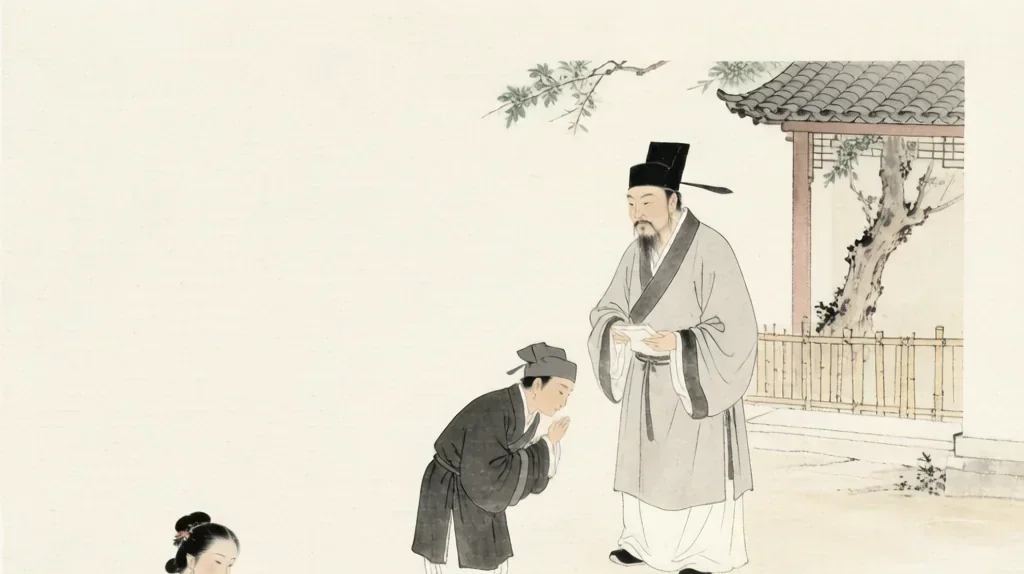
In Chinese, the simple act of naming someone is never simple. The word you choose — a title, a kinship term, a respectful 「you」 — announces exactly how you place the other person in the web of rank and relation. This delicate system, called 称谓敬语 (chēngwèi jìngyǔ, "forms of address and honorifics"), is where Chinese etiquette becomes audible. Get it right and you show refinement; get it wrong and you may, however unintentionally, imply familiarity, superiority, or slight. For learners and visitors alike, mastering a handful of these forms opens far more doors than fluent grammar alone. This guide walks through the main patterns and the logic beneath them.
The Logic: Rank, Relation, and Respect
Chinese address assumes that every encounter happens between people who stand in some relation — senior or junior, insider or outsider, worthy of honor or not. The language therefore builds respect directly into nouns and pronouns. Unlike English, where 「you」 is blandly equal, Chinese offers 你 (nǐ) for peers and 您 (nín) for those owed deference, a grammatical bow built into the second person.
Names follow the same logic. The surname (姓 xìng) comes first, and in polite speech one rarely uses a given name alone for a superior. Instead you pair the surname with a title: 张老师 (Zhāng lǎoshī, "Teacher Zhang"), 陈总 (Chén zǒng, "President Chen"). The title does the respectful work; the name merely fixes who. This habit reflects the Confucian conviction that a person is best addressed by their role in the social whole, not by their private self.
Underneath sits a paired etiquette of 谦辞 (qiāncí, 「modest words」) and 敬辞 (jìngcí, 「respectful words」). In a single exchange you lower yourself while raising the other — calling your own view 拙见 (zhuójiàn, "clumsy opinion") and theirs 高见 (gāojiàn, "lofty opinion"). The dance keeps both parties comfortable, each spared the awkwardness of seeming to boast.
Surnames, Titles, and Occupational Honorifics
The most common polite form is surname plus title. Occupational honorifics are numerous: 老师 (lǎoshī, teacher) for educators and sometimes any expert; 医生 (yīshēng, doctor) or 大夫 (dàifu) for physicians; 经理 (jīnglǐ, manager) and 老板 (lǎobǎn, boss) for businesspeople; 师傅 (shīfu, "master") for skilled workers, drivers, and craftspeople; 教授 (jiàoshòu, professor) for academics. Using the right one shows you see the person's standing.
Gender-neutral civic terms round it out: 先生 (xiānsheng, "Mr.") and 女士 (nǚshì, "Ms.") attach to the surname for strangers and officials, while 小姐 (xiǎojiě, "Miss") is used cautiously since it can imply a hostess. For the very senior, 老 (lǎo, "old") before the surname — 老李 (Lǎo Lǐ) — is a warm term among equals, never an insult, signaling long acquaintance and trust.
Given names are reserved for intimates, the young, and juniors. A subordinate calling a boss by given name would sound presumptuous; a friend doing so sounds natural. The line is not fixed by age alone but by the relation, which is why the same person may be 王总 (Wáng zǒng) at work and 老王 (Lǎo Wáng) at dinner with friends.
Kinship Terms as Social Glue
One of the most charming features of Chinese address is the habit of calling unrelated people by family terms. An elderly man becomes 爷爷 (yéye, 「grandpa」), an elderly woman 奶奶 (nǎinai, 「grandma」); a middle-aged man 叔叔 (shūshu, 「uncle」) or 伯伯 (bóbo, "uncle elder"); a woman of middle age 阿姨 (āyí, 「auntie」). A peer may be 大哥 (dàgē, 「big brother」) or 大姐 (dàjiě, "big sister").
These terms do real work. They pull a stranger into the relational world where courtesy is automatic, and they encode the respect due to age. Addressing a shopkeeper as 阿姨 or a taxi driver as 师傅 is not pretend kinship but a quick, polite placement of the other as someone owed warmth. Even beggars were traditionally addressed with the same family words, a small equalizer in a hierarchical society.
The system has fine gradations. 伯伯 versus 叔叔 distinguishes an older from a younger father-figure; 舅舅 (jiùjiu, maternal uncle) and 姑姑 (gūgu, paternal aunt) name the side of the family, because Chinese kinship distinguishes maternal from paternal with precision. To use them for strangers is to borrow that precision's warmth without its exact claims.
Modest and Respectful Self-Reference
Just as you elevate the other, traditional etiquette asks you to shrink yourself. A man might refer to 鄙人 (bǐrén, "this humble person") or simply 我 (wǒ); a woman to 妾身 (qièshēn) in old usage, now historical. One's home is 寒舍 (hánshè, 「humble dwelling」), one's spouse 贱内 (jiànnèi, "my lowly one inside," old-fashioned) or 内人 (nèirén), and one's children 犬子 (quǎnzǐ, "dog-son") or 小女 (xiǎonǚ, "little daughter"). None is literal humility but a ritual lowering that makes the other's rise graceful.
The counterpart raises the other: their home is 府上 (fǔshàng, 「your honored residence」), their parents 令尊 (lìngzūn, "your honored father") and 令堂 (lìngtáng, "your honored mother"), their children 令郎 (lìngláng) or 令爱 (lìng'ài). The character 令 (lìng, "noble/your") is a tiny honorific prefix that appears across these terms. A letter might close with 敬上 (jìngshàng, "respectfully submitted"), and an invitation opens with 敬请 (jìngqǐng, "respectfully invite").
Modern speech has dropped the most elaborate of these, but the instinct remains. People still say 请多指教 (qǐng duō zhǐjiào, "please offer your guidance") when meeting someone, a humble opener that invites the other's superiority. The modest-respect pair is the呼吸 (hūxī, breathing) of polite Chinese — invisible once you know it, impossible to fake once you don't.
Forms of Address in Modern Use
Today the system is lighter but intact. Young people use given names freely among friends and 你 (nǐ) almost everywhere casual, yet switch to 您 (nín) and titles the moment an elder, customer, or official enters the room. Business cards are offered and received with both hands, and the title on the card governs how you address the person thereafter. Online, strangers often begin as 亲 (qīn, "dear") in commerce or 您好 (nín hǎo, "hello, respected you") in formal messages.
Some older honorifics survive mainly in letters, toasts, and formal speeches — the 敬辞 (jìngcí) cluster — while everyday talk leans on surnames and titles. Still, a foreigner who uses 您 (nín) for elders, 师傅 (shīfu) for workers, and 老师 (lǎoshī) broadly will be read as remarkably polite. The forms are easy to learn and, because they encode respect rather than mere labeling, they repay the effort many times over.
In the end, Chinese address is a compact ethics. To choose the right term is to acknowledge the other's place and your own, to honor age and role, and to keep harmony by never claiming more than your share of stature. The language does the etiquette for you — if you let it.