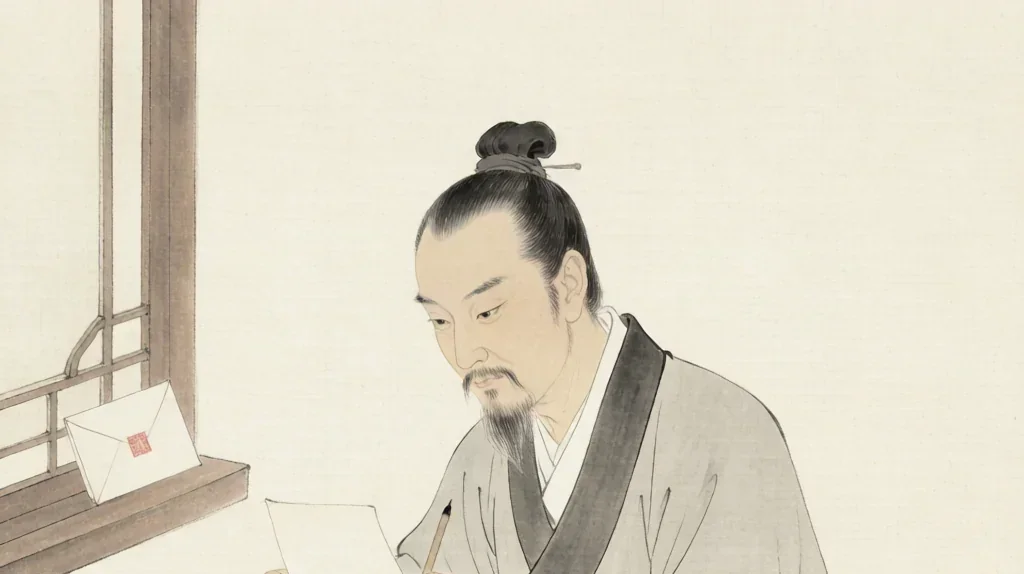
Long before the telephone, the Chinese letter was a small ceremony. A sheet of paper, a brush, and a careful order of words could carry not just news but reverence across a thousand miles — to a parent, a teacher, a friend, or an official. This art, called 书信礼仪 (shūxìn lǐyí), treated writing as an extension of the person: to write carelessly was to treat the receiver carelessly. From the humble self-reference to the respectful close, every convention lowered the writer and lifted the reader. Though emails and texts have displaced the brush, the old habits of honoring the receiver survive in Chinese correspondence today. Understanding them reveals how politeness was once built, line by line.
The Letter as a Moral Act
In a culture that prized 礼 (lǐ, propriety), the letter was never neutral. The Lǐjì (礼记, Book of Rites) taught that even distant communication should embody respect, and the Confucian emphasis on right relations made the written word a place to perform them. A letter to a father was a continuation of filial piety; a letter to a teacher, of 尊师 (zūnshī); a letter to a friend, of 信 (xìn, trust and sincerity). The form proved the feeling.
Calligraphy raised the stakes. Because the brush revealed character — both moral and literal — a careless hand suggested a careless heart. Boys drilled 书法 (shūfǎ, calligraphy) so that their letters would be legible, balanced, and respectful. A beautifully written letter was itself a gift; a sloppy one implied the receiver was not worth the effort. The paper, the ink, and the posture all counted as etiquette.
The genre also carried state weight. Official memorials to the throne followed rigid formats; a misplaced honorific could mean disgrace. The letter was thus a training ground for the larger etiquette of hierarchy, teaching every literate person how to place themselves correctly before a superior, years before they ever faced one in a hall.
The Structure of a Proper Letter
A formal letter opened by honoring the receiver. The salutation named them with a fitting honorific — 敬爱的 (jìng'ài de, "respectfully beloved") for family, 仁兄 (rénxiōng, "worthy elder brother") for a friend, or a full title for an official — followed by the conventional 敬启者 (jìngqǐzhě, "respectfully, I write to you"). Only then came the body. Early in it the writer asked after the recipient's health and parents, the literary equivalent of bowing before speaking.
The body observed modesty. The writer used 谦辞 (qiāncí) for their own affairs — 贱函 (jiànhán, "my lowly letter"), 拙笔 (zhuōbǐ, "my clumsy brush") — and 敬辞 (jìngcí) for the reader's — 尊意 (zūnyì, "your honored wishes"), 雅教 (yǎjiào, "your refined teaching"). Boasting was avoided; requests were wrapped in apology for the trouble caused. Even disagreement was phrased as the writer's own dullness rather than the reader's error.
The close returned to deference. Standard valedictions included 谨上 (jǐnshàng, 「respectfully submitted」), 顿首 (dùnshǒu, "bowing my head to the ground"), or 百拜 (bǎibài, "a hundred bows") for the most solemn. The writer then signed with a humble self-term and the date by the traditional calendar. The envelope reversed the hierarchy outward: the receiver's name grand, the sender's small — politeness visible before the seal was broken.
Paper, Folding, and the Silent Code
The physical letter carried etiquette without words. Scholars used 八行书 (bāhángshū, "eight-line paper"), a sheet ruled into vertical columns with the top and bottom lines left blank as a frame of honor; writing on those margins was a breach. The sheet was folded so that the recipient's name appeared on the outside and, when opened, faced the reader — a small choreography of respect encoded in the creases.
Folding order signaled rank. Letters to superiors were folded to show the writer's humility in the very sequence of the folds, and the direction the page faced when opened mattered. Seals (印章 yìnzhāng) and red ink marked authenticity and warmth; a blank, unfolded, or wrongly folded letter read as careless or even insulting. Even the choice of paper — plain for equals, finer for elders — was a quiet courtesy.
Delivery added another layer. A letter entrusted to a friend or a hired courier was accompanied by thanks for the bearer, since carrying words was a service. Replies were expected promptly, and a long silence without excuse was a social failing. The letter was a relationship maintained by punctual, polite exchange, not a one-off message.
Famous Letters and Their Lessons
Classical letters became models of the art. The 诸葛亮 (Zhūgě Liàng, "Zhuge Liang") "memorial" to the throne modeled loyalty and plain devotion; the 报任安书 (Bào Rèn Ān shū) of Sīmǎ Qiān turned a personal defense into a meditation on integrity. In the family sphere, the 傅雷家书 (Fù Léi jiāshū, "Fu Lei's Family Letters") of the twentieth century showed a father teaching sons abroad through patient, honorific, loving prose — proof that the old etiquette could be both formal and tender.
Such letters were copied and taught, so the conventions spread beyond the elite. Even villagers who could barely write learned the opening and closing formulas from scribes, and the postal courier (信客 xìnkè) who read letters aloud became a respected village figure. The etiquette of the letter thus reached deep into ordinary life, making courtesy a written habit for millions.
The lesson of these models is constant: the letter is not about the writer's eloquence but about the receiver's honor. The more formal the relation, the more elaborate the deference — a rule that still quietly governs Chinese correspondence in every medium.
Letter Etiquette in the Digital Age
Email and messaging have not erased the old instincts. A Chinese professional email still opens with a polite salutation, asks after the reader, and closes with 此致 敬礼 (cǐzhì jìnglǐ, 「with respect」) or a simple 祝好 (zhù hǎo, "best wishes"). Texts to elders and bosses begin with 您好 (nín hǎo, "hello, respected you") and avoid the slang one uses with peers. The medium changed, but the habit of honoring the receiver and humbling the sender travels straight from brush to keyboard.
Some specifics faded — few now fold paper by rank — yet new equivalents appeared. We choose formal wording for a teacher's WeChat, send festival greetings punctually, and reply without long silence, all echoing the old obligations of the letter. The 书信礼仪 survives not as ritual but as reflex: in China, even a message remembers to bow.
In the end the etiquette of letter writing is the etiquette of attention. To write to someone properly is to slow down, to imagine their worth, and to place yourself modestly before them. That is a courtesy no technology can make obsolete — and one the Chinese letter perfected over two thousand years.