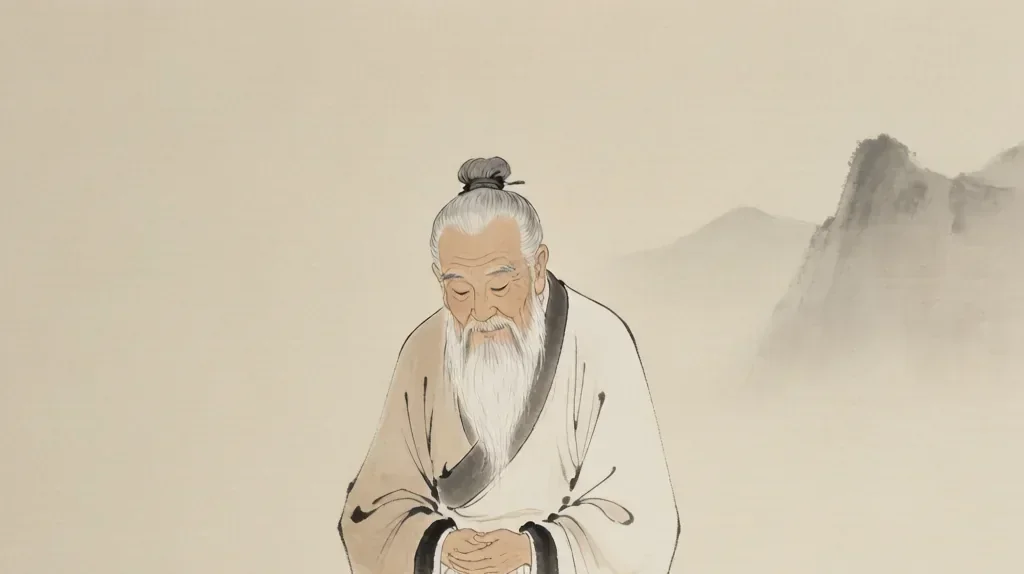
In China the teacher has never been merely an employee of the school. For more than two thousand years the master who opens a child's mind has been ranked among the most honored figures in society — beside the parent who gave life and, in older formulations, just below the emperor who gave order. This reverence is captured in four characters, 尊师重道 (zūnshī zhòngdào), "revere the teacher and value the Way." It is a cornerstone of Chinese etiquette, shaping how students bow, how families treat tutors, and how the whole culture thinks about learning. To grasp it is to understand why a single teacher's word could redirect a life, and why gratitude to a master could last a lifetime.
Confucius and the Founding of a Tradition
The cult of the teacher begins with Confucius (孔子 Kǒngzǐ, 551–479 BCE). Though he held no high office, he gathered disciples, taught the classics, and insisted that education, not birth, should form the gentleman. His saying "In education there are no class distinctions" (有教无类 yǒu jiào wú lèi) opened learning to students of humble origin and made the teacher a force for moral renewal. After his death, disciples mourned him as they would a father, and within centuries the state canonized him as "the First Teacher" (至圣先师 zhìshèng xiānshī).
Confucius taught that the teacher transmits the 道 (dào, the Way) — not a doctrine of magic but the accumulated civilized order of rites, music, history, and virtue. To respect the teacher was therefore to respect the culture itself. The Lúnyǔ records students treating their master with grave deference, rising when he approached and speaking only when called upon. This model became the template for every later schoolroom, from village tutoring halls to the imperial academy.
The tradition hardened into ritual under the imperial state. By the Táng (唐) and Sòng (宋) eras, Confucian temples (文庙 wénmiào) stood in every prefecture, where officials and students bowed to the sage's tablet each term. To honor the teacher was, quite literally, a public act of state, binding personal gratitude to the survival of civilization.
The Teacher Among the "Three Authorities"
A famous traditional ranking placed the teacher within the "three authorities and two complements" often summarized as 天地君亲师 (tiāndì jūn qīn shī) — heaven and earth, the ruler, the parents, and the teacher. The logic is striking: parents give the body, the ruler gives political order, but the teacher alone gives the civilized mind. Without the teacher, a person remains "uncooked," knowing nothing of rites or right conduct. For this reason the teacher was owed a bow second only to that given parents, and students observed a formal mourning period for a master much as for a father.
This standing showed in daily life. A local magistrate might dismount and bow to a venerated schoolmaster, because office yielded to learning. Families treated the tutor (先生 xiānsheng, "former-born," a respectful term for teacher) as an honored guest at the table and a moral authority over the children. Even the characters of address reveal the weight: a student calls the teacher 恩师 (ēnshī, "grace-teacher"), acknowledging a debt of kindness as well as instruction. The relationship was understood as lifelong, not contractual.
The proverb 一日为师,终身为父 (yīrì wéi shī, zhōngshēn wéi fù) — "one day a teacher, a lifetime a father" — sums it up. The bond outlasts the classroom. A student who rose in the world was expected to care for an aged master, defend the master's name, and carry the master's teachings forward. Betraying a teacher was among the gravest of disgraces.
Concrete Practices of Reverence
Respect took concrete, repeatable forms. On the first day of school, a child would bow to the teacher and present a gift — often a modest bundle of meat or a writing brush — as tuition and tribute. At larger ceremonies students knelt and kowtowed (叩头 kòutóu) before the teacher and the Confucian tablet, confirming their place in the lineage of learning. Even ordinary classes opened with a bow and the polite greeting 老师好 (lǎoshī hǎo, "good, teacher").
Language itself enforced the hierarchy. One never called a teacher by given name; the title 老师 (lǎoshī, "old master") or 先生 (xiānsheng) was mandatory, even among adults. Students used humble self-reference and avoided contradicting the teacher in public. Written work was submitted with both hands, and a student who corrected a teacher did so only through the most indirect, face-saving phrasing. These manners were not empty; they trained the student in the humility that learning requires.
The strictness of the teacher was part of the respect, not its enemy. The saying 严师出高徒 (yánshī chū gāotú, "a strict teacher breeds excellent disciples") held that firm correction was a form of care. A student who resented discipline misunderstood the bond. The ideal was not warmth but devotion to the student's growth, and gratitude was owed precisely because the teacher demanded much.
Modern Observance and Teachers' Day
The tradition survives robustly in contemporary China. Since 1985 the nation has observed Teachers' Day (教师节 jiàoshī jié) on September 10, a modern echo of the old rites. Students bring flowers, cards, and small gifts; schools hold assemblies; and former pupils message or visit their old teachers, reaffirming ties across decades. The date keeps 尊师重道 visible in a secular, patriotic frame, celebrating educators as builders of the nation.
In daily life the teacher still commands unusual deference. Parents speak of 感谢老师 (gǎnxiè lǎoshī, "thanking the teacher") and treat educators with a courtesy close to that given elders. University students may host a banquet for their advisor on graduation, and it is common to list one's 导师 (dǎoshī, mentor) with something like familial gratitude in speeches. Even martial arts and crafts maintain the master–disciple bond, with the 师父 (shīfu, "master-father") owed loyalty beyond any contract.
Challenges exist — crowded classrooms, commercial pressures, and the occasional erosion of formality — but the emotional core holds. Ask almost any Chinese adult about a beloved teacher and the answer comes with unusual warmth. The respect is no longer expressed in kowtows, but in the enduring sense that a good teacher gave something no one else could.
Why Reverence for Teachers Endures
The durability of 尊师重道 lies in what it protects: the conviction that passing on wisdom is sacred work. A culture that honors its teachers honors its own future, because the teacher is the hand that carries the torch from one generation to the next. In an age of infinite information, China's old lesson still bites — knowledge is not just data to be downloaded, but a gift transmitted person to person, and the person who gives it deserves a bow. To respect the teacher is, finally, to respect the long, patient effort of becoming civilized.