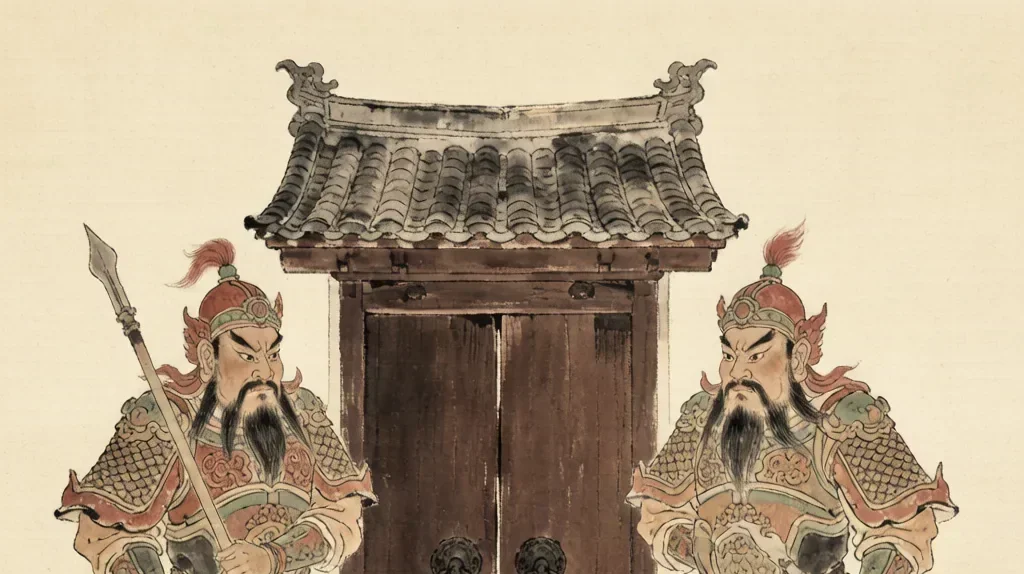
Door god paintings (mén shén) are colorful images of guardian deities pasted on entry doors to ward off evil and welcome good fortune, a practice woven into Chinese New Year customs for more than a thousand years. Typically shown as a pair of martial figures flanking the gateway, these prints transform a plain door into a protective threshold. Beyond superstition, they are a vivid folk-art genre that combines woodblock printing, bold color, and popular belief into one of the most widespread images in Chinese homes, a printed prayer that every family could afford to hang.
Mythic Origin
The custom is often traced to a Tang-era legend in which the emperor, troubled by nightmares, had two loyal generals stand guard at his bedroom door; sleeping peacefully, he later had their images painted on the palace gates. The idea spread to common homes.
Another strand links door guardians to ancient threshold rituals meant to block wandering spirits. Over time the guardians became fixed, named deities rather than temporary watchmen.
The story shows how a royal practice filtered into folk tradition, moving from the palace wall to the farmer's gate within a few generations of imitation.
Some versions add that the generals, unable to stand forever, were honored by being depicted instead, so devotion to the throne birthed a domestic custom of protection.
The Two Guardians
The most common pair are the Tang generals Qin Shubao and Yuchi Jingde, depicted in armor with weapons, fierce expressions, and often a whip or mace. Their presence signals "no evil may pass."
Other pairs include mythological figures or civil officials granting different blessings, such as wealth or harmony, depending on the household's hope for the coming year.
Paintings are almost always symmetrical, one god on each leaf of a double door, facing outward to scan the street and the unseen for threats.
The two are often shown in mid-stride, weapons ready, so the doorway reads as a guarded checkpoint rather than a mere passage between rooms.
Production by Woodblock
Most door gods were mass-produced by woodblock printing: a carved board inked and pressed onto paper, then colored by hand or with additional blocks. This made them cheap enough for every household.
Cutting the block was skilled work; the carver had to render armor and faces in bold, legible lines that read from a distance across a courtyard at a glance.
Regional print centers developed house styles of line and color, much like local opera, so a door god's "accent" could place its birthplace.
A single master block might serve a workshop for decades, re-inked each season, the wood itself a quiet heirloom of the printing family.
Color and Symbol
Strong reds and greens dominate, with gold accents for rank. Color was chosen for visibility and auspice: red drives away evil and invites luck, while green signals growth and vitality.
The figures' weapons, boots, and beasts underfoot are not decoration but signs of power over demons. Even the eyes are painted to "see" intruders approaching the threshold.
Subtle differences marked civil versus martial guardians, guiding which door they suited and which blessing a family was quietly asking for that year.
The gold, often applied as powder or a bright block, caught the lantern light at the new year, making the guardians literally shine as they began their year of watch.
Seasonal Renewal
Families replaced old door gods at the Lunar New Year, peeling the faded pair and pasting fresh ones as part of the thorough spring cleaning. The act itself was a renewal of protection.
Old prints were often burned or quietly removed, never left to curl and weather, since a peeling guardian was thought to lose efficacy and even invite the very misfortune it barred.
This annual rhythm kept the craft in constant demand, so print shops timed their biggest runs for the weeks before the new year like a holiday industry.
Children often helped paste the new pair, learning the ritual's order and the names of the generals before they could read, so the custom reproduced itself.
Regional Print Traditions
Famous centers such as Yangliuqing and Weifang produced door gods alongside other New Year prints, each with recognizable palettes and figure types that collectors can still identify.
Southern and northern styles differed in proportion and ornament, reflecting local taste and the wood available for blocks, as well as the light and walls they adorned.
Trade carried popular images across provinces, creating a shared visual language of guardianship that a traveler would recognize from Shandong to Guangdong.
In a few towns the door-god block was the workshop's pride, shown to visitors as proof of skill before any other print was pulled from the press.
From Ritual to Collectible
Today door gods are less commonly pasted on urban doors but remain popular as festive decoration and tourist art. Scholars study them as a window into folk religion and popular taste.
Museums collect fine old prints, and designers reissue the images on cards and posters, keeping the guardians in view even where the doorway no longer hosts them.
The meaning has softened from fear to nostalgia, yet the image still says "this home is protected," a comfort that outlives the literal belief behind it.
Some families keep a small pair inside the house year-round, a private talisman now more sentimental than sacramental, linking them to grandparents who pasted the real thing.
Cultural Meaning
Door gods express a core Chinese idea: the home is a sacred boundary needing defense. They externalize the wish for safety onto the very threshold crossed daily by the family.
As folk art, they prove that belief and beauty shared the same surface, a printed prayer everyone could afford and even children could help hang straight.
Their endurance reflects a lasting comfort in being watched over at the door, a small daily reassurance that the world outside will not enter unbidden.
In the broader calendar, the door god is the first line of the new year's defenses, pasted before the lanterns are lit and the debts are settled, setting the tone of the season.
❓ Frequently Asked Questions
What are door god paintings?
They are printed or painted images of guardian deities pasted on doors to block evil and bring blessing, especially at the New Year.
Who are the door gods?
Usually the Tang generals Qin Shubao and Yuchi Jingde, shown in armor; other pairs represent different blessings.
How were they made?
Mainly by woodblock printing: a carved board inked onto paper, then colored, making them affordable for ordinary homes.
Why replace them yearly?
Families renewed them at the Lunar New Year during cleaning, treating it as refreshing the home's protection.
What do the colors mean?
Bold reds and greens with gold signal power and luck; red in particular is linked to warding off evil.
Are door gods still used?
Less on urban doors, but they survive as festive decor, collectibles, and studied folk art.