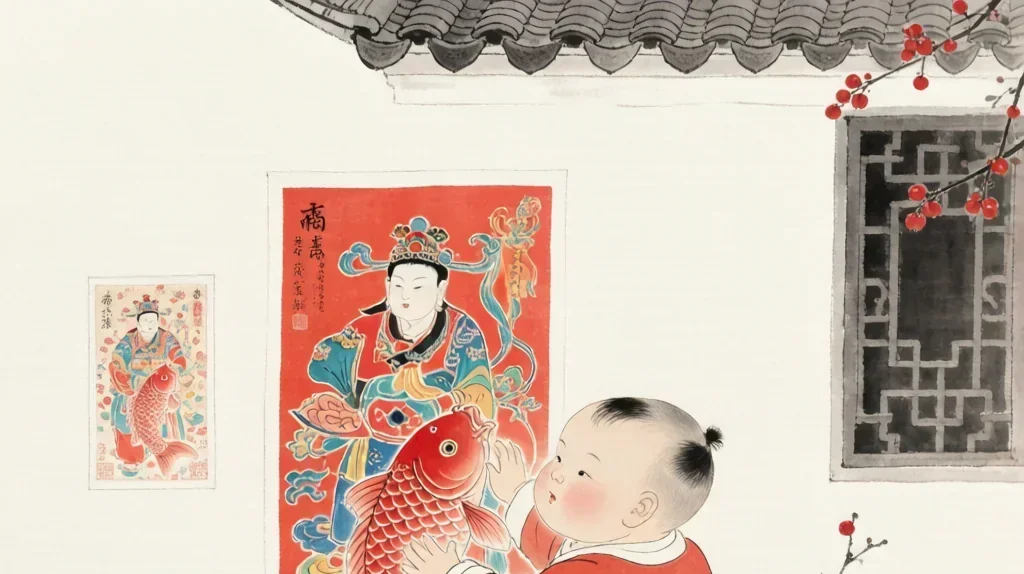
In the last week of the lunar year, a Chinese household does something no museum would dare: it takes down last year's pictures, sweeps the walls clean, and glues up a brand-new set of bright, gaudy, utterly optimistic prints. These are nián huà (年画, "year pictures"), the woodblock prints made specifically for the Spring Festival. A pair of armored door gods glare from the gate; a fat baby clutching a lotus sits above the bed; the God of Wealth sails in through the courtyard wall. For a few coins, a family could buy an entire cosmology of good fortune, printed from carved pear wood and pasted where every guest and ghost would see it.
What Are Nianhua?
A nianhua is a colored woodblock print produced for the Lunar New Year and pasted on doors, interior walls, and sometimes the kitchen stove. The name means literally "year picture," marking both its season and its disposable nature: unlike a painting kept for generations, a nianhua was expected to be renewed each spring, so the old ones were peeled off, sometimes burned, and replaced. This custom is why so few early prints survive — the art was designed to be consumed, not conserved, and its history must be reconstructed from a handful of Ming examples and a wealth of Qing and Republican ones.
The form descends from two older practices: the door gods (门神, mén shén) pasted on gates since the Tang Dynasty, and the secular "calendar pictures" (历画, lì huà) that doubled as almanacs. By the Ming and Qing, specialist print towns turned these into a mass industry, and the nianhua became the most widely distributed image in pre-modern China — the equivalent of the poster and the greeting card combined. In nearly every rural home, whatever the income, a wall of red and green prints announced the new year.
What makes nianhua distinct from fine art is its purpose. The composition is frontal, the color is loud, the message is unmistakable. There is no ambiguity and no subtlety; a nianhua wants to be read at a glance by an illiterate farmer and to do its protective, prosperous work without explanation. That forthrightness is exactly the point, and it is why the prints feel so joyfully direct compared with scholar painting.
Yangliuqing and Yangjiabu
China's print towns each developed a recognizable hand. The most refined is Yangliuqing (杨柳青), south of Tianjin, whose workshops produced exquisitely detailed figural scenes — operas, beautiful women, plump children — that were printed in outline and then lavishly hand-colored by teams of painters, so a fine Yangliuqing looks halfway between a print and a painting. At its Qing Dynasty peak the town employed several thousand artisans, and its pictures were shipped along the Grand Canal as far as the south.
By contrast, Weifang's Yangjiabu (杨家埠) village in Shandong built its reputation on prints made almost entirely from blocks, with minimal hand-coloring, giving them a flatter, bolder, more humorous look. Yangjiabu designs favor comic door gods, zodiac animals, and satirical scenes, printed in a few vivid colors at high speed for the mass market. The contrast with Yangliuqing is the classic one in Chinese folk print: the courtly, hand-finished north-Tianjin style versus the earthy, block-driven Shandong style.
Two southern schools round out the great quartet. Taohuawu (桃花坞) in Suzhou produced delicate, narrative prints that, after the port opened in the nineteenth century, absorbed Western perspective and shading — a fusion visible in their architectural backdrops. Mianzhu (绵竹) in Sichuan is famed for freehand brush coloring laid over a light print, giving a looser, more painterly result suited to the southwest's taste. Each town was a small factory: carvers, printers, colorists, and peddlers divided the labor, and whole villages lived by the year-picture trade.
Themes of Luck and Protection
Every nianhua is a wish, and the wishes fall into clear types. Protection comes first: the door gods, originally the mythical brothers Shèn Tú (神荼) and Yù Lěi (郁垒) who roped a troublesome demon, and later the Tang generals Qín Qióng (秦琼) and Yùchí Jìngdé (尉迟敬德), who stood guard at Emperor Taizong's door and were then immortalized on it. Wealth follows, in the person of the God of Wealth (财神, cái shén), often shown riding a black tiger and carrying ingots. Fertility and family appear as plump babies (胖娃娃, pàng wá wa) holding lotuses (莲, lián, punning on "continuous" 连) or sitting on a fish, praying for sons and surplus.
Then come the seasonal and zodiac images: the Kitchen God (灶王爷, Zào Wáng Yé) sent up to Heaven to report on the family (and bribed with sticky sweets so he says only sweet things), the ox and the plow celebrating spring plowing, and the animal of the incoming year. Narrative prints retell opera and novel scenes for households that had no books — a nianhua could be the only illustration of the Three Kingdoms a village child ever saw. A single wall thus functioned as a household's newspaper, altar, and dream board at once.
The Printing Process
Making a nianhua is a craft of separation. An artist first draws the design on thin paper; the carver pastes this drawing face-down onto a smoothed block of pear wood (梨木, lí mù) or jujube wood and, with a knife and chisels, cuts away the blank areas so the lines and shapes stand in relief. A separate block is engraved for each color — black for the key line, then red, yellow, green, blue as needed — and registering them all on one sheet demands great skill.
The printer inks a block, lays a sheet of paper on it, and rubs the back firmly with a round pad called a baren (马连, mǎ lián), transferring the impression. The sheet then passes in turn through the line block and each color block, the colors layered until the image is complete. In the "fine" schools like Yangliuqing, a painter finally adds faces, highlights, and fine details by brush, which is why those prints glow with a hand-painted softness. A complex design might use five to seven blocks, and a busy workshop could pull thousands of impressions a day in the run-up to the festival — speed was everything when the market lasted only a few weeks.
Spring Festival Today
The nianhua trade collapsed in the mid-twentieth century as lithography, then mass-produced posters and finally digital printing, displaced the woodblock. Whole print villages shifted to other work, and masters died without apprentices. Recognition came in 2006, when the Yangliuqing, Yangjiabu, Taohuawu, and Mianzhu nianhua crafts were listed among China's national Intangible Cultural Heritage items, prompting revival workshops, museum collections, and a new market among collectors who value the old blocks.
Today the living custom survives in two forms. In villages, factory-printed "year pictures" still go up at Spring Festival, keeping the door-god and baby imagery alive even if the medium has changed. Among connoisseurs and inheritors, the classical woodblock process is preserved and taught, and contemporary artists cut new designs — pandas, rockets, Olympic mascots — in the old technique. Either way, the instinct is the same as a thousand years ago: when the new year comes, put up a fresh picture of luck, and let the old year's fears be peeled away with the old paper.