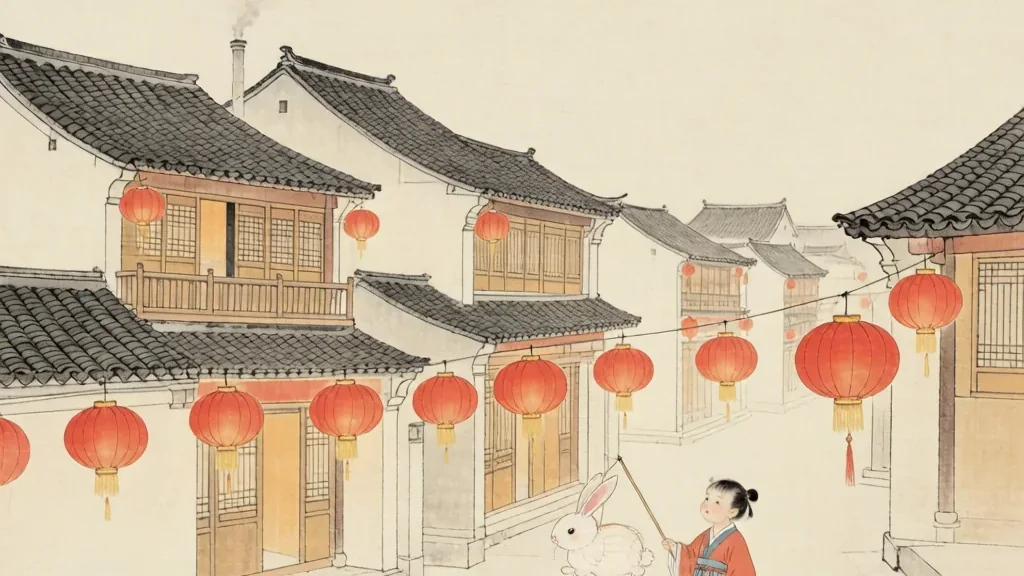
Imagine a night when the sky glows not with stars alone, but with thousands of crimson lanterns drifting upward like fiery prayers. Streets buzz with laughter, the air smells of sweet glutinous rice, and riddles dangle from every eave, daring passersby to solve them. This is Yuanxiao Jie (元宵节), the Lantern Festival — the grand finale of Chinese New Year celebrations and one of the most visually spectacular traditions in the world.
Celebrated on the 15th day of the first lunar month, the Lantern Festival marks the first full moon of the new year. But behind the beauty lies a gripping legend — a tale of divine anger, mortal cleverness, and a near-catastrophe that was averted by a sea of light.
The Legend: The Jade Emperor's Revenge Plan
Long ago, the Jade Emperor (玉皇大帝, Yù Huáng Dà Dì), the supreme ruler of heaven, kept a beautiful and beloved celestial crane. One day, the crane flew down to the mortal world to explore. But as it wandered through a village, a group of hunters — mistaking it for an ordinary bird — shot it down with their arrows.
When news of the crane's death reached the Jade Emperor, his sorrow curdled into fury. The crane was not merely a pet; it was a sacred creature of the heavenly court. In his rage, the Jade Emperor made a terrifying decree: on the 15th day of the first lunar month, he would send a storm of divine fire to burn the entire village to ashes. Every man, woman, child, and beast would perish as punishment for humanity's insolence.
But not all in heaven agreed with such merciless justice. The Jade Emperor's daughter, a kind-hearted celestial princess, was horrified by her father's plan. Unable to openly defy him, she secretly descended to the mortal world under cover of darkness. She found the village elder and warned him of the coming destruction.
The villagers were terrified. How could mere mortals stop the wrath of the most powerful god in the Chinese pantheon? Panic spread through the village like wildfire. People wept in the streets. Some began packing what little they owned, preparing to flee into the mountains. But the princess's warning was clear: there was no escape from divine fire.
Then, an old man — a clever and resourceful village elder known for his wisdom — stepped forward with an extraordinary idea. "If the Jade Emperor expects to see our village burning," he said, "then let us give him exactly what he expects to see."
The Clever Deception
The elder's plan was as brilliant as it was simple. On the appointed night, every household would hang red lanterns outside their doors. Every street would be lined with torches. Bonfires would blaze in the village square. The people would set off firecrackers, creating thunderous explosions and brilliant flashes of light. From the heavens, the village would appear to be engulfed in flames.
The villagers embraced the plan with desperate hope. For days leading up to the 15th, they worked feverishly — crafting lanterns from oiled paper and bamboo, stockpiling firecrackers, and preparing offerings. When the fateful night arrived, the entire village transformed into a breathtaking spectacle of light and sound.
From his celestial throne, the Jade Emperor looked down and saw the village ablaze with red, orange, and golden light. Firecrackers popped and crackled like burning timber. Satisfied that his divine punishment had been carried out, he turned away from the mortal world and returned to his heavenly affairs. The village was saved — not through strength or defiance, but through wisdom, unity, and the clever use of light.
From that year onward, the people celebrated their deliverance by repeating the ritual: hanging lanterns, lighting fires, and setting off fireworks on the 15th day of the first lunar month. What began as a desperate act of survival evolved into one of China's most beloved festivals — a tradition that has now endured for over two thousand years.
Tangyuan: The Sweet Taste of Reunion
No Lantern Festival is complete without tangyuan (汤圆) — round, glutinous rice balls filled with sweet or savory fillings, served in a warm, fragrant broth. The name "tangyuan" is a homophone for "reunion" (团圆, tuányuán), and eating these chewy spheres symbolizes family togetherness and completeness.
Traditional tangyuan fillings include black sesame paste, red bean paste, crushed peanuts, and sweet osmanthus. In northern China, you'll find yuanxiao (元宵) — a similar but distinct treat where the filling is cut into small cubes, dampened, and shaken in a basket of dry glutinous rice flour until it builds up a thick, chewy coating. In the south, tangyuan is made by wrapping a soft rice dough around the filling, yielding a smoother, more delicate texture.
The round shape of tangyuan is deeply symbolic. In Chinese culture, roundness represents wholeness, harmony, and the eternal cycle of life. Eating tangyuan together as a family is an act of love — a sweet reminder that no matter where life takes you, reunion is always possible.
Lantern Riddles: The Original Brain Teasers
One of the most delightful traditions of the Lantern Festival is cāi dēngmí (猜灯谜) — guessing lantern riddles. Lantern owners write riddles on slips of paper and attach them to their lanterns. Passersby are invited to guess the answers. If someone solves the riddle correctly, they might win a small prize or simply earn the admiration of the crowd.
These riddles are a unique form of Chinese wordplay. They often involve puns, homophones, classical literary allusions, and clever misdirection. Some describe an object without naming it; others play on the multiple meanings of a single Chinese character. The tradition dates back to the Song Dynasty (960–1279 CE) and reflects the Chinese love of wit, language, and intellectual play.
"It has a head but no neck, a body but no arms, a tail but no legs. What is it?"
— Answer: A fish (鱼, yú). The character 鱼 has a "head" radical, a "body" radical, and a "tail" stroke.
Lantern riddles transform the festival from a visual spectacle into an interactive community event. Families stroll through lantern displays, pausing to ponder riddles together. Children tug at their parents' sleeves, eager to show off their cleverness. The tradition bridges generations, connecting the young and old through shared moments of discovery.
The Festival Today
Modern Lantern Festival celebrations are a dazzling fusion of ancient tradition and contemporary artistry. Cities across China and Chinese communities worldwide host elaborate lantern displays featuring intricate, larger-than-life sculptures made of silk, paper, and LED lights. You'll see glowing dragons coiling through parks, phoenixes spreading radiant wings, and entire scenes from Chinese mythology recreated in luminous detail.
The festival also marks the official end of Chinese New Year celebrations. After two weeks of feasting, visiting relatives, and exchanging red envelopes, the Lantern Festival provides a spectacular closing ceremony. In many regions, it's the last day firecrackers and fireworks are permitted before the new year festivities formally conclude.
In an age of digital communication, the Lantern Festival has taken on new forms. People send virtual lanterns and animated tangyuan stickers through messaging apps. But the core traditions endure: families gather to eat tangyuan, children carry lanterns through the streets, and communities come together under the light of the first full moon of the year. The story of the Jade Emperor's crane may be ancient, but its lesson — that wisdom and unity can overcome even the greatest threats — remains as relevant as ever.