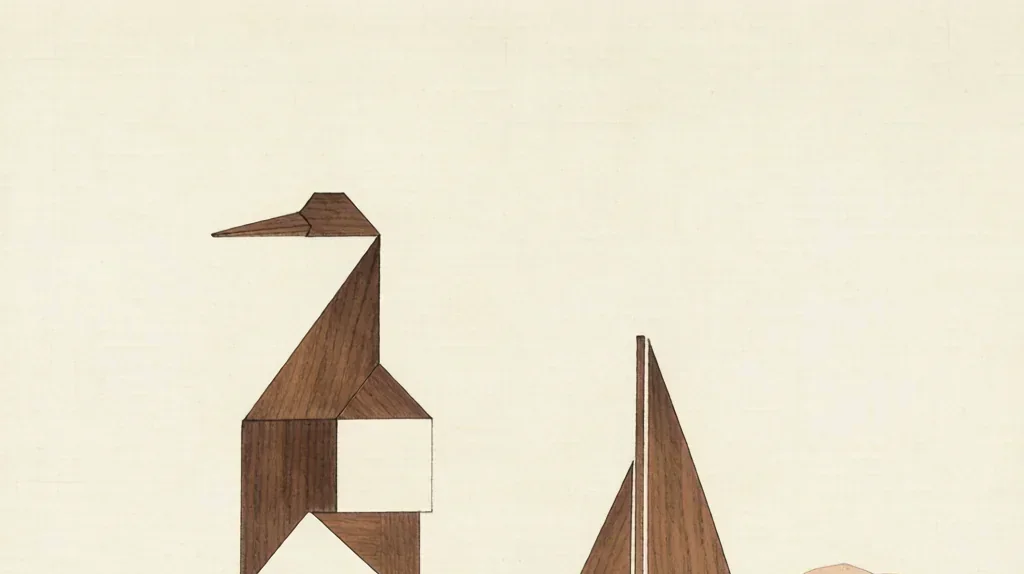
Seven flat shapes, one square, and an infinity of forms. The qī qiǎo bǎn (七巧板), known in English as the tangram, is a dissection puzzle that has charmed children and mathematicians alike since the Song dynasty. With nothing but seven simple tiles, players can build birds, boats, houses, running figures, and abstract patterns that seem to multiply without end. The tangram matters because it distills geometry, creativity, and visual reasoning into a pocket-sized game, proving that the simplest materials can unlock the richest imagination.
Where the Tangram Came From
The tangram's roots lie in China, most likely evolving from the practice of dividing a square into decorative geometric shapes. Similar ideas appear in Chinese furniture inlays and floor-tile patterns of the Song and Ming periods. By the Qing dynasty the seven-piece square was a beloved household amusement. A famous legend credits the design to a man who dropped a square tile, which shattered into seven pieces that he then tried to reassemble—an origin story that captures the puzzle's essence of reconstruction.
The tangram reached the wider world in the early nineteenth century, when trading ships carried the "Chinese puzzle" to Europe and America. It triggered a craze there, with books of tangram patterns selling by the thousands. Interestingly, while the West treated it as a fashionable novelty, in China it had long been a gentle teacher of geometry for the young, blending play with the study of shapes and spatial relationships.
The Seven Pieces Explained
A standard tangram contains exactly seven pieces cut from a single square. There are two large right triangles, one medium right triangle, two small right triangles, one square, and one parallelogram. Together these tiles always reassemble into the original square, and they can be rearranged into countless silhouettes. The parallelogram is the only piece that is not symmetric, and it is the trickiest to place because it can be flipped.
What is remarkable is the mathematical harmony among the pieces. All triangles share the same angles, the square has the same side length as the short leg of the small triangles, and the parallelogram mirrors the area of two small triangles. This hidden consistency is what allows the seven pieces to fit together so seamlessly in so many configurations. Holding the tiles, one literally holds a hands-on lesson in congruence and proportion.
How to Play and Create
The classic game offers a target silhouette—often a person, animal, or object—and challenges the player to reproduce it using all seven pieces, with each piece touching at least one other but never overlapping. No measuring is allowed; only placement and rotation. Because the goal is a shape rather than a number, the tangram rewards intuition and experimentation over calculation, making it accessible to very young children.
Beyond copying given figures, players can invent their own designs, competing to see who can build the most elegant or surprising scene. Two popular variations are the "parlor" version, where one player arranges a shape and others must match it, and free composition, where the only limit is the imagination. The puzzle's open-ended nature is precisely why it remains a fixture in classrooms and family rooms across the world.
Educational and Mathematical Value
The tangram is a powerful, low-cost teaching tool. It builds spatial awareness, an understanding of fractions and area, and the ability to mentally rotate shapes—a skill linked to success in later mathematics and engineering. Because children manipulate concrete pieces, they grasp abstract ideas like congruence and similarity far more readily than from a textbook alone. Many educators use the tangram as an introduction to geometry before any formal instruction.
Mathematicians, too, have studied the tangram. Questions about which shapes can be formed, how many distinct solutions exist for a given figure, and the properties of dissections connect the toy to serious fields like tiling theory and combinatorial geometry. The humble seven-piece square thus sits at the crossroads of folk play and rigorous mathematics, a reminder that deep ideas often arrive in playful packaging.
Tangram in Art and Culture
The tangram has inspired artists who use its silhouettes to tell stories without words. Song-and-dynasty-era pattern books and later European publications presented hundreds of figures, from dragons to dancers, each a small visual poem. The puzzle's clean black-and-white aesthetic influenced design and even modern logo-making, where the suggestion of a form from a few geometric blocks feels both clever and economical.
In Chinese homes the tangram has long been more than a game; it is a shared activity that crosses generations. Grandparents teach grandchildren, and the quiet concentration it demands offers a welcome break from screens. Its enduring presence in both Eastern and Western playrooms makes the tangram a rare cultural bridge, a Chinese invention that became a universal language of shapes.
Why the Tangram Endures
The tangram endures because it is inexhaustible. Unlike a jigsaw with a single solution, the seven-piece square offers endless puzzles, and no two players arrive at the same figure in quite the same way. It costs almost nothing to make, travels anywhere, and suits every age. In an era of disposable digital entertainment, its wooden or cardboard tiles feel refreshingly permanent.
Most importantly, the tangram teaches a quiet lesson: that limits breed creativity. Confined to seven pieces and one rule, the mind discovers freedom. That paradox—constraint producing invention—is the true gift of the qī qiǎo bǎn, and it explains why, a thousand years after its invention, the world still picks up the seven pieces and begins to play.
Competitive Tangram and Records
Though often played alone, the tangram has a competitive side. Speed-solving contests challenge players to reproduce a given silhouette as fast as possible using all seven pieces, and team formats add the pressure of matching a partner's arrangement. In the 1800s Western craze, printed challenge books invited readers to design the most original figure, turning composition into a friendly rivalry. Modern puzzle communities post timed solves and themed silhouette challenges online, and some mathematics competitions use tangram tasks to test spatial reasoning under pressure. The appeal of competition lies in the puzzle's fixed rules: because everyone works with the same seven pieces, victory comes purely from sharper visualization and steadier hands. Far from spoiling the toy's calm reputation, this competitive layer adds a spark, showing that even a quiet dissection puzzle can stir a spirit of friendly contest.
The Tangram as a Creative Tool
The tangram's greatest strength may be its openness. Unlike a jigsaw with one correct picture, it invites invention: players compose their own scenes—boats, birds, dancers, houses—limited only by imagination and the rule that all seven pieces must be used. Artists and designers have long exploited this, using tangram silhouettes in illustration, logo design, and teaching materials where a few clean shapes suggest a form economically. In classrooms the set bridges play and art, letting children tell wordless visual stories before they can draw with a pencil. Some educators even stage tangram theater, where moving pieces act out a tale. This creative freedom is why the qī qiǎo bǎn outlived countless other parlor fads: it is never finished, only set down, ready for the next maker to reshape the square into something newly seen.
❓ Frequently Asked Questions
📝 Chinese Vocabulary
七巧板 — : the seven-piece clever board, or tangram.
巧 — : clever; skillful.
板 — : board; plank; flat piece.
形 — : form; shape.
拼图 — : puzzle; picture assembled from pieces.
三角 — : triangle, the most common tangram piece
正方形 — : square, the shape the seven pieces reassemble into
平行四边形 — : parallelogram, the only piece that can be flipped
🎉 Fun Facts
- The tangram sparked a worldwide craze in early 1800s Europe and America, with pattern books selling by the thousands.
- The parallelogram is the only tangram piece that is not symmetric and the only one that can be flipped.
- All seven pieces can always be reassembled back into the original perfect square.
- Tangram silhouettes influenced modern design and logo-making with their clean geometric style.
- During the early 1800s Western craze, some publishers released luxury tangram sets with velvet boards and ivory tiles, turning the folk puzzle into a fashionable parlor luxury.
- The seven-piece count is fixed, yet players have invented thousands of distinct silhouettes, from animals to architecture, proving the set's near-limitless variety.