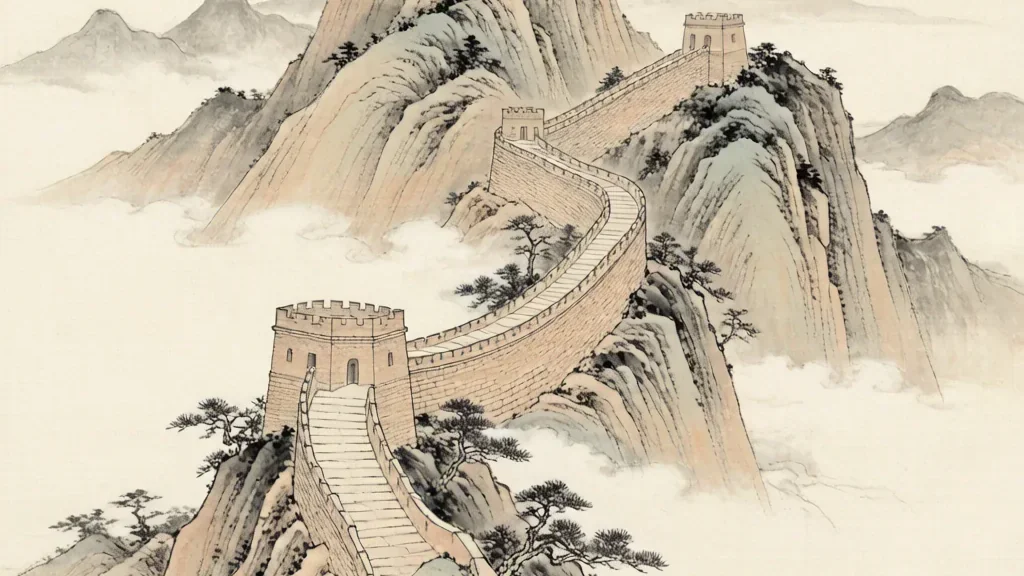
There is nothing else like it on Earth. Snaking across deserts, climbing mountain ridges, and plunging into valleys, the Great Wall of China stretches over 21,000 kilometers — more than half the circumference of the planet. Visible from space only under specific conditions, the Wall is not merely an architectural marvel; it is a monument to human determination, a stone dragon that has guarded the Chinese imagination for over two millennia. To understand the Great Wall is to understand something essential about China itself: the tension between openness and defense, between unity and fragmentation, that has defined its long civilization.
Warring States: The First Walls Rise
Long before China was unified, it was a patchwork of warring kingdoms. During the Warring States period (475–221 BCE), seven major states — Qi, Chu, Yan, Han, Zhao, Wei, and Qin — fought endlessly for supremacy. To defend their borders against each other and against nomadic raiders from the northern steppes, several states built walls of rammed earth. These were not the stone fortifications we picture today; they were simpler barriers of packed soil, wood, and stone rubble. But the logic was the same: define a boundary, control movement, and keep the enemy out.
The states of Yan, Zhao, and Qin built the most extensive northern walls, positioned to block incursions by the Xiongnu and other steppe nomads. These early walls were local, disconnected, and varied wildly in quality. But they established a precedent that would define Chinese military thinking for the next two thousand years.
Qin Shi Huang: The First Great Wall
In 221 BCE, the state of Qin conquered all its rivals and unified China under a single emperor — Qin Shi Huang, the First Emperor. Among his many sweeping reforms — standardizing weights, measures, writing, and even axle widths — he ordered the connection and extension of the northern frontier walls into a single continuous barrier.
The scale of the project was staggering. General Meng Tian, commanding a workforce of hundreds of thousands — soldiers, convicts, and conscripted peasants — oversaw the construction of a wall stretching from Lintao in the west to Liaodong in the east. The conditions were brutal. Workers labored in extreme heat and freezing cold, with inadequate food and shelter. Historical records suggest that tens of thousands died during construction, their bodies reportedly buried within the wall itself — giving rise to the Wall's grim nickname as "the longest cemetery on Earth."
This Qin wall, built primarily of rammed earth, has largely eroded away. But its psychological impact was permanent. The Wall became a symbol of imperial power, a physical manifestation of the emperor's ability to reshape the landscape itself.
The Legend of Meng Jiangnu
No story captures the human cost of the Wall more poignantly than the legend of Meng Jiangnu. According to the tale, during the Qin Dynasty, a young woman named Meng Jiangnu was newly married to a man named Fan Xiliang. Shortly after their wedding, imperial soldiers arrived and conscripted Fan Xiliang to work on the Great Wall. Months passed with no word from him.
As winter approached, Meng Jiangnu sewed warm clothes and set out on the long, dangerous journey north to find her husband. When she finally reached the Wall, the other workers told her that Fan Xiliang had died from exhaustion and been buried within the structure. Overcome with grief, Meng Jiangnu wept bitterly at the Wall. Her tears were so powerful, so filled with sorrow, that a section of the Wall collapsed, revealing her husband's bones beneath.
When the emperor heard of this, he was furious — but when he saw Meng Jiangnu's beauty, he demanded she become his concubine. She agreed on three conditions: that the emperor hold a grand funeral for her husband, that he wear mourning clothes, and that she be allowed to visit the sea. After the emperor fulfilled the first two conditions, Meng Jiangnu went to the sea — and threw herself into the waves rather than submit.
The legend of Meng Jiangnu has been told for over two thousand years, in operas, ballads, and shadow plays across China. It is a reminder that behind every great monument lie countless individual tragedies, and that even the mightiest walls cannot contain the human heart.
The Ming Dynasty: The Wall We Know Today
The Great Wall that visitors see today is overwhelmingly the work of the Ming Dynasty (1368–1644). After the Mongol Yuan Dynasty was driven out, the Ming emperors faced a persistent threat from the northern steppes. Unlike earlier dynasties that sometimes pursued expansionist policies, the Ming adopted a largely defensive posture, pouring immense resources into fortifying the northern frontier.
The Ming Wall was a quantum leap in military engineering. Instead of rammed earth, builders used kiln-fired bricks and stone blocks, held together with a mortar made from sticky rice — a surprisingly effective binding agent that has proven more durable than many modern cements. The Wall averaged 7–8 meters in height and 4–5 meters in width at the top, wide enough for five horsemen to ride abreast. Watchtowers, signal towers, and garrison stations were built at regular intervals, creating a comprehensive defensive system that included not just the wall itself, but trenches, moats, and parallel inner walls.
The Ming Wall was not a single line but a complex network. In critical areas near Beijing — at Badaling, Mutianyu, Jinshanling, and Simatai — the fortifications were especially dense, with multiple layers of walls and watchtowers. These sections, with their dramatic mountain settings and remarkably preserved stonework, have become the iconic image of the Great Wall worldwide.
The Signal System: An Ancient Internet
The Wall was not just a barrier; it was a communication network. Watchtowers were equipped with signal fires, cannon, and flag systems. When guards spotted approaching enemies, they lit fires — one column of smoke during the day, one fire at night — to alert neighboring towers. The number of smoke columns or fires indicated the size of the attacking force. In this way, a message could travel the length of the Wall in hours, a speed that would not be surpassed until the telegraph.
This system was extraordinarily effective. During daylight, smoke from burning wolf dung was used because it produced a dense, dark column that rose straight into the air and was visible from great distances. At night, fires were built on elevated platforms. The system was so refined that by the Ming Dynasty, guards could communicate not just the presence of enemies but their approximate numbers, direction of movement, and distance from the Wall.
The Wall in Modern Times
The Great Wall's military function ended centuries ago, but its symbolic power has only grown. In the 20th century, it became a rallying symbol of Chinese resilience.
In 1987, UNESCO designated the Great Wall a World Heritage Site, recognizing it as "an unparalleled feat of human construction." Today, it attracts over 10 million visitors annually. Sections near Beijing are carefully restored and easily accessible; more remote sections in Gansu and Inner Mongolia crumble quietly into the landscape, the rammed earth slowly returning to the soil from which it came.
The Wall faces modern challenges: erosion, vandalism, and the sheer pressure of tourism. Conservationists work to balance access with preservation, and some remote sections are being documented with drones and 3D scanning before they are lost forever. The Wall endures — not just as stone and brick, but as an idea. It is China's dragon of stone, still guarding the imagination of the world.
From Sea to Desert: The Wall's Ends
The Ming Wall stretches between two dramatic endpoints. In the east, Shanhai Pass meets the Bohai Sea, where the Wall appears to march straight into the water at a spot called the Old Dragon's Head. In the far west, Jiayu Pass stands at the edge of the Gobi, the gateway through which caravans left China for Central Asia. Between them the line crosses mountains, plateaus, and grasslands, and its builders shaped each section to the land it defended. To stand at either end is to grasp the Wall's true scale: it is less a single wall than a continent-spanning frontier, whose two tips mark the meeting points of China with the sea and with the inner Asian deserts. Modern travelers who walk the restored battlements at Badaling often forget that the Wall they admire is only one chapter of a much longer story written across the whole northern frontier.
More Than Defense: The Wall as a Filter
Although built for war, the Wall was never a sealed border. Its passes were also gates of trade, where merchants paid duties and caravans passed with official permission, and where garrison towns grew rich on the traffic that gathered at the gates. In peacetime the Wall helped move troops and supplies and marked the belt where farmers and nomads met, married, and traded. Migrants and goods filtered through the same gates that armies defended, so the structure shaped commerce and culture as much as conflict. Seen this way the Wall was a membrane rather than a wall, a managed edge of an empire that both feared and depended on the world beyond it. This double role explains why, even after its military use ended, the Wall kept shaping maps, taxes, and the very idea of where China began and the steppe left off.