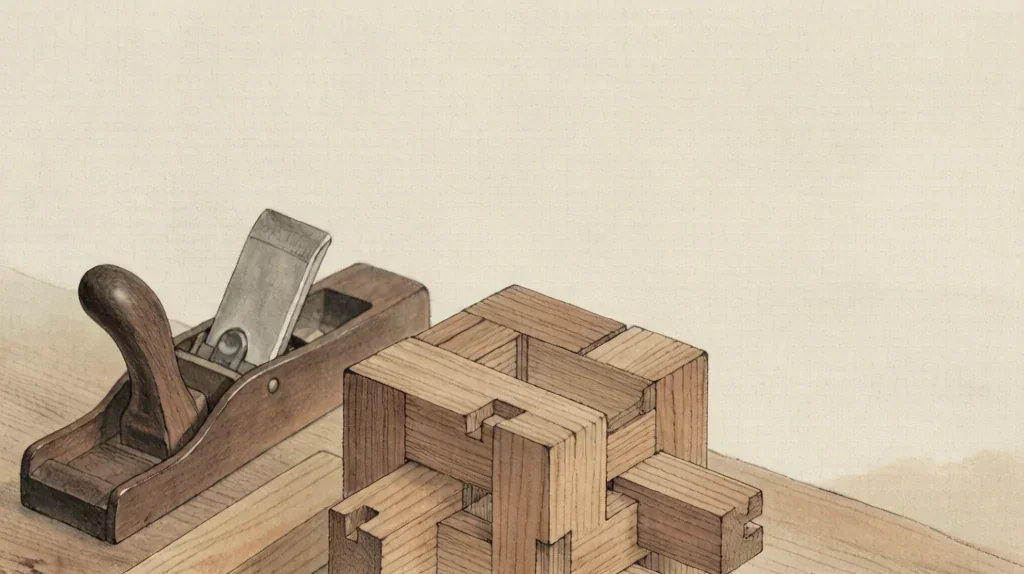
A knot that has no rope, a lock with no key, a puzzle held together by pure geometry. The lú bān suǒ (鲁班锁), or Luban Lock, is a traditional Chinese interlocking wooden puzzle named after Lu Ban, the legendary master carpenter of antiquity. Six or more precisely cut blocks interlock so tightly that the whole seems impossible to take apart—and even harder to rebuild. The Luban Lock matters because it reveals the genius of classical Chinese joinery, the same principles that hold together temples and pavilions without a single nail.
The Legend of Lu Ban
Lu Ban, whose real name was Gongshu Ban, lived during the Spring and Autumn period and is honored as the patron god of carpenters, masons, and builders in Chinese tradition. Stories credit him with inventing tools such as the saw, the square, and the cloud ladder used in warfare. Whether or not he truly designed the lock that bears his name, the association is fitting: the puzzle is a miniature of the mortise-and-tenon craft for which Chinese woodworking is famous.
According to one charming tale, Lu Ban created the interlocking puzzle to test his wife's ingenuity, or to amuse a child with a toy that taught spatial skill. The story may be apocryphal, but it captures the spirit of the object: a playful challenge rooted in serious craft. By attaching the puzzle to a revered name, Chinese culture linked everyday play to the dignity of the artisan and the wisdom of the workshop.
How the Interlocking Puzzle Works
The classic Luban Lock is built from six wooden bars, each notched with precise rectangular cuts. When the bars are slid together in the correct orientation, the notches engage one another and create a stable, self-supporting knot. No glue, nail, or screw holds it; only the geometry of the cuts keeps the structure rigid. To disassemble it, one must find the single piece that, once removed, frees the rest in sequence.
The precision required is unforgiving. A fraction of a millimeter off in any notch, and the pieces will either jam permanently or fail to hold. This is why the Luban Lock is as much a feat of craftsmanship as of puzzle design. Traditional versions are cut from a single species of hardwood so that all pieces expand and contract evenly, preserving the fit across seasons and years of handling.
Variations and Complexity
While the six-piece version is the most familiar, the Luban Lock family includes many variations with different numbers of bars and notch patterns. Some use eight, twelve, or more pieces, and master puzzle makers have devised locks with hidden keys, asymmetric shapes, and multiple solution paths. The famous "universal" or "burr" puzzle in the West shares the same interlocking principle and was likely inspired by Chinese examples reaching Europe centuries ago.
Modern designers have expanded the tradition with puzzle boxes, decorative knots, and even furniture joints that echo the Luban Lock's logic. Competitions now exist for designing the most elegant or the most fiendishly difficult interlock. Yet the heart of the puzzle remains unchanged: a set of simple blocks whose whole is far greater, and far stronger, than the sum of its parts.
Craft and the Mortise-and-Tenon Tradition
The Luban Lock is a direct descendant of Chinese mortise-and-tenon (榫卯, sǔn mǎo) joinery, the technique that allows wooden structures to stand for centuries without metal fasteners. In classical architecture, beams slot into columns through precisely shaped joints that lock under load. The same philosophy of "fit by form" appears in the puzzle, making it a tangible lesson in a building tradition that produced the great temples and pagodas of China.
Appreciating the lock therefore opens a window onto a broader cultural value: respect for material, precision, and the quiet intelligence of the hand. To solve a Luban Lock is to momentarily think like the carpenter, reading the grain and the cut, understanding how pressure distributes through a structure. It is play that honors work, and work that feels like play.
Learning and Cognitive Benefits
Beyond its cultural roots, the Luban Lock is a superb brain exercise. Taking it apart and putting it back develops three-dimensional spatial reasoning, fine motor control, and systematic problem-solving. Because there is no picture to copy, the solver must infer the internal structure by feel and logic, a skill valuable in engineering, surgery, and any field requiring mental visualization.
Parents and teachers value the puzzle for its patience-building quality. Children who persist through the initial frustration often experience a deep satisfaction when the final piece clicks home. Unlike digital games that reward speed, the Luban Lock rewards careful observation and methodical trial. It is a rare toy that grows more interesting the longer one lives with it.
Why the Luban Lock Endures
The Luban Lock endures because it is honest. There is no trick, no hidden spring, no battery—only wood, cut with intention, meeting wood. In a world of plastic and pixels, the warmth of a wooden puzzle and the silence of its solution feel almost radical. It connects the player to a lineage of craftspeople stretching back more than two thousand years.
More than a curiosity, the lú bān suǒ is a small ambassador of Chinese design philosophy: that strength can come from harmony of parts rather than force, and that the best locks are those that open to understanding. Whether displayed on a scholar's desk or given as a gift of good wishes, it remains a timeless token of cleverness, patience, and the quiet power of fitting things together.
The Luban Lock as a Gift and Symbol
Beyond its puzzle appeal, the Luban Lock carries quiet symbolic weight. Because its blocks hold only through precise mutual fitting, it is often read as an emblem of harmony—separate parts forming a stable whole without nails or glue. That meaning makes it a favored gift among friends, students, and business partners, who present it as a wish for cooperation and clever resolution of difficulty. Woodworkers value it too as a miniature diploma of their craft, an object that proves the power of the joint. Displayed on a scholar's desk or a shop counter, the lock is both toy and token, a small sculpture that invites the hand to test its secret. In this dual life as plaything and emblem, the lú bān suǒ shows how Chinese material culture blends usefulness, beauty, and meaning in a single unassuming object.
Modern Makers and Global Influence
The Luban Lock did not stay in China. The interlocking principle traveled along trade routes and inspired the Western burr puzzle, and today makers on several continents design new variants with hidden keys and novel notch patterns. In China, contemporary workshops merge tradition with modern tools, using laser cutting for consistency while preserving the hand-finished feel that makes the fit satisfying. Design schools study the lock as a case in parametric joinery, and furniture engineers borrow its logic for flat-pack assemblies that need no hardware. Hobbyists share dissections and rebuild sequences online, turning a solitary toy into a connected global craft. Exhibitions of fine wooden puzzles now routinely include Luban Lock derivatives alongside modern art toys. The result is a folk object that has become a shared design language, proving that a two-thousand-year-old idea still seeds new invention.
❓ Frequently Asked Questions
📝 Chinese Vocabulary
鲁班锁 — : the Luban Lock, an interlocking puzzle.
锁 — : lock.
榫卯 — : mortise-and-tenon joint.
木匠 — : carpenter; woodworker.
巧 — : clever; ingenious.
鲁班 — : Lu Ban, the legendary master carpenter
榫 — : tenon, the projecting part of a wooden joint
卯 — : mortise, the hole that receives the tenon
🎉 Fun Facts
- Lu Ban is revered as the patron god of carpenters and is credited with inventing the saw and the carpenter's square.
- A well-made Luban Lock holds together with no nails, glue, or screws—only the geometry of its notches.
- The Western "burr puzzle" shares the same interlocking principle and was likely inspired by Chinese examples.
- The puzzle reflects mortise-and-tenon joinery that lets Chinese temples stand for centuries without metal fasteners.
- Today the Luban Lock is a popular souvenir and gift, often given as a symbol of cleverness and the harmonious fitting of parts, and displayed as a desk ornament.
- Master puzzle makers still hand-cut versions from a single block of wood, so that all pieces share the same grain and expand evenly with changes in humidity.