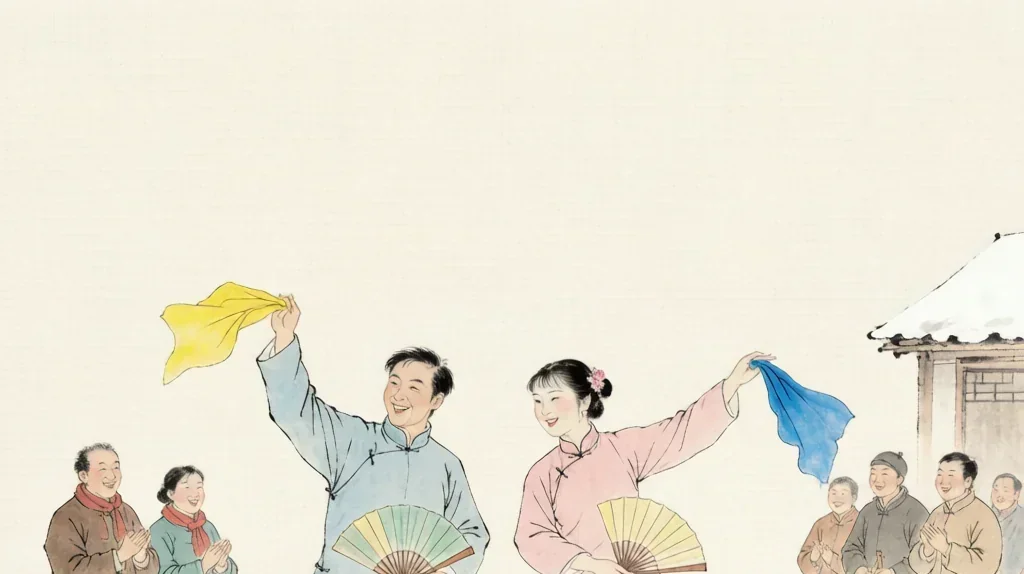
Errenzhuan (二人转), often translated as the "two-person turn," is a song-and-dance duet from China's Northeast (Dongbei)—the provinces of Liaoning, Jilin, and Heilongjiang. Performed by a singing dancer and a comedian-instrumentalist who trade songs, jokes, and acrobatic bits, it is the region's most beloved folk stage art. Blurring the line between music, comedy, and opera, errenzhuan has warmed countless winter nights with its bawdy humor, quick wit, and tunes that anyone can hum.
Origins in the Northeast
Errenzhuan grew from the mingling of northern and southern folk arts that met in the Northeast as settlers moved into the cold frontier. Early forms combined local ditties with elements borrowed from Hebei and Shandong singing traditions carried by migrants.
By the Qing dynasty, a recognizable duet form had emerged in the rural Northeast, performed by itinerant pairs who traveled between villages. Its portable, two-person format suited a sparse, hard-living frontier where a full opera troupe was a luxury.
The name "errenzhuan" captures the core: two people, turning through song, dance, and patter in a single continuous show.
The Two-Person Format
A classic errenzhuan pair consists of a female-impersonating singer-dancer (usually called the "dan") and a male comic (the "chou"), though both performers sing and clown. They face the audience, exchange lines, and take turns at center stage.
The "dan" typically handles the lyrical singing and dancing, while the "chou" plays instrument, cracks jokes, and ribs the partner. Their banter—half affectionate, half teasing—is the engine of the show's comedy.
Though called two-person, a single artist may perform solo passages, and troupes often present several acts in one evening, varying the pairs.
Music and Instruments
Errenzhuan music draws on a large body of traditional tunes, each linked to a mood or type of scene. Singers join these melodies to new lyrics on the fly, a skill that lets performers tailor a show to the crowd.
The leading instrument is the suona horn or the four-stringed banhu fiddle, backed by drums, clappers, and the performer's own fan or handkerchief rhythms. The sound is loud, bright, and rhythmic—built for cold open squares.
Singing can shift from a soaring lyric line to rapid comic patter in seconds, showing the form's vocal agility.
Dance, Props, and Comedy
Movement is central. Performers twirl handheld fans and red silk handkerchiefs, the latter often flipped onto the wrist or spun overhead with dazzling control. Simple steps build into lively, athletic dance.
Comedy ranges from wordplay and mock arguments to slapstick and mild burlesque. Because errenzhuan traditionally played to mixed rural crowds, its humor is earthy and direct, never distancing itself from ordinary life.
Acrobatic bits—balances, drops, and quick turns—add spectacle, linking errenzhuan to the broader world of northern variety entertainment.
Repertoire and Stories
Errenzhuan draws on folktales, episodes from popular novels, and original comic sketches. Many pieces retell the loves and tricks of familiar characters, while others invent small domestic farces.
Some programs consist of "small pieces" (xiaodiao) built around a single tune and situation, prized for clever lyrics. Longer narrative items let the pair show off sustained singing and characterization.
The repertoire's flexibility is key: a good team reads the room and lengthens or cuts material to keep the laughs coming.
From Village Fair to Modern Stage
For most of its history errenzhuan was a grassroots entertainment of Northeast villages, performed at temple fairs, harvest celebrations, and family banquets. Its fortunes rose and fell with rural prosperity and official taste.
In the twentieth century the form was professionalized and brought to urban theatres, with troupes standardizing favorite pieces. Reforms trimmed the roughest material while preserving the comic spirit.
Television and, later, a famous comedy brand built around Northeast humor carried errenzhuan-style performing to national audiences, making its accents and catchphrases widely known.
Language, Dialect, and Humor
Errenzhuan is inseparable from the Northeastern Mandarin dialect, whose flat, punchy rhythm is part of the comedy. Outsiders often find the accent itself funny, which helped the art travel beyond its home region.
The humor leans on wordplay, role reversal, and gentle mockery of authority and pretension. Self-deprecating and warm, it invites the audience in as accomplices rather than spectators.
This linguistic identity is why errenzhuan feels like a voice of Dongbei itself—regional, resilient, and sociable.
Relation to Other Arts
Errenzhuan shares DNA with northern quyi (oral comic and musical performance) and with local opera, and its singers sometimes cross into opera or comic dialogue (xiangsheng). The boundaries are porous by design.
It also influenced the development of Pingju and other nearby forms, exchanging tunes and comic routines. Scholars treat it as both a folk opera and a variety art, depending on the lens.
Its willingness to borrow and send up other genres is part of its enduring vitality.
Errenzhuan Today
Today errenzhuan thrives in the Northeast and beyond, with professional troupes, television specials, and a boom in commercial theatres where audiences eat and laugh late into the night.
Heritage efforts record old tunes and train young performers, since the art depends on live, improvisatory skill hard to capture on paper. Meanwhile stars of Northeast comedy have made the style a national shorthand for regional humor.
Whatever the setting, errenzhuan still does what it always did: turn two people, a few tunes, and a cold room into shared, uproarious warmth.
Training the Errenzhuan Performer
Behind the seeming ease of a duet lies hard training. A young performer drills voice, comic timing, fan and handkerchief work, and the stamina to hold a crowd for a long show. Many learn within family troupes or under a master who demands both skill and stage sense.
Because so much depends on live reaction, students are pushed to read an audience and adjust on the spot. That improvisatory habit is what separates a true errenzhuan artist from someone who merely knows the tunes.
❓ Frequently Asked Questions
What is errenzhuan?
Errenzhuan is a Northeastern Chinese song-and-dance duet performed by a singing-dancing role and a comic instrumentalist who trade songs, jokes, and dance.
Where did it come from?
It formed in China's Northeast as migrant folk songs from Hebei and Shandong mixed with local tunes, becoming a portable two-person frontier entertainment.
What instruments are used?
A suona horn or banhu fiddle leads, backed by drums, clappers, and the rhythmic snapping of fans and handkerchiefs.
Is it opera or comedy?
It is both—a folk opera that sings stories and a variety act full of comic patter, improvisation, and acrobatic dance.
Why is the dialect important?
The Northeastern Mandarin accent is part of the comedy and identity, making the humor land even for listeners who follow the gist rather than every word.
Is errenzhuan still popular?
Yes. It flourishes in Northeast theatres and on television, with heritage programs preserving old tunes and training new performers.