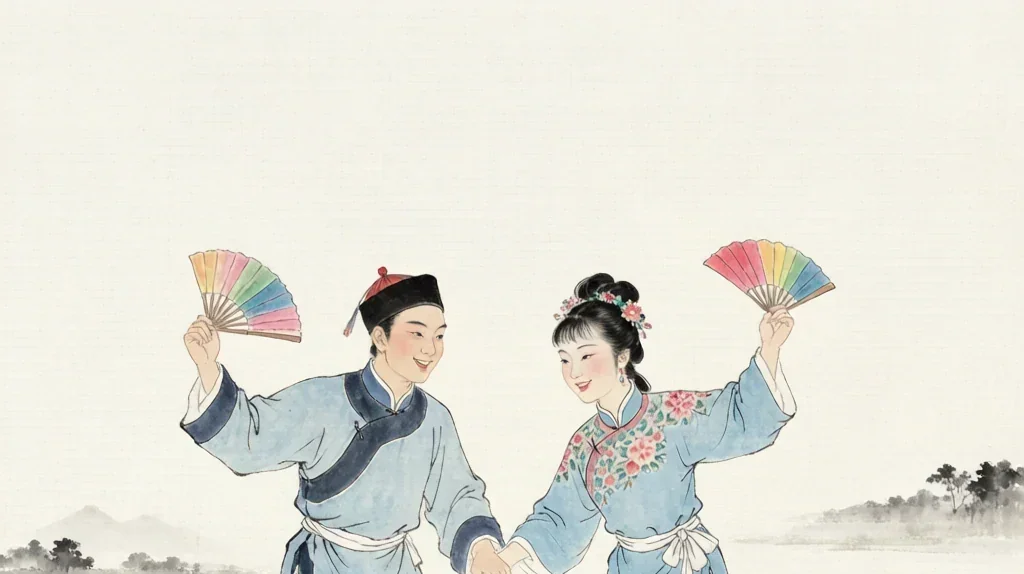
Huagu (花鼓), literally "flower drum," refers to a family of Chinese folk song-and-dance performances built around a small hand-carried drum and bright, rhythmic singing. Found across several provinces—most famously as Fengyang flower-drum in Anhui and as a groundwork for Hunan and other regional operas—huagu pairs a dancer who beats the drum with a partner on gong, clappers, or fan. Cheerful, portable, and deeply tied to ordinary celebrations, it is one of the grassroots performance arts from which Chinese opera itself grew.
What "Flower Drum" Means
The name joins "flower" (a traditional emblem of festivity and beauty) with "drum," the instrument at the heart of the performance. A huagu show typically features one or two performers who sing alternating lines while keeping up a driving percussion rhythm.
Unlike a staged opera with fixed roles, huagu is closer to a singing dance: the body, the drum, and the voice move as one. Its pieces are short and repeatable, easy to learn and easy to join.
This simplicity is the secret of its spread; wherever people gathered to celebrate, a flower-drum pair could turn up and lead the mood.
Fengyang Flower-Drum
The best-known huagu is the Fengyang flower-drum of Anhui, associated with the old Fengyang prefecture. Historically performed by singers—often women—carrying a small drum and a pair of slender clappers, it became a symbol of both festivity and, in older ballads, of hardship and migration.
Fengyang huagu tunes are plaintive yet tuneful, and the accompanying "flower-drum" song texts sometimes narrate the singer's wandering life. Over time the form was polished for the stage while keeping its intimate, hand-played character.
Today Fengyang flower-drum is recognized as a distinctive regional art and taught as part of Anhui's performance heritage.
From Folk Dance to Opera
Huagu is not one fixed genre but a seedbed. In several regions, flower-drum singing grew into fuller theatrical forms once troupes added roles, costumes, and plot. Hunan flower-drum opera is the clearest example, evolving from village huagu into a beloved regional opera.
Similar paths appear elsewhere: flower-drum tunes and dance steps were absorbed into local operas as comic or opening numbers. The boundary between "huagu" and "huagu opera" is therefore fluid and historical.
This genealogy makes huagu a key to understanding how Chinese regional opera multiplied from shared folk roots.
Performance and Instruments
A basic huagu pair divides labor: one beats the small drum slung at the waist or held in hand, the other strikes a gong, clappers, or a second drum. The drum sets the pulse; the voices ride above it in call-and-response.
Dancers use fans, handkerchiefs, or ribbons that flash with the rhythm, turning percussion into visible motion. The choreography is folk-simple—steps, turns, and playful gestures rather than acrobatics.
Because the instruments are small and worn on the body, a huagu act needs no stage and no setup, which is why it thrived at fairs and doorstep celebrations.
Repertoire and Themes
Huagu songs favor short, singable texts about love, labor, the seasons, and small domestic scenes. Many are flirtatious exchanges between a young man and woman, full of teasing rhyme that crowds enjoyed.
Some pieces are "flower-drum tunes" (huagu diao) with fixed melodies reused for new lyrics, a modular habit shared with other folk operas. Others narrate a tiny story in a few minutes.
The lightness of subject is deliberate: huagu is entertainment for relief and joy, not solemn ritual.
Social Role and Festivals
For centuries huagu was the sound of celebration—Lunar New Year, harvest thanksgiving, temple fairs, and weddings. A flower-drum pair could "wish prosperity" at a household door in exchange for a small reward, blending performance with blessing.
In harder times the same songs traveled with migrants who carried their music to new regions, spreading tunes far from their home villages. The music thus doubled as both festivity and a tie to home.
Its closeness to daily life is why huagu feels less like "theatre" and more like neighbors performing.
Regional Variants
Beyond Anhui and Hunan, flower-drum traditions appear across central and southern China under local names. Each region colors the basic drum-and-song formula with its own dialect, rhythm, and favorite dance steps.
Some variants lean comic and acrobatic; others stay lyrical and graceful. The shared marker is always the flower drum and the alternating, dance-bound singing.
Studying these variants reveals a map of how one folk idea adapted to countless local cultures.
Huagu in the Modern Era
In the twentieth century, huagu was collected, notated, and staged by cultural workers who valued it as folk heritage. Its tunes entered schoolbooks and broadcast programs, reaching audiences far from the countryside.
Professional "flower-drum opera" companies formalized the evolutionary descendants, while grassroots huagu survived at festivals and in amateur clubs. Heritage listings now protect the older forms from disappearance.
The challenge is keeping the spontaneous, participatory spirit alive when the art moves from doorstep to proscenium.
Legacy and Continuity
Huagu's legacy is twofold. As a living folk dance it still brings rhythm to celebrations; as a historical source it helped birth regional operas that millions now watch in theatres.
Its hand-beaten drum and call-and-response singing echo in later forms, a reminder that grand opera often begins with two people, a drum, and a song. Appreciating huagu is appreciating the soil from which Chinese theatre grew.
Preserved and performed, the flower drum keeps beating out the cheerful pulse of village China.
Huagu Beside Yangge and Lantern Dance
Huagu belongs to a wider family of northern and central folk dances. The yangge of the north and the lantern songs of the south share its love of rhythmic, drum-led group movement and teasing song, though each uses different steps and occasions.
Where yangge often parades through streets in lines and lantern dance blooms at festivals, huagu stays intimate, built around the hand drum and a small pair. Seeing them together shows how one festive impulse took many local shapes across China.
❓ Frequently Asked Questions
What is huagu?
Huagu, or "flower drum," is a Chinese folk song-and-dance built around a small hand drum and bright alternating singing, performed by one or two dancers.
What is Fengyang flower-drum?
It is the best-known huagu from Anhui, performed with a small drum and clappers, famous both as festive song and as a ballad of wandering life.
Is huagu the same as opera?
Not exactly. Huagu is a folk dance-song; in places like Hunan it evolved into a fuller "flower-drum opera," so the two are historically linked.
What instruments are used?
A small drum plus gong, clappers, or a second drum, with fans or handkerchiefs adding visible rhythm through dance.
When is huagu performed?
Traditionally at New Year, harvest fairs, temple festivals, and weddings, where a pair might "wish prosperity" at a household door.
Is huagu still alive today?
Yes. It survives at festivals and in amateur clubs, while its operatic descendants thrive in professional companies; heritage programs protect the older forms.