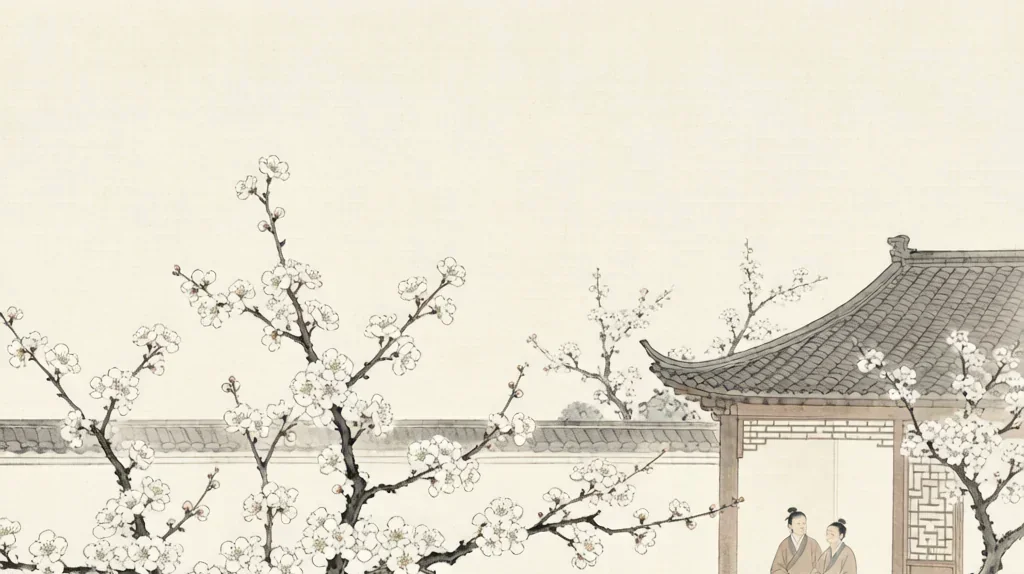
Liyuan (梨园), the "Pear Garden," is one of the most evocative words in Chinese theatrical culture. Historically it names the imperial musical and theatrical academy founded during the Tang dynasty, where the emperor himself trained performers in song, dance, and music. Over the centuries "entering the Pear Garden" became a poetic way of saying "to become a performer," and the term still stands as a respectful shorthand for the Chinese opera profession as a whole. To understand liyuan is to understand how Chinese theatre came to see itself as a noble craft.
The Tang-Dynasty Pear Garden
The original Pear Garden was an institution of the Tang imperial court, associated with the reign of Emperor Xuanzong. Within the palace grounds, the emperor gathered musicians, dancers, and singers to rehearse and refine performances under his personal direction.
According to later tradition, the emperor was himself musically gifted and took part in training, earning him the honorary title "founder" of the theatrical profession in the eyes of later performers. The Garden was thus both a school and a troupe.
Though the Tang institution was small and courtly compared with later popular opera, its prestige cast a long shadow, giving performers a dignified origin story.
What the Garden Taught
The imperial Pear Garden trained a broad range of performing arts: instrumental music, vocal song, and the choreographed dances favored at court banquets. The goal was polished ensemble entertainment for the emperor and his guests.
Members were selected for talent and drilled rigorously, much like later opera apprentices. The emphasis on combined music, movement, and singing prefigures the integrated art that Chinese opera later became.
In this sense the Garden was an ancestor of every conservatory that trains opera actors today.
From Court to Common Term
After the Tang, the specific institution faded, but the phrase "Pear Garden" survived in memory. By the late imperial era it had become a general name for the theatrical world, and performers spoke of themselves as "Pear Garden disciples."
The term carried respect. To call opera the "Pear Garden art" linked a sometimes-looked-down-upon trade to a refined imperial past, softening social stigma around the stage.
Families of performers, guilds, and temples adopted Pear Garden imagery, building a shared identity across regions and roles.
Liyuan as a Professional Identity
In traditional parlance, "entering the Pear Garden" meant choosing the life of a singer-actor. Apprentices pledged to masters and joined a tight community bound by training, ritual, and mutual aid.
Patron deities and founder-figures were honored within Pear Garden culture, and troupes observed customs marking their belonging to the theatrical lineage. The word thus denoted not just a job but a belonging.
Even today, elderly performers and opera lovers use "Pear Garden" with affection, as insiders' shorthand for the art they love.
The Pear Garden and Chinese Opera's Status
Chinese opera long occupied an ambiguous social place: beloved by audiences, yet ranked low among professions. The Pear Garden myth helped elevate that standing by tying the art to imperial patronage and refinement.
By claiming Tang origins, performers framed opera as a cultivated tradition rather than mere showmanship. This self-image shaped how troupes behaved, trained, and presented themselves.
The result is a theatrical culture that takes its own seriousness for granted—an attitude visible in the discipline of opera training.
Ritual and the Theatre Community
Pear Garden identity expressed itself in ritual. Troupes honored protective gods, observed opening-night customs, and maintained halls where the profession gathered. Such practices built solidarity in a mobile, precarious trade.
Temples and guild houses often served as both workshop and shrine, where the living and the legendary founders of the art were honored together. The Pear Garden was as much a community as a place.
This communal dimension helps explain opera's persistence: it was a family-like network as much as a performance form.
Liyuan in Language and Literature
The phrase seeped into the language. "Pear Garden" appears in novels, poetry, and everyday speech as a metonym for the stage, and "Pear Garden offspring" became a courteous term for actors.
Writers used the image to evoke the glamour and the melancholy of theatrical life—fame won and lost behind the painted face. The Garden thus became a literary symbol as well as a tradesman's label.
Its durability shows how a single Tang institution was transformed into a lasting cultural idea.
Modern Echoes of the Pear Garden
In modern China, "Pear Garden" survives in school names, troupe titles, and broadcasts about opera. Programmes that introduce traditional theatre often invoke the Pear Garden as a proud heritage label.
Some institutions use the name to signal seriousness about preservation, linking today's conservatories to the Tang academy in spirit if not in line. The continuity is more symbolic than literal.
For audiences, hearing "Pear Garden" conjures centuries of song, paint, and disciplined bodies—the whole imagined history of Chinese theatre.
Why Liyuan Still Matters
Liyuan matters because it answers a question every art faces: who are we? For Chinese opera, the answer reaches back to an emperor's garden and forward to every student in a training school.
The term reminds performers and public alike that opera is an inherited craft with a recognized place in culture, not a passing entertainment. That self-respect underlies the art's resilience.
When a singer steps on stage, the Pear Garden is present in the gesture—an old word made flesh in a new performance.
The Master-Apprentice Bond
The Pear Garden idea shaped how opera knowledge passed between generations. A novice did not merely learn songs; he entered a bond with a master who taught voice, movement, and conduct as one inheritance. This relational training mirrored the Garden's own image of a disciplined household of artists.
In troupes, seniors watched juniors closely, correcting a misplaced step or a slack tone on the spot. The term "Pear Garden disciple" thus described a real social tie, not just a poetic phrase, binding performers to teachers and to each other across a lifetime.
❓ Frequently Asked Questions
What was the Pear Garden?
The Pear Garden was a Tang-dynasty imperial academy where musicians, dancers, and singers trained under court patronage, later remembered as the cradle of Chinese theatre.
Who founded it?
Later tradition credits Emperor Xuanzong of the Tang dynasty, said to have personally directed rehearsals and thus become honored as the profession's patron.
Why is it important to opera?
The term gave performers a refined, imperial-linked identity and a dignified origin story, helping raise the social standing of the stage.
What does "Pear Garden disciple" mean?
It is a respectful way to call someone a Chinese opera performer, signaling membership in the theatrical community and its traditions.
Is the Tang institution still around?
No, the original court academy faded long ago, but the name survives as a cultural idea used by schools, troupes, and broadcasts about opera.
How is "liyuan" used today?
It appears in troupe names, program titles, and everyday speech as a proud shorthand for Chinese traditional theatre and its heritage.